Connect with us

Uncategorized

Bauchi APC in Crisis: How a Governorship Primary Became a Political Powder Keg

Published

on

By Adebayo Adeoye

All is clearly not well within the ranks of the All Progressives Congress in Bauchi State.

What should, ordinarily have been a defining moment for party unity and strategic positioning ahead of the 2027 elections, has instead deepened mistrust, widened internal divisions and exposed dangerous cracks within the party.

For an opposition party still struggling to regain political momentum in one of Nigeria’s most competitive states, the timing could hardly be worse. Rather than serving as a launchpad for renewed ambition, the governorship primary has become a stark reflection of the APC’s internal dysfunction — one that could shape its political fortunes long before voters head to the polls.

Last Friday’s governorship primary, which produced former Governor Mohammed Abubakar as candidate, was expected to rally party faithful around a credible challenger for 2027. Instead, it has triggered widespread controversy and bitter reactions across the party.

What ought to have strengthened internal cohesion has, in many quarters, been condemned as deeply flawed, opaque and lacking the transparency required to inspire confidence among party members. Allegations of backroom deals, imposed outcomes and the sidelining of longstanding stakeholders have rapidly evolved from whispers into open accusations the party leadership can no longer ignore.

The resulting credibility crisis is not merely reputational; it strikes at the institutional foundations necessary for any serious electoral campaign.

See also  Insecurity: Ignore Buhari, convene unity summit, Atiku tells Govs

For many observers and loyal party members, the exercise represented more than a routine internal contest. It was a test of the APC’s democratic credentials and its readiness to reposition itself after years of electoral setbacks in Bauchi.

The party had a rare opportunity to demonstrate discipline, inclusiveness and a genuine commitment to internal democracy. It had the chance to show voters that it had learned from past mistakes and was prepared to offer a coherent alternative to the ruling Peoples Democratic Party.

Instead, the primary has left many supporters frustrated, alienated and uncertain about the party’s direction. What should have united the APC has instead pushed it closer to fragmentation.

Concerns continue to grow over what critics describe as the complete absence of participatory democracy in favour of a forced consensus process.

These concerns were reinforced by comments attributed to the endorsed candidate, Mohammed Abubakar, and by the controversial declaration of results announced by retired AIG John Abang, which many party stakeholders insist reflected a predetermined outcome rather than a credible electoral exercise.

The grievances extend far beyond the immediate contestants and their campaign teams. Ward officials, delegates and grassroots mobilisers — the very backbone of electoral politics in Nigeria — feel sidelined and betrayed after investing time, loyalty and resources into a process they believe disregarded their voices.

These are the individuals who organise communities, mobilise voters and translate party messaging into electoral support. When such actors lose faith in the process, the consequences are rarely passive. In closely contested political environments like Bauchi, disillusionment at the grassroots can prove decisive.

See also  2023 Elections: From the pulpit to Benue Government House - Rise of a Catholic priest

The broader political context makes the crisis even more consequential. Bauchi has long been a battleground state where power has alternated between the APC and the PDP.

Governor Bala Mohammed has significantly consolidated the PDP’s political networks and influence across the state. Against that backdrop, the APC’s most realistic path to electoral competitiveness in 2027 depended on presenting a united front, a credible candidate and a compelling alternative vision.

The governorship primary was therefore not just an internal exercise; it was a strategic moment capable of defining the party’s electoral future. Instead, it has handed the ruling party an early political advantage.

More troubling still is the growing fear that unresolved grievances could trigger defections, weaken party cohesion and embolden rival political forces ahead of 2027.

Nigerian political history repeatedly shows that opposition parties rarely succeed when consumed by internal divisions and leadership disputes. In many cases, electoral defeats stem less from the popularity of opponents than from unresolved internal crises allowed to fester unchecked. Bauchi itself has witnessed this pattern before, and the APC now risks repeating it.

Indeed, the party faces one of its most consequential internal tests in recent years. Influential figures across the state are reportedly disenchanted with both the outcome of the primary and the manner in which it was conducted.

See also  'Our hope gone' — Family mourns army officer killed in Oyo rescue operation

Quiet consultations outside official party structures have already begun — often an early sign of possible realignments. In several local governments, ward executives are said to be demoralised and uncertain about committing themselves to a process they no longer trust.

If left unresolved, the fallout could cripple grassroots mobilisation, weaken fundraising efforts and push influential stakeholders toward strategic defections, political abstention or alternative alliances.

For a party serious about reclaiming political relevance in Bauchi, unity cannot remain a slogan recited at press conferences while the conditions necessary for unity are undermined in practice.

Reconciliation, dialogue and genuine inclusion must now become urgent priorities. That requires more than symbolic appeals for calm. It demands credible engagement with aggrieved aspirants, delegates and grassroots structures. It requires transparent mechanisms for addressing grievances and accountability for actions that have left the party more divided than before the primary.

The 2027 election is approaching quickly, and time is not on the APC’s side. The window for reconciliation and political recovery remains open, but not indefinitely. The party must now make a clear choice: unity with all its difficult compromises, or division with all its predictable consequences.

Continue Reading
Click to comment

Leave a Reply

Your email address will not be published. Required fields are marked *

Uncategorized

Alleged forged NYSC certificate: Court rejects request by Atiku, ADC to amend suit against Tinubu

Published

on

By

A federal high court in Abuja has dismissed an application by Atiku Abubakar and the African Democratic Congress (ADC) seeking to amend their suit challenging President Bola Tinubu’s eligibility for the 2027 presidential election over his National Youth Service Corps (NYSC) certificate.

In a ruling on Friday, Inyang Ekwo, the presiding judge, held that the proposed amendments would introduce new facts and alter the substance of the case.

The judge upheld the arguments by Tinubu, the All Progressives Congress (APC) and the Independent National Electoral Commission (INEC) that the applicants were attempting to introduce a fresh allegation of fraud after the defendants had responded to the original suit.

Ekwo said pre-election cases are sui generis, meaning they belong to a special category of legal proceedings and are subject to strict timelines.

He added that litigants cannot institute such actions and subsequently search for evidence to support their claims.

See also  The actual For On line Hookup Sites Revealed in 5 Simple steps

The judge also faulted the applicants for failing to challenge claims in the defendants’ counter-affidavits that the proposed amendments were intended to mislead the court.

“This is a time-bound suit, and the law makes it mandatory for all exhibits to be filed in court within 14 days of the occurrence of the event being challenged. Anything outside the prescribed 14 days is null and void and of no effect,” the judge held.

“I find no merit in this application to bring a fresh exhibit; it is hereby refused for being against the express provision of the law.

“I hereby make an order dismissing this application, and it is hereby dismissed.”

The matter was adjourned until December 2 for hearing.

Atiku and the ADC filed the substantive suit on August 14, asking the court to disqualify Tinubu and the APC from the 2027 presidential election over an alleged forgery of the NYSC discharge certificate submitted to INEC.

See also  70bn Loan: Jimoh lbrahim, NICON Tackle AMCON

They also sought an order compelling the electoral commission to remove Tinubu’s name and the APC from the list of candidates and political parties for the election.

After the defendants filed their responses, Atiku and the ADC approached the court on September 10 to amend their originating summons.

They said they wanted to correct errors in the description of INEC forms attached to their affidavit, provide clearer copies of exhibits, include particulars of the alleged fraud and incorporate Atiku’s written deposition.

However, Tinubu opposed the application, arguing that the proposed changes went beyond correcting errors and would introduce new facts, documents and reliefs.

He also argued that the original suit was statute-barred and that an incompetent originating process could not be amended.

The APC and INEC also opposed the application, contending that the proposed changes would introduce a new cause of action after the 14-day constitutional period for filing pre-election cases.

See also  Okcupid Vs Meet Vs Eharmony

Tinubu and the APC have denied submitting a forged certificate to INEC, arguing that the NYSC had never disowned the discharge certificate.

Continue Reading

Uncategorized

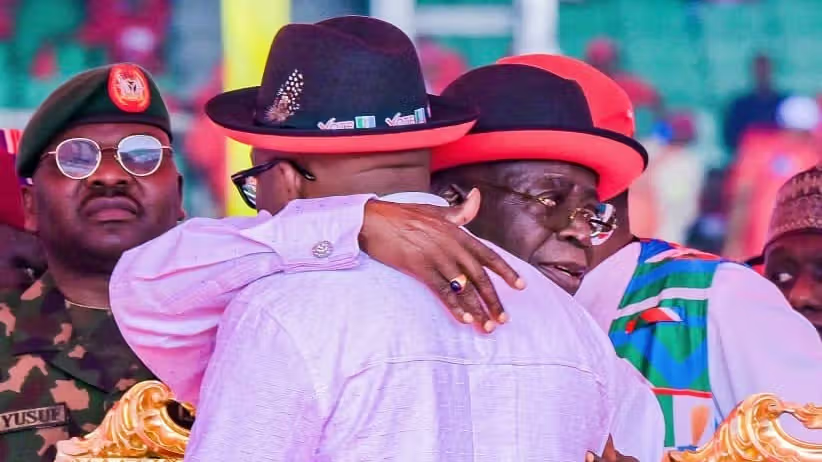
Tinubu embraces Fubara, tells him he won’t regret embracing peace deal in Rivers

Published

on

By

President Bola Tinubu on Saturday told Rivers governor, Siminalayi Fubara, that he will not regret his decision to embrace the peace agreement put in place to resolve the state’s political crisis.

The President made the the promise at the All Progressives Congress (APC) presidential campaign in Port Harcourt, the capital of Rivers.

Tinubu commended Fubara for demonstrating maturity and respect for elders’ intervention in resolving the political crisis in the south-south state.

“I want to thank you specifically for maturity, understanding, and respect for the wisdom of elders. When we intervened, you respected our position and maintained peace. You are a committed democrat. Fubara, you will not regret what you have done,” Tinubu told the Rivers governor.

Nyesom Wike, minister of the Federal Capital Territory (FCT), was instrumental in Fubara’s emergence as governor in 2023.

However, shortly after Fubara took the oath of office, the two politicians’ relationship deteriorated.

See also  Strike: IG sacks nine policemen for spearheading wage increase demand

Wike’s allies dominated the state house of assembly and made several impeachment moves against the governor.

The crisis eventually escalated into a state of emergency, which Tinubu declared in March 2025, suspending the governor and members of the state parliament for six months.

The emergency rule ended in September 2025, with Fubara returning to office. But the underlying struggle over the state’s political structure persisted.

In January 2026, the assembly again initiated impeachment proceedings against Fubara but suspended the process after further reconciliation efforts.

The political conflict culminated in Fubara dropping his re-election bid and withdrawing from the APC governorship primary, a decision he attributed to the need for peace and stability in the state.

Tinubu would again intervene in the rift between Fubara and Wike until both politicians agreed to work together for the president’s re-election in 2027.

Continue Reading

Uncategorized

Ondo plane crash: NAF recovers ‘black box’ from crash site

Published

on

By

The Nigerian Air Force (NAF) says it has recovered the Cockpit Voice Recorder (CVR) from the wreckage of its ATR-42 aircraft, which crashed in Igbokoda, Ilaje Local Government Area of Ondo State, killing all 25 people on board.

.

The Air Force also recovered part of the aircraft’s Flight Data Recorder (FDR), while efforts are ongoing to locate and retrieve the remaining portion of the device.

The Director of Public Relations and Information, NAF, Air Commodore Ehimen Ejodame, announced the development in a statement issued in Abuja on Friday.

Ejodame said technical teams from the Air Force and the Nigerian Safety Investigation Bureau (NSIB) had confirmed that the recovered cockpit voice recorder was intact.

He said other items recovered from the crash site included aircraft wreckage, engine components and human remains.

According to him, recovery operations are continuing despite the difficult swampy terrain, with technical personnel working to retrieve the remaining aircraft components for further examination.

See also  Good morning! Nigerian Newspapers Headlines: 2027 election: Missing names, party disputes cloud INEC list

He said the investigation was being conducted with due diligence to ensure that its findings were comprehensive and based on available evidence.

Ejodame added that the handling of human remains was being carried out carefully, with the NAF Directorate of Identification and Classification undertaking necessary procedures to ensure proper identification.

He said the Air Force had remained in contact with families of the deceased to provide updates and support, while discussions with relevant authorities over environmental concerns raised by the host community were also ongoing.

The spokesman appealed to members of the public to exercise patience, explaining that the recovery and investigation exercises required time, professional attention and coordination.

He said the investigation would establish the circumstances surrounding the accident and identify lessons that could strengthen flight safety and protect military personnel and civilians.

The aircraft, with registration number NAF 931, crashed on October 5, 2026, in a swampy area near Igbokoda in Ilaje Local Government Area of Ondo State.

See also  Insecurity: Ignore Buhari, convene unity summit, Atiku tells Govs

Continue Reading

Trending News