The Federal Government confirmed a case of Ebola virus disease in Nigeria on Tuesday.
The minister of health and social welfare, Ali Pate, confirmed it in a statement, saying the development followed a laboratory confirmation of the case.
Pate said the patient, a woman who recently arrived in Nigeria on an international flight from Uganda, was admitted to a private hospital in the FCT, where she received care for several days before the diagnosis was confirmed.
“She is currently in isolation and receiving medical care,” the statement reads.
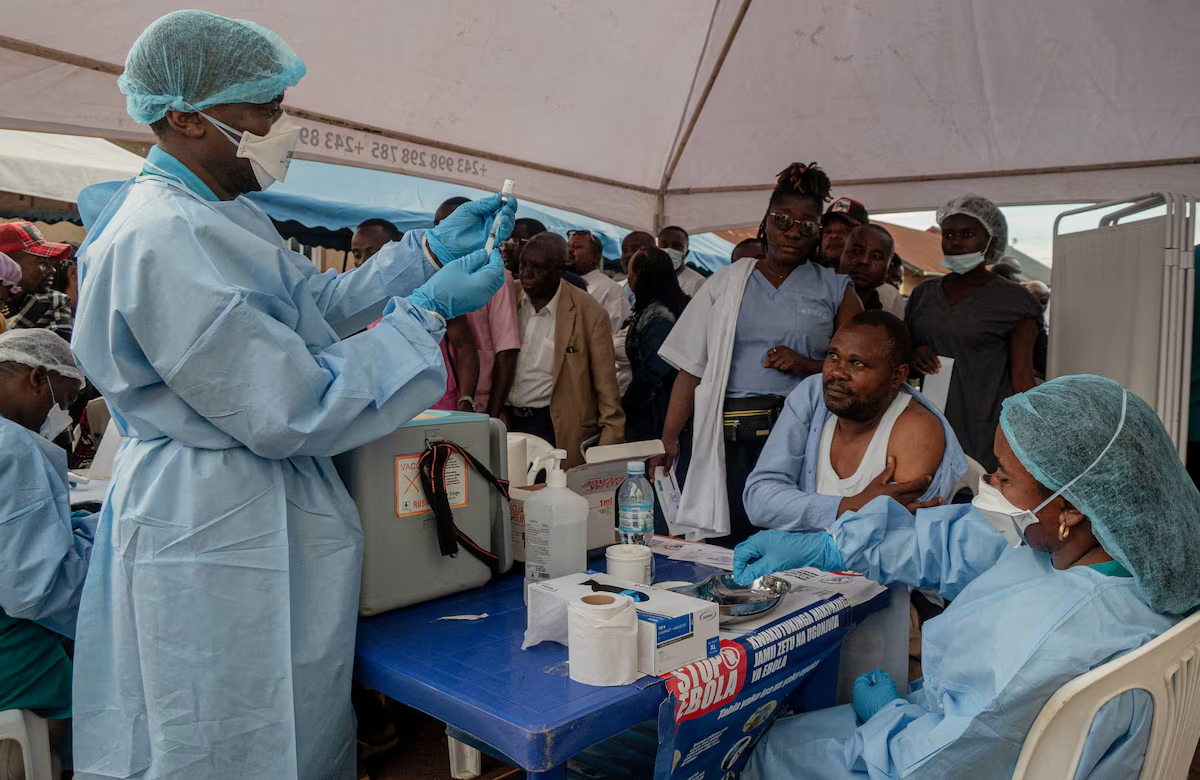
The government said contact tracing has commenced with 44 close contacts identified presently, with public health teams identifying and monitoring people who may have been exposed, including healthcare workers, patients, caregivers and travel contacts.
Nigeria recorded its first case of the Ebola virus in July 2014.
In May, the World Health Organisation (WHO)declared the Ebola outbreaks in the DRC and Uganda a public health emergency of international concern.
Also, in October, Kenyan authoritiesconfirmed the country’s first case of Ebola Bundibugyo virus disease (BVD).
What you need to know about the Ebola virus.
WHAT EXACTLY IS EBOLA VIRUS?
Ebola is a serious infectious disease caused by a virus. It spreads through direct contact with the blood or body fluids of someone who is sick with the disease or has died from it, or through contact with contaminated materials.
Ebola virus emerged in 1976, and it was named after the Ebola River in the Democratic Republic of the Congo (DRC), then known as Zaire.
The virus appears in animal populations in regions close to the African equator. The equator is the imaginary line that cuts continents right down the middle, into northern and southern halves.
The virus is highly transmissible between humans and primates, including chimpanzees, apes, and gorillas.
The virus becomes infectious when infected persons develop symptoms.
WHAT ARE THE SIGNS AND SYMPTOMS OF EBOLA?
Ebola virus disease is a severe and fatal infection that can begin with fever, headache, muscle pain and weakness before progressing to vomiting, diarrhoea and, in some cases, internal or external bleeding, according to the WHO.
Other symptoms can include sudden fatigue and sore throat. As the illness progresses, patients also develop abdominal pain, skin rash and signs of impaired kidney or liver function.
The WHO said symptoms appear between two and 21 days after exposure to the virus, although the disease initially resembles malaria, typhoid fever and other common infections.
The WHO added that other symptoms of Ebola virus are vomiting, diarrhoea, rash, and internal and external bleeding.
Although Ebola is widely associated with bleeding, the WHO notes that haemorrhagic symptoms occur less frequently and may emerge later in the illness.
Such symptoms can include bleeding from the nose and gums, blood in vomit or stool.
The Nigeria Centre for Disease Control and Prevention listed other symptoms of Ebola disease as headaches, lethargy, anorexia, loss of appetite, aching muscles or joints, stomach pain, difficulty swallowing, vomiting, difficulty breathing, and diarrhoea
The virus is highly transmissible and can cause large outbreaks, epidemics, and pandemics, said the National Library of Medicine. It is an epidemic that can have a devastating global impact on healthcare, the economy, and society.
HOW EBOLA VIRUS SPREADS
Ebola virus spreads primarily through contact with infected animals and direct contact with the bodily fluids of infected people, including people who have died from the disease.
The virus can also spread through objects contaminated with infectious bodily fluids. WHO and the US Centers for Disease Control and Prevention (CDC) identify these as the primary routes of transmission.
The global think tanks on health said that the time interval from infection to onset of symptoms ranges between 2 and 21 days.
Scientific evidence suggests that fruit bats may serve as natural hosts of Ebola viruses, although the precise reservoir-host relationships are not fully established for every Ebola virus species.
The virus can spread from person to person via exposure to blood or other body fluids (mostly through faeces, vomit, sweat and saliva) of an infected person, alive or deceased.
A vivid example includes contaminated bedding, clothing, needles, syringes and medical equipment.
The virus enters the body through broken skin or mucous membranes (such as the eyes, nose or mouth), most often while someone is caring for a patient or touching the body of someone who has died from the disease.
It is also spread by touching or handling objects that have been contaminated with the body fluids of a sick person or someone who has died from Ebola disease.
HOW DANGEROUS IS IT?
Ebola virus disease is extremely dangerous and can be fatal, without prompt medical care.
It is a severe infectious disease that can cause serious damage to the body, including organ dysfunction and, in some cases, internal or external bleeding.
However, not everyone infected with Ebola dies. Early supportive treatment and appropriate medical care can significantly improve the chances of survival.
HOW DID NIGERIA OVERCOME EBOLA IN 2014
Ebola is not a strange word to many Nigerians; they had witnessed an outbreak in 2014.
The outbreak began on July 20, 2014, when Patrick Sawyer, a Liberian government official travelling from Liberia, arrived in Lagos while ill with Ebola. He was admitted to a private hospital, where the infection was suspected and subsequently confirmed. Sawyer died on July 25.
The disease broke out in a major commercial centre with extensive international travel connections, raising concerns that the disease could spread rapidly across Nigeria and beyond. Nigeria stopped sustained transmission within three months.
A CDC investigation published in the Morbidity and Mortality Weekly Report identified the rapid organisation of the response and the effective use of existing public-health infrastructure as key factors in containing the outbreak.
The federal ministry of health, with the Lagos state government, the Nigeria Centre for Disease Control and international partners, activated an Ebola Incident Management Centre on July 23, three days after Sawyer arrived in the country.
The centre coordinated surveillance, case investigation, laboratory testing, patient management and contact tracing. Its incident-management structure helped bring different agencies and response teams under a coordinated system.
According to the CDC, Nigeria drew on emergency-response structures and personnel developed through its polio-eradication programme. The existing Lagos Emergency Operations Centre provided an operational foundation for coordinating the Ebola response..
A central component of the response was identifying people who had contact with infected patients and monitoring them for symptoms.
A CDC investigation reported that response teams identified and followed 894 contacts during the outbreak. WHO later reported that contact tracing reached 100 per cent of identified contacts in Lagos and 99.8 per cent in Port Harcourt.
Public-health workers monitored exposed individuals, investigated possible infections and arranged further assessment or isolation when necessary. Most contacts were monitored at home, while selected high-risk contacts were placed in an observation unit.
The WHO’s retrospective account of the outbreak said the virology laboratory affiliated with Lagos University Teaching Hospital provided the capacity to diagnose Ebola promptly.
The CDC said that the response established an Ebola treatment unit within two weeks and trained approximately 2,000 Ebola caregivers. It also recorded about 19,000 home visits as part of contact tracing.
Nigeria also used public information campaigns to inform communities about Ebola and encourage cooperation with surveillance and control measures.
WHO reported that house-to-house information campaigns and radio messages in local languages were used to address public fears.
CULLED FROM THE CABLE




 News4 years ago

 Privacy5 years ago

 News5 years ago


 News5 years ago

 Opinion5 years ago

 News6 years ago

 Sports5 years ago