Connect with us

Business

I’ll select technocrats in first 100 days in office, run private sector-driven economy, says Tinubu

Published

on


Asiwaju Bola Tinubu, presidential candidate of the All Progressives Congress (APC), says there’s nothing bad in the country having a budget deficit.

Tinubu said this on Friday at a presidential dialogue organised by the Nigerian Economic Summit Group (NESG).

President Muhammadu Buhari recently signed the N21.83 trillion 2023 appropriation bill into law, with a deficit of about N11.34 trillion.

The government intends to finance the deficit mainly by new borrowings which would compound Nigeria’s public debt stock already at N44 trillion.

But according to Tinubu, the country’s budget deficit is “not necessarily bad”.

“I do not hold to the mainstream view that all forms of inflation are best tackled by interest rate hikes and shrinking the economy. Supply-induced inflation does not lend itself to this harsh medicine, just as one does not cure a headache by plucking out one’s eye, ” he said.

“I do not embrace the conventional wisdom that fiscal deficits by the national government are inherently bad. All governments, especially in this era of fiat currency, run secular budget deficits. This is an inherent part of modern governance. The most powerful and wealthiest governments run deficits, as do the poorest nations.

“A budget deficit is not necessarily bad. Look at the Japanese example with high government borrowing and low inflation. The real issue is whether deficit spending is productive or not. Unproductive deficit spending is a compound negative. Especially if backed by excessive borrowing of foreign currency. This is not classroom economics but it is the lesson of the real economic history of nations.”

See also  Petrol may sell for N800/litre after subsidy removal – Marketers

SUBSIDY OUTLIVED ITS SHELF LIFE

Tinubu, further speaking on his economic agenda for the country, reiterated his to plans remove subsidy immediately he gets into office.

He said the existence of subsidy has outlived its stay, adding that the funds will redirected “into public infrastructure”.

“We must remove the PMS subsidy immediately. It has outlived its shelf life as a public good. We will neither subsidise neighbouring countries’ fuel consumption nor allow a select few to reap windfall profits and hoard products.

“And the subsidy money will not be ‘saved’ because that means elimination from the economy. Instead, we will redirect the funds into public infrastructure, transportation, affordable housing, education and health, and strengthen the social safety net for the poorest of the poor, thus averting increased security challenges.

“Fiscal policy will be the main driver. Monetary policy is weaker and a less effective instrument. Bad monetary policy is, of course, destructive. But even good monetary policy cannot carry the load the fiscal arm can. Thus, we must steadily remove ourselves from the fiction of tying our budgets to dollar denominated oil revenues.

“This is effectively pegging our budget to a dollar standard. It is as outdated as the fuel subsidy itself. It is also restrictive and ties the economy to slow growth. Just as the common man must mentally sever the cord to the subsidy, the elite must sever the cord to this artificial fiscal restraint.”

See also  Updated: Subsidy is gone – Tinubu declares

PRIVATISATION OF ECONOMY

Tinubu assured that if elected, the private sector would be the prime driver of economic progress of Nigeria with his administration providing the enabling framework for the sector to drive.

He also said before economic recovery could be achieved, the nation must be secured.

“First, to achieve the economy we seek, we must resolve the pressing security issues. No nation can flourish with terrorists and kidnappers in their midst,” he said.

“My core belief is that the private sector must be the prime driver of economic progress. However, the government establishes the framework within which the private sector must operate. If that framework is sound, the private sector will flourish. If the framework is frail or incomplete, then the private sector will struggle.

“For our industries to thrive, they need inputs, many of which are agriculture based. The present administration has invested heavily in agriculture, providing loans and expanding the country’s total area of cultivated land for crops, livestock and fisheries. We will also promote vibrant commodity exchanges that will guarantee minimal pricing for produce.

“We will build on this, with a focus on using technology and expertise to accelerate growth in yields. We will deliver the critical infrastructure necessary to achieve the commodity transformations and agribusinesses to plug seamlessly into higher, more lucrative, entry points in regional and global value chains.

See also  Subsidy: Petrol price will come down, NNPC assures Nigerians

“Building on this foundation, we will accelerate the faithful implementation of the “infrastructure master plan” by adopting proven financing structures till we deliver an acceptable stock of hard infrastructure through seaports and airports; and road, rail and water transportation linkages that can support our desired economic growth.

“Fixing the perennial problem of energy supply is a top priority. There is no version of the world where Nigeria’s ambitions for itself can be achieved without solving the problem of how to provide energy to homes and businesses across the country.

“What we need to do, going forward, is to improve the enabling environment, further decentralise transmission, and deliver cost reflective tariffs to attract more private investments in the sector.”

He added that his administration would, urgently address fiscal, monetary, and trade reforms to effectively increase domestic production by accelerating inclusive growth and job creation across Nigeria.

Tinubus said on his first 100 days, if elected, he would hit the ground running by selecting a team of technocrats that will help him run the country as he did when he was governor, adding that building a good team was important.

Business

Wema Bank launches Hackaholics Accelerator 2026 Cohort with ten startups

Published

on

By

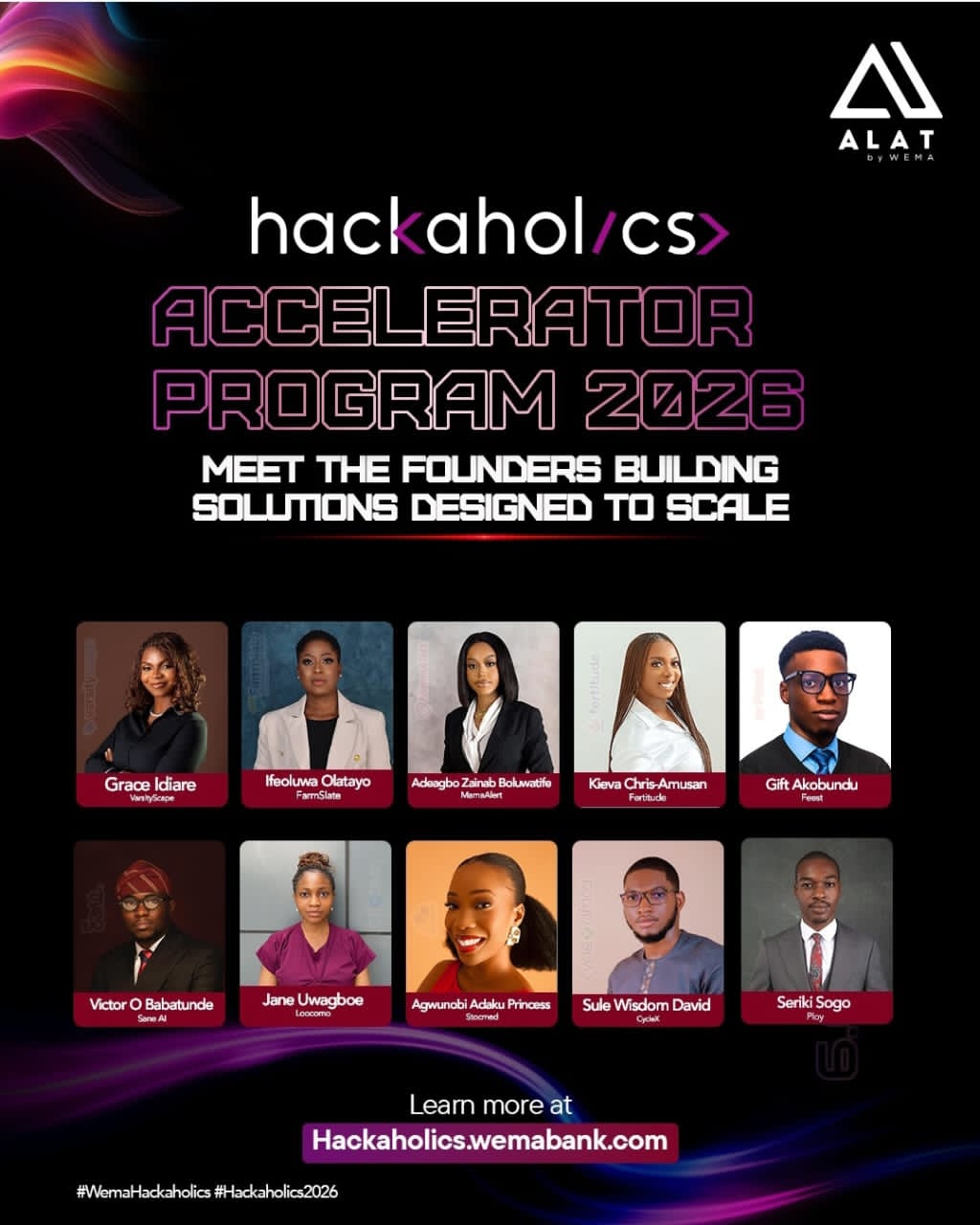
Wema Bank, Nigeria’s most innovative bank and the pioneer of Africa’s first fully digital bank, ALAT, has launched the 2026 Hackaholics Accelerator Program, welcoming ten startups into the cohort.

The Hackaholics Accelerator, a selective growth program under Wema Bank’s Hackaholics platform, is designed to help promising Nigerian startups strengthen their business foundations and prepare for sustainable scale and investment.

After six years of driving innovation through Hackaholics, Wema Bank is extending its support beyond ideation and competition into hands-on startup building through Hackaholics Accelerator. The initiative provides founders with the structure, mentorship, and ecosystem access they need to turn strong ideas into viable, scalable businesses.

The 2026 cohort comprises ten startups in total, drawn from the top 10 performing finalists from Hackaholics 6.0. The startups include Farmslate, Ploy, Stocmed, Feest (Chao), Varsityscape, MamaAlert, Sane, Cyclex, Kieva, and Loocomo.

Commenting on the evolution of Hackaholics and the second edition of its Accelerator program, MD/CEO of Wema Bank, Moruf Oseni, said it reflects the Bank’s commitment to supporting founders beyond ideation and helping promising innovations grow into sustainable businesses.

See also  Good Morning! Here Are Some Major News Headlines In The Newspapers Today: Police arrest notorious transborder arms dealers, recover 17 rifles

“Over the past six years, Hackaholics has grown into more than a competition; it has become a platform that reveals the depth of innovation and entrepreneurial potential that exists across Nigeria,” Oseni said. “With this second edition of Hackaholics Accelerator, we are taking the next step by supporting founders beyond the ideation stage and into the process of building sustainable businesses.

The startups selected for this cohort represent some of the most promising solutions emerging from the Hackaholics ecosystem, and we are committed to helping them refine their models, strengthen their foundations, and scale their impact.”

Speaking on the ten startups selected for the cohort, Babatunde Mumuni, Chief Transformation Officer, Wema Bank, added that the Accelerator will guide founders through a structured process to strengthen their businesses and prepare them for sustainable growth.

“The startups selected for this cohort already have strong foundations, with products already in market, early traction, and clear potential for growth,” Mumuni said. “Each of the selected startups brings a unique solution to real challenges across different sectors. What Hackaholics Accelerator provides is the environment to strengthen those foundations through hands-on mentorship, strategic guidance, and access to the right networks. Over the course of the program, we will work closely with these founders to refine their models, deepen market traction, and prepare them for sustainable scale.”

See also  Canadian Police arrest woman threatening to ‘poison’ Yoruba, Benin people

All 10 startup founders will undergo a series of training sessions led by industry experts across key areas critical to startup growth. Facilitators for the programme include the Chief Transformation Officer, Corporate Transformation & Innovation, Wema Bank, Babatunde Mumuni; Head, Strategy & Investor Relations, Wema Bank, Femi Akinfolarin; Head, Data Transformation, Wema Bank, Olamide Jolaoso; and Team Lead, Corporate Social Investment, Wema Bank, Oluwatoyin Adetunji.

Other facilitators include the Managing Director, Impact Hub Lagos, Idowu Akinde; Managing Director, B4B Partners, Napa Onwusa; Startup Advisor and Scout, Onaopemipo Dara; Mentor at Google for Startups, Rosemond Phil-Othihiwa; Head of Growth, Africhange, Tega Ogigirigi; and Startup Advisor and Mentor, Ademola Adewuyi.

Hackaholics Accelerator is supported by Wema Bank’s broader innovation infrastructure, including IDEAx Labs, the Bank’s innovation and venture platform, and its corporate venture programme, which focuses on enabling startup growth through partnerships, infrastructure, and capital access.

Since its launch in 2019, Hackaholics has grown into one of Nigeria’s most influential youth innovation platforms, attracting over 15,000 applicants and supporting hundreds of digital solutions across multiple industries.

See also  Good Morning! Here Are Some Major News Headlines In The Newspapers Today: Wike defends Tinubu’s action on subsidy removal, says president has shown he’s prepared for the job

Through the Hackaholics initiative, Wema Bank has disbursed over $400,000 in funding to young innovators and startup founders across Nigeria.

Startups, such as Feegor, Myitura, and Bunce are among those that have participated in previous editions of the program, reflecting the Accelerator’s focus on supporting growth-ready companies across diverse sectors. This second edition builds on that progress by helping startups move decisively from innovation to growth.

Continue Reading

Business

Banks to charge 7.5 VAT for mobile transfer, PoS transaction fees

Published

on

By

Banks are set to commence the deduction of 7.5 percent value-added tax (VAT) on banking services, including point of sale (POS) transaction fees, mobile banking transfer fees, from January 19. 

In an email to customers, Moniepoint Microfinance Bank said the charge stems from a government-endorsed regulatory change.

According to reports, the VAT is charged on the N50 stamp duty and does not affect the actual amount being transferred or withdrawn.

The proceeds of the charge will be remitted to the Nigerian Revenue Service (NRS).

“We would like to inform you of an upcoming government-endorsed regulatory change regarding Value Added Tax (VAT),” Moniepoint said.

“From Monday, 19 January 2026, we are required to collect a 7.5% VAT, to be remitted to the Nigerian Revenue Service (NRS) (formerly known as the Federal Inland Revenue Service).

“VAT will apply to certain banking services that include: electronic banking charges such as POS transaction fees, mobile banking fees (transfers), USSD transaction fees, POS activation fee, card issuance fee and Moniebook subscription.”

See also  2023: South-West APC leaders to meet Tinubu, Osinbajo, others in Lagos

According to the bank, the charge also applies to other fees, such as loan processing and documentation fees.

“Services that DO NOT attract VAT include: interest on loans and advances, and interest on deposits and savings,” Moniepoint said.

“Please note: This is not a price increase by Moniepoint. Moniepoint is required to collect and remit VAT to the Nigerian Revenue Service (NRS).

“The NRS has communicated a deadline of 19th January for all financial institutions (commercial banks, microfinance banks and electronic money transfer operators) to start collecting and remitting VAT.”

The bank clarified that VAT applies only to banking or service fees and not to interest, adding that the charge will be listed separately on transaction reports and statements.

The new tax laws retain the VAT rate at 7.5 percent.

Continue Reading

Business

Wema Bank Launches Upgraded Version of ALAT Banking App

Published

on

By


…introduces Voice Banking, Tap and Pay and Uptime Prediction

Wema Bank, Nigeria’s most innovative bank and pioneer of Africa’s first fully digital bank, ALAT, has launched the upgraded version of its flagship digital banking platform, ALAT by Wema. Designed as the next phase in digital banking, the upgraded version of ALAT delivers a smarter, faster, and more intuitive experience, reinforcing Wema Bank’s leadership in technology-driven financial services.


Tagged ALAT: The Evolution, the upgraded version represents a significant advancement in how customers interact with their bank.


It enables seamless banking through intelligent features such as voice banking (called SAW), which allows customers to carry out banking activities using natural voice commands, reducing friction and improving accessibility. It also introduces Tap and Pay for quick, secure, and convenient contactless transactions, alongside uptime prediction that enhances transparency, reliability, and confidence around service availability.


Together, these innovations are designed to simplify everyday banking while anticipating customer needs in real time, reinforcing Wema Bank’s commitment to trust, efficiency, and customer-centric digital experiences.

See also  Tinubu, Peter Obi, Fayemi meet at Pope Leo XIV’s inauguration


Announcing the upgraded version, the Managing Director and Chief Executive Officer of Wema Bank, Mr. Moruf Oseni, said, “ALAT: The Evolution is more than an upgrade. It is a clear demonstration of our commitment to redefining digital banking in Africa.

” By understanding the future of banking and listening closely to our customers, we have upgraded ALAT by Wema to a digital banking platform that is smart, intelligent and dependable.

“This evolution reinforces our promise to deliver innovation that genuinely enhances how people live, work, and transact everyday.”


He added that migrating to the upgraded app is seamless. “Existing customers can simply visit the Google Play Store or Apple App Store to update their existing ALAT app and sign-in with their existing login details (All their account information and transaction history remain intact on their profile and they will also gain access to new features that make banking faster, more intuitive, and more reliable).

See also  Breaking: Nigerian military kills 200 Boko Haram fighters, 5 commanders in Super Tucano airstrikes


For new customers, all they have to do is visit the Google Play Store or Apple App Store to download ALAT by Wema app and click the Get Started icon to onboard seamlessly.


Speaking on the technology in the upgraded ALAT by Wema, Mr. Olusegun Adeniyi, Chief Digital Officer at Wema Bank, explained, “With ALAT: The Evolution, we set out to enhance not just functionality but the overall banking experience. By integrating voice banking, contactless payments, and predictive reliability, we are delivering a platform that is built on powerful technology and responds intelligently to customer needs. This upgrade reflects our long-term digital vision to create a digital bank that is adaptive, intuitive, and consistently available.”


Built on speed, intelligence, and user-centric design, ALAT: The Evolution redefines everyday banking through intuitive features such as voice-enabled transactions, contactless payments, and predictive service reliability. Designed to anticipate customer needs in real time, the platform delivers a smarter, more seamless, and dependable digital banking experience that reflects Wema Bank’s vision for the future of finance.

See also  2023 Presidential Elections: How Tinubu got more votes from north-west than south-west — other facts of the election


With the upgraded version of ALAT, Wema Bank continues to strengthen its position as a digital-first institution, delivering innovative solutions that empower individuals and businesses to bank with confidence in an increasingly digital economy.

Continue Reading

Trending News