Connect with us

News

Aisha Achimugu Floors EFCC as Appeal Court Rejects Bid to Freeze Accounts

Published

on

The Court of Appeal sitting in Port Harcourt, Rivers State, has dealt another significant blow to the Economic and Financial Crimes Commission (EFCC) in its protracted legal battle with prominent businesswoman, Aisha Achimugu, dismissing the commission’s application for leave to challenge an earlier appellate judgment at the Supreme Court.

The ruling, delivered on Thursday, October 22, 2026, represents another important judicial victory for Achimugu, whose prolonged confrontation with the anti-graft agency has involved investigations, asset seizures, the freezing of corporate and personal bank accounts, and several court proceedings.

In dismissing the EFCC application, the appellate court held that the commission had failed to establish sufficient grounds to justify granting the permission sought.

According to an excerpt of the ruling, the court declared that the commission’s motion for leave to appeal its earlier judgment to the Supreme Court “lacks merit and accordingly dismissed.”

The decision leaves undisturbed, for now, the substantive judgment delivered by the same appellate court on July 22, 2026, which discharged an interim order freezing her bank accounts linked to Achimugu and corporate entities associated with her.

It also constitutes a fresh procedural setback for the EFCC in its efforts to sustain the restrictions earlier imposed on the businesswoman’s financial operations.

The latest development is particularly significant because the earlier Court of Appeal judgment had raised fundamental questions about the manner in which investigating agencies deploy interim freezing orders and the limits of their statutory powers in relation to private individuals and corporate organisations.

See also  EFCC declares 59 wanted over N435bn, $397m, €9.9m frauds

In that judgment, a three-member panel comprising Justices Muhammad Ibrahim Sirajo, Ishaq Mohammed Sani and Eleojo Enenche unanimously vacated the freezing order initially granted by the Federal High Court in Port Harcourt on April 10, 2025.

The court held that allowing an interim ex parte freezing order to remain in force for more than 15 months amounted to an abuse of court process and a subversion of the rule of law.

The appellate court reasoned that such orders were intended as temporary measures to preserve disputed funds pending the hearing and determination of substantive applications, rather than indefinite instruments for restricting access to bank accounts.

The judgment followed a legal dispute arising from an application by the EFCC before Justice Turaki Adamu of the Federal High Court, Port Harcourt, seeking to freeze the accounts linked to Achimugu and companies associated with her.

The application was granted on April 10, 2025, with affected banks directed to prevent outward transactions on the accounts.

However, Achimugu subsequently challenged the order, arguing that the continued restrictions constituted an abuse of judicial process.

The dispute took another dimension when the businesswoman raised concerns over the movement of N1.8 billion from a SunTrust Bank account to a Central Bank of Nigeria/EFCC recovery account while the freezing order remained in force.

See also  Who is After Aisha Achimugu?

In a ruling delivered on August 27, 2025, Justice Adamu held that the transfer was unlawful and directed its reversal.

Dissatisfied with that decision, the EFCC approached the Court of Appeal, questioning, among other issues, the jurisdiction of the trial court to deliver its ruling during the judicial vacation, an alleged denial of fair hearing, and the evaluation of evidence relating to the bank accounts.

In its July 22 judgment, the Court of Appeal rejected the commission’s arguments concerning jurisdiction and fair hearing, holding that the delivery of a reserved ruling during judicial vacation did not invalidate the proceedings.

The appellate court, however, agreed with the EFCC on the separate issue involving the N1.8 billion transfer, finding that the evidence before the lower court did not sufficiently establish that the money originated from an account covered by the April 10 freezing order.

Consequently, it set aside the order directing the reversal of the N1.8 billion, while expressly clarifying that its decision did not validate the legality of the EFCC directive transferring the funds.

Notwithstanding that limited finding in favour of the commission, the appellate court discharged the freezing order in its entirety, ruling that the prolonged restriction could no longer be justified as an interim measure.

See also  Gunmen attack Anambra checkpoint, shoot police officers,  raze two vehicles

The court’s conclusion was unequivocal: the ex parte order restricting the accounts of Achimugu and the affected corporate entities was discharged and vacated.

Yesterday’s refusal to grant the EFCC leave to challenge that judgment at the Supreme Court has now reinforced Achimugu’s position in the particular dispute over her accounts.

For Achimugu, the decision is an important development in a legal battle she has consistently maintained was characterised by excessive enforcement measures and disregard for her constitutional rights.

The founder of Oceangate Engineering Oil and Gas Limited and Group Managing Director of Felak Concept Group has repeatedly denied wrongdoing and questioned the commission’s handling of investigations into her business activities.

In a public statement in July, she accused the EFCC of subjecting her to intimidation, reputational damage and prolonged disruption of her legitimate business interests.

She maintained that investigations and enforcement measures against her had adversely affected substantial investments, business relationships and the operations of companies built over several years.

The businesswoman also raised concerns about what she considered a sustained trial by media, insisting that allegations against any individual must be established through proper judicial processes rather than public accusations.

—

Continue Reading
Click to comment

Leave a Reply

Your email address will not be published. Required fields are marked *

News

NDLEA dismantles transnational cocaine cartel, arrests eight suspects in Lagos, Kano

Published

on

By

Operatives of the National Drug Law Enforcement Agency (NDLEA) have dismantled a transnational drug trafficking cartel that moves cocaine from Lagos through Kano, Niger Republic and Libya to Europe.

Femi Babafemi, NDLEA spokesperson, who disclosed this in a statement on Tuesday, said that eight suspected members of the syndicate were arrested during intelligence-led operations in Lagos and Kano.

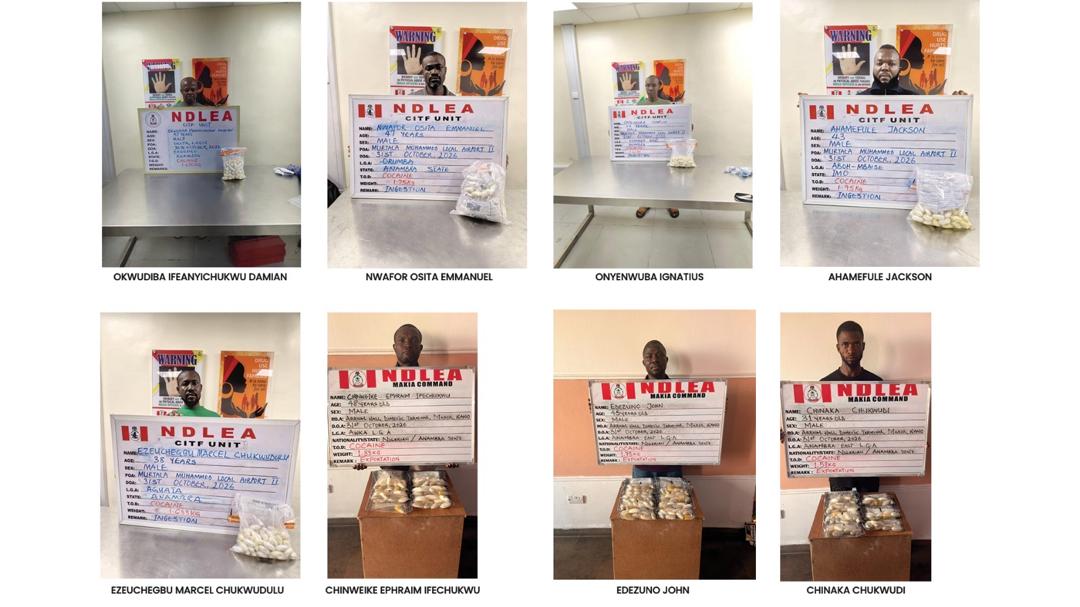
“All eight suspects who were nabbed between Friday 30th and Saturday 31st October 2026 were drug mules who had swallowed cocaine pellets, excreting a total of 634 wraps weighing 13.795 kilograms over several days in custody,” the statement reads.

“The operation began on Friday 30th October, when operatives of a Special Operations Unit of the Agency arrested the first suspect, 57-year-old Okwudiba Ifeanyichukwu Damian, at Nice Touch Hotel, Ago Palace, Okota, Lagos.

“He later excreted 74 wraps of cocaine weighing 1.650kg.”

According to Babafemi, on October 31, four other members of the cartel were arrested at the Murtala Muhammed Airport, Lagos, while preparing to board a flight to Kano.

See also  EFCC declares 59 wanted over N435bn, $397m, €9.9m frauds

They were identified as Jackson Ahamefule, who excreted 90 wraps weighing 1.950kg; Nwafor Osita Emmanuel, who excreted 85 wraps weighing 1.750kg; Marcel Nnabuike, who excreted 75 wraps weighing 1.655kg; and Onyenwuba Ignatius, who excreted 75 wraps weighing 1.650kg.

Babafemi added that intelligence gathered during the operation showed that other alleged members of the cartel had travelled to Kano.

He said NDLEA operatives at the Mallam Aminu Kano International Airport were deployed to intercept them at the arrival hall of the domestic terminal.

Three suspects, identified as Chinweike Ephraim Ifechukwu, 48; Edezuno John Nwaorji, 45; and Chukwudi Chinaka, 31, were subsequently arrested.

“A body scan showed that all three had swallowed drugs after which they were placed under excretion observation,” the statement reads.

“Over the following days, Ifechukwu excreted 85 pellets of cocaine weighing 1.853kg; Nwaorji expelled 80 pellets weighing 1.752kg, while Chinaka excreted 70 pellets with a total weight of 1.535kg.

See also  Aisha Achimugu bags African Achievers Award

“The suspects said they had planned to travel by road from Kano through Niger Republic to Libya, with Europe as the final destination for the drugs.”

Mohamed Marwa, NDLEA chairman, appealed to young people not to sell their lives to drug barons.

“This cartel thought it had found a back door to Europe through our northern borders and the Sahara,” he said.

“Their arrests are a message to drug barons and their couriers that there is no safe route out of Nigeria. Whether they go by air, by road or through the desert, we will trace them, find them and bring them to justice.

“Swallowing wraps of cocaine is a death wish. One burst pellet can kill a mule before the journey ends. No amount of money is worth that risk.”

Continue Reading

News

Kano Governor Abba Yusuf  divorces Kwankwaso’s niece, in search of another wife

Published

on

By

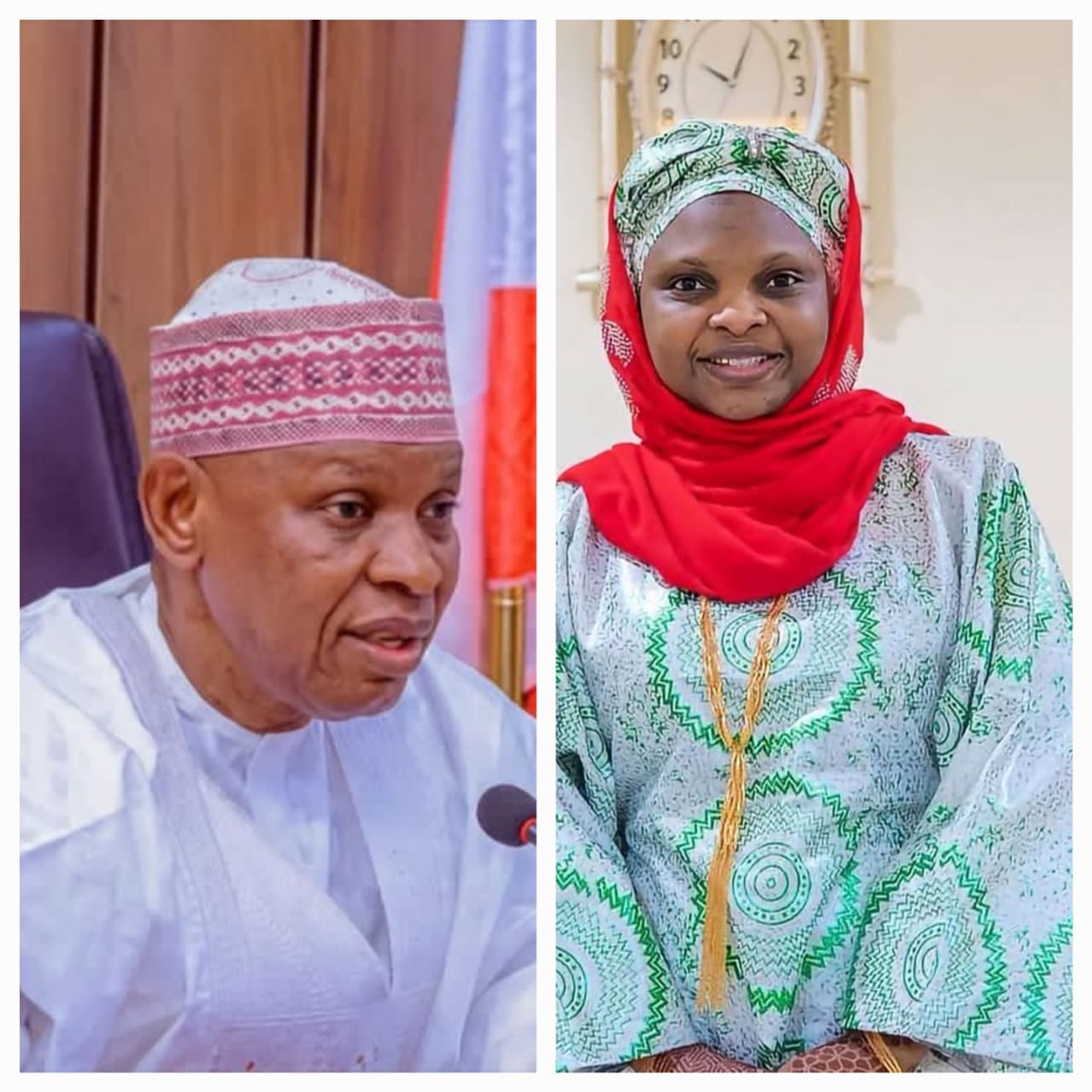
Governor Abba Yusuf of Kano State has confirmed that he has issued a notice of marriage dissolution to Zainab Musa Kwankwaso, daughter of Dahiru Kwankwaso, elder brother of Rabiu Kwankwaso, vice-presidential candidate of the Nigeria Democratic Congress (NDC).

The governor disclosed this on Monday while addressing pensioners at the government house in Kano, where he expressed his readiness to take another wife.

Yusuf, who spoke in Hausa, jokingly said he had directed his commissioner for information to place an advertisement on radio and social media, inviting applications to fill the role left behind by Zainab.

“Those who understand will understand, and those who do not understand will not; the governor has agreed to divorce her. Is it a document? The governor has issued it,” he said.

“You should assist the governor with prayers regarding those who will apply when the advertisement is released in the newspapers. May Almighty Allah grant the governor the wisdom to choose someone responsible who knows the value of a second term, so that he can continue for two terms.”

See also  Peter Obi, Kwankwaso receive NDC membership cards

The governor’s remarks come two days after reports emerged that Zainab, said to be his second wife, had approached an Upper Area Court in Gudu, Abuja, seeking a divorce.

Zainab reportedly cited a breakdown of the marriage, alleging a persistent lack of love, care, affection and emotional connection.

Kwankwaso’s niece married Yusuf on July 29, 2006, and their marriage produced six children.

Her divorce suit comes weeks after she reportedly left the Kano government house for her father’s residence before travelling to Abuja.

The development comes amid an ongoing strained relationship between the governor and Kwankwaso, his estranged godfather.

The rift came to public light in January, shortly after the governor defected from the New Nigeria Peoples Party (NNPP) to the All Progressives Congress (APC), the party on whose platform Kwankwaso backed him to become governor in 2023.

Continue Reading

News

Eight Nigerians among suspected car theft syndicate arrested in Canada, 96 stolen vehicles worth $4.5m recovered

Published

on

By

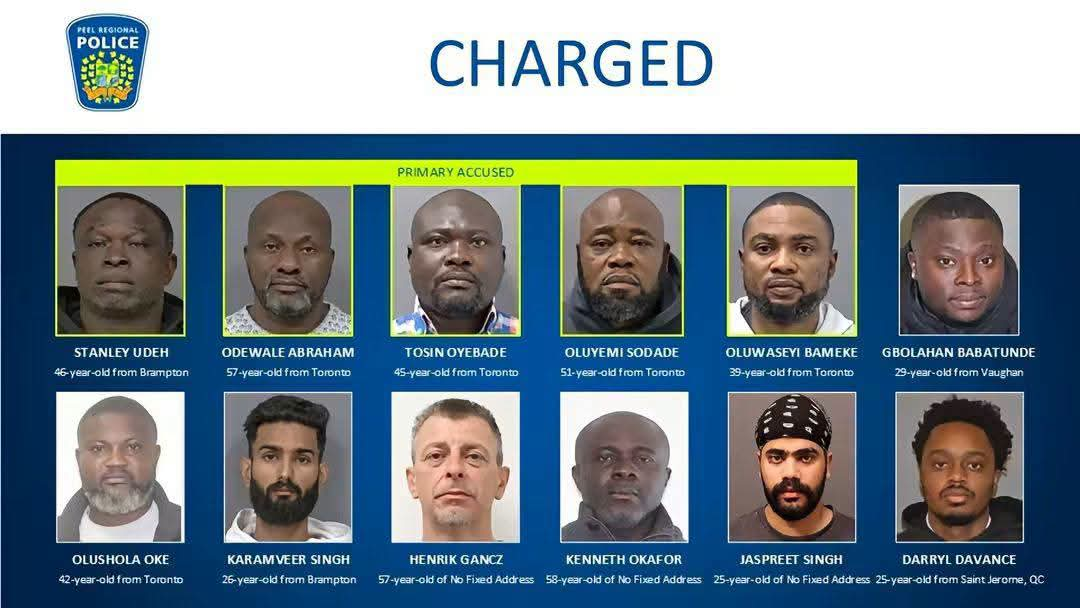
The Canadian police have arrested 12 suspects, including eight Nigerians, allegedly linked to an international vehicle theft syndicate that specialises in the export of stolen cars.

In a statement released on Monday, the police said the car theft investigation codenamed “Project Cadetta” led to the recovery of 96 stolen vehicles valued at $4.5 million and  “destined for overseas markets”.

Police said the operation targeted a warehouse in Brampton used as a “primary staging area for stolen vehicles that were concealed in shipping containers and destined for West Africa through Canadian ports”.

According to the police, the 12 suspects are expected to face 231 criminal charges.

“The investigation subsequently uncovered a broader criminal network operating throughout the Greater Toronto Area and surrounding jurisdictions,” the statement reads.

“Police allege the network was led by five key suspects responsible for coordinating the theft, movement and export of stolen vehicles. Other accused individuals are alleged to have supported the operation.

See also  Aisha Achimugu: From Business Powerhouse to Paris Style Icon

“Together, investigators linked the network to loading sites, container movements and the transportation of stolen re-VINed vehicles.

“Following a series of coordinated search warrants and arrests in fall 2026, Peel Regional Police charged 12 individuals in connection with the investigation.

“Investigators laid 231 charges and recovered 96 stolen luxury SUVs, pickup trucks, and other high-value vehicles concealed within shipping containers.”

The eight Nigerians are Stanley Udeh (46), Odewale Abraham (57), Oluyemi Sodade (51), Tosin Damilola Oyebade (45), Oluwaseyi Olawale Bameke (39), Gbolahan Qudus Babatunde (29), Olushola Oke (42), and Kenneth Okafor (58).

Other suspects are Karamveer Singh (26), Henrik Gancz (57), Jaspreet Singh (25), and Darryl Davance (25).

Police said some suspects charged in court may be referred to the Canada Border Services Agency (CBSA) for immigration enforcement action, including deportation, after their trial.

Continue Reading

Trending News