Connect with us

News

Adeleke alleges plot by EFCC to freeze Osun government accounts ahead of guber poll

Published

on

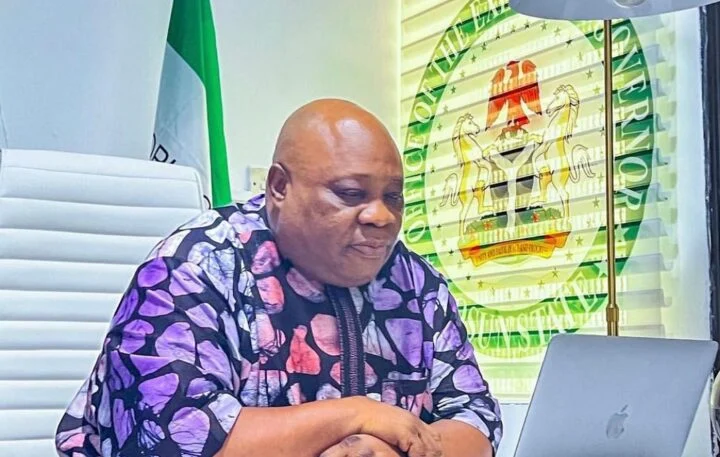
Governor Ademola Adeleke of Osun state has alleged that the Economic and Financial Crimes Commission (EFCC) is working to freeze all bank accounts belonging to the state government ahead of the August 15 governorship election.

Kolapo Alimi, the state commissioner for information and public enlightenment, in a statement on Wednesday, said the governor raised the alarm on Tuesday at the Government House in Osogbo.

Alimi alleged that the anti-graft agency also plans to extend the freeze to the accounts of top government functionaries.

According to the statement, the governor said such a move, if true, would amount to “the height of lawlessness”, noting that “the plot to freeze the state government accounts is meant to paralyse government activities ahead of the governorship election”.

“The governor affirmed that there is no legal basis or justification for any move to freeze the state government accounts, declaring that the anti-graft agency has no legal powers to freeze the account of a state government,” the statement added.

See also  Dowen College: Sylvester Oromoni's death a slap on education system, Lagos - Sanwo-Olu

In recent weeks, Osun state has witnessed renewed political violence, with members of both camps engaged in clashes as they seek to consolidate early gains ahead of the poll.

Speaking on Monday at a campaign rally in Olorunda LGA, Adeleke, who is seeking re-election on the Accord party platform, asked President Bola Tinubu to intervene in the pre-election violence rocking the state, warning against a repeat of the 1983 political crisis in the south-west.

He argued that the recent endorsement of Tinubu’s re-election bid by Accord in Osun should earn the state some reprieve from the president.

According to the governor, the president’s intervention is needed to halt the “loss of innocent lives” in the state, noting that “all we are asking for is simply a free and fair election”.

News

Osun threatens lawsuit as EFCC freezes govt account 10 days to election

Published

on

By

Less than 24 hours after Governor Ademola Adeleke alleged that the Economic and Financial Crimes Commission (EFCC) was planning to freeze the state government account domiciled with First Bank, the anti-graft agency has reportedly freezed the account, according to Vanguard.

The account, reportedly used for the payment of workers’ salaries, was placed on “Post No Debit” status by the anti-graft agency.

The development came hours after Governor Ademola Adeleke raised the alarm that the EFCC was planning to freeze the state government’s accounts and those of top government officials ahead of the August 15 governorship election.

In a statement issued earlier on Wednesday by the Commissioner for Information and Public Enlightenment, Kolapo Alimi, Adeleke described the alleged move as an attempt to cripple government activities before the poll.

The governor had insisted that there was no legal basis for freezing the accounts of a state government, arguing that the EFCC lacked the statutory powers to take such action.

See also  Arsenal beat Slavia Prague to reach the Europa League semi-finals.

However, a source reportedly told Vanguard that the account had already been restricted.

“I can confirm that the state government account has been frozen by the EFCC. It is no longer an allegation. The governor will address the press shortly to update the public on the situation,” the source reportedly told Vanguard.

The reason for the restriction was not immediately known as of the time of filing this report.

The EFCC had yet to issue an official statement on the development.

The development comes as Osun prepares for its August 15 governorship election, with the account restriction expected to generate political reactions ahead of the poll.

Meanwhile, the state’s Attorney General and Commissioner for Justice, Oluwole Jimi-Bada, had said he has the mandate of the governor to sue the Economic and Financial Crimes Commission for freezing the government accounts.

Jimi-Bada said a ‘Post no debit’ letter from the EFCC was forwarded to the management of the First Bank where Osun government accounts were domiciled on Wednesday.

See also  EFCC arrests nine internet fraudsters in Warri

The commissioner, who expressed readiness to proceed to court, said the move by the anti-graft agency may hamper government’s business, noted that Governor Ademola Adeleke was not using state funds to run its campaign for reelection.

“I have the mandate of the governor to proceed to the Federal High Court to challenge this move. EFCC can investigate the accounts but it can’t freeze the accounts without order of court.

Continue Reading

News

WAEC releases 2026 WASSCE results, withholds 167,486 candidate’s results over malpractice 

Published

on

By

The West African Examinations Council says it is withholding the results of 167,486 candidates, representing 8.59 per cent of those who sat the 2026 Computer-Based West African Senior School Certificate Examination for School candidates, over alleged examination malpractice.

This was disclosed by the Head of WAEC Nigeria National Office, Dr Amos Dangut, who announced the release of the results in Lagos on Wednesday.

The number of withheld reults, however, represents a decline from the 9.7 per cent recorded in 2025.

Dangut said the council withheld the affected results due to various infractions, including the increasing use of mobile phones in examination halls despite the existing ban and organised cheating in some schools.

“The increasing use of cell phones in the examination hall, in spite of the existing ban, and organised cheating in some schools, are other nagging issues,” Dangut said.

He added that some supervisors and invigilators found assisting candidates in malpractice had been arrested and would face disciplinary action through the relevant state ministries of education.

See also  Alleged Naira abuse: EFCC, Cubana Chief Priest to settle out of court

A total of 1,959,668 candidates from 24,207 schools registered for the examination across Nigeria, Benin Republic, Côte d’Ivoire and Equatorial Guinea, while 1,950,726 candidates eventually sat for the examination.

1,200,514 candidates (61.54 per cent) obtained credits and above in at least five subjects, including English Language and Mathematics.

1,687,378 candidates (86.50 per cent) secured credits and above in a minimum of five subjects, with or without English Language and Mathematics.

The number of candidates who obtained credits in five subjects including English and Mathematics dropped by 1.42 percentage points compared with the 2025 examination.

Of the 1.2 million candidates who achieved credits in English and Mathematics:

558,883 (28.65 per cent) were male.

641,631 (32.89 per cent) were female.

Overall, 997,267 females (51.12 per cent) and 953,459 males (48.88 per cent) participated in the examination.

WAEC said 1,834,695 candidates, representing 94.05 per cent, had their results fully processed and released, while the results of 116,031 candidates (5.95 per cent) were still being processed.

See also  EFCC arrests ex-convict, 54 others for Internet fraud in Oyo

The council also disclosed that 1,213 candidates with special needs participated in the examination. They included:

137 visually impaired candidates;

491 candidates with hearing impairment;

55 spastic and mentally challenged candidates; and

41 physically challenged candidates.

The 2026 examination marked the second edition of the Computer-Based WASSCE for School Candidates, following the introduction of the format by WAEC.

Dangut said the council introduced several innovations, including the Digital Examiner Mark System to improve the speed of processing results, serialisation of question papers to curb malpractice, and a new portal that allows candidates to generate e-PINs directly for checking their results.

The examination was conducted between April 24 and June 19, 2026, with 102,708 examiners involved in marking across 88 marking venues.

Dangut, who described the briefing as his third and final engagement as WAEC Nigeria National Office head, said candidates sponsored by states indebted to the council would not have their results released until the outstanding payments were cleared.

See also  Terrorists attack Buhari’s security convoy, kill two policemen

Continue Reading

News

How fake federal agency DG Adeyemi duped businessman N400m for a purported PFIPC contract

Published

on

By

The House of Representatives Ad-hoc Committee investigating the alleged establishment and activities of the PFIPC, on Tuesday heard the heart-rending story of how a businessman, Gbenga Collins, allegedly paid N400 million to Adeniyi Adeyemi, who presented himself as the director-general of the purported Presidential Foreign Investment Promotion Council (PFIPC), after being promised a government contract to renovate and furnish an official residence.

Collins, managing director of Divine Dopacy Nigeria Limited, said he was convinced that Adeyemi was indeed a genuine government official because he operated from an office at the Federal Secretariat in Abuja, used vehicles with Federal Government number plates and was surrounded by security personnel and visitors he described as dignitaries.

According to Collins, he first met Adeyemi in December 2024 at a programme in their hometown, Ogbomoso, Oyo State.

He said Adeyemi subsequently invited him to Abuja in January or February 2025 to discuss a business opportunity.

Collins said an official vehicle picked him up at the Abuja airport and took him to Adeyemi’s office at the Federal Secretariat.

“When I arrived at the airport, he sent an official car to come and pick me from the airport to his office at the Federal Secretariat, Abuja,” he told the committee.

He said the vehicle was a Lexus SUV with a federal government registration number.

Collins said he met several people, including security personnel, at the office and that Adeyemi presented himself as the director-general of both the Presidential Economic Advisory Council (PEAC) and the PFIPC.

“I saw police officers with him. That was my first time coming to Abuja because I’m not familiar with Abuja very well. He sent his official car to pick me up from the airport. It had a federal government registration number attached to the Lexus SUV,” he said.

The businessman said Adeyemi subsequently told him that an official residence had been allocated to him as director-general and that the property required renovation and furnishing.

He said Adeyemi offered his company, Divine Dopacy Nigeria Limited the contract to carry out the work.

According to him, Adeyemi personally took him to inspect the property the following day.

“He told me that he wanted to do refurbishment and renovation of the official house assigned to him as the DG of that agency and asked whether I would be able to handle the contract,” he said.

Collins said they visited the property with several staff members and security personnel, adding that several vehicles were used for the inspection.

See also  EFCC arrests ex-convict, 54 others for Internet fraud in Oyo

“He took me to the house to show me the property because I slept in Abuja. We went there the following day with his staff. We went with more than four, five or six vehicles with security. They opened the house and took us round, showing me what they wanted to do,” he said.

He, however, said he could not remember the exact location of the property because he was unfamiliar with Abuja, but still had photographs of the building.

Collins said discussions over the project continued after he returned to Ogbomoso until April 2025, when Adeyemi invited him back to Abuja.

He said the ‘DG’ then gave him a contract award letter, a scope of work and an agreement between the purported agency and his company.

According to him, Adeyemi told him to pay N400 million as evidence of his financial capacity to execute the project and to facilitate mobilisation.

“He gave me the contract award letter, the scope of work and the agreement with my company to execute the refurbishment project.

“I had to pay N400 million for the facilitation of that project to show my strength that I would be able to handle the project. At the same time, he said it would fast-track the mobilisation for the contract,” he said.

Collins said he sourced the money from business associates who trusted his judgment because he had personally visited Adeyemi’s office and believed he was dealing with a legitimate federal government official.

He said the N400 million was paid in five instalments between May and July 2025.

The first N100 million was paid on 16 May 2025 into an account held by World Entrepreneurs Limited at Guaranty Trust Bank.

Another N100 million was paid into the same account on 22 May, and a further N100 million on 28 May.

Collins said he later paid N80 million into the account on 20 June, bringing the total paid into the World Entrepreneurs Limited account to N380 million.

He said he subsequently told Adeyemi that he could no longer raise any more money, as he had exhausted his resources.

The remaining N20 million was eventually paid on 29 July 2025 into an Access Bank account belonging to Sunshine Confectionery and Catering Services, bringing the total amount to N400 million.

See also  Osun communal clashes: I’ll wield the big stick, depose monarchs — Adeleke threatens

“When I was paying the money, I kept telling him that I collected the money from my colleagues who were doing business with me.

“I was the one who told them I had gone to this man’s office, so I believed it was going to be a great opportunity for us. That was why people started giving me the money,” he said.

Collins said fake DG repeatedly assured him that mobilisation for the project would begin in August 2025.

The payment, however, did not lead to the promised contract execution.

“When I finished the payment, he said they were going to do the mobilisation by August,” he said.

He said Adeyemi later attributed the delay to security concerns and subsequently promised that payment would be made in November.

“I continued calling him. He kept managing me, telling me they were handling security issues and that they would pay in November,” he said.

As pressure mounted from the associates who had contributed the money, Collins said he made several trips to Abuja in an attempt to reach  Adeyemi.

He said the purported PFIPC chief eventually stopped answering his calls.

Collins said he then sought legal advice in Abuja.

“My lawyer was the first person who told me that I had been scammed,” he told the committee.

Collins said his lawyer petitioned the Economic and Financial Crimes Commission (EFCC) on 13 November 2025.

He said he was formally invited to adopt the petition six days later.

“The petition was written on the 13th, and I was invited to adopt it on the 19th,” he said.

According to him, the EFCC subsequently commenced an investigation and invited individuals connected to the bank accounts into which the money was paid.

He said investigators told him Adeyemi had repeatedly failed to honour invitations from the agency, allegedly citing ill health through his lawyer.

“Since then, the EFCC has been trying to invite him. I think he has been sending his lawyer. According to the Investigating Police Officer handling the case, his lawyer kept saying he would appear,” he said.

Collins said he had not received further information on the investigation but believed the EFCC was handling the matter.

Collins appealed to the committee to intervene, saying the alleged transaction had left him financially distressed and damaged his business.

“I just want to beg the chairman and the honourable members to help me talk to all the agencies involved because I have been frustrated, especially by those people who gave me the money. I have started selling my property. My business is not going well again,” he said.

See also  Sister from hell: Rev Sister arrested with 15 children, says I bought each for N50,000

He said he had acted on trust because his encounters with Adeyemi gave him the impression that he was dealing with a genuine government official.

“I did all this based on trust. When I went to his office, I met many dignitaries, people waiting to see him, and others with whom he was in discussions about contracts. I also did it because he is from my hometown,” he said.

During the hearing, the House Ad-hoc Committee chairman, Yusuf Gagdi (APC, Plateau) asked Collins whether the N400 million payment constituted a bribe to secure the purported government contract.

But Collins rejected the description, saying he paid the money because Adeyemi presented it as a condition for facilitating and mobilising the project.

The lawmakers also asked whether he had followed the required public procurement process before accepting the contract.

Collins admitted that he had not gone through any procurement process before proceeding with the transaction.

He further urged the committee to prevail on the security agencies investigating the matter to ensure justice.

“What I just have to say is to beg the committee, or to implore the committee, to please, in all their capacity, whatever they can use to assist me with the police that are investigating him.

“Because I was invited to the Cybercrime office. He said the same thing, that he did not deny collecting the N400 million,” he said.

Gagdi also asked whether the businessman had converted any part of the N400 million into United States dollars before making the payment.

But he said he did not.

Following the testimony, members of the committee questioned how vehicles allegedly associated with the purported council obtained Federal Government registration number plates.

The lawmakers noted that the presence of government number plates on the vehicles was among the factors that convinced the businessman that Adeyemi was operating a legitimate government institution.

The committee consequently summoned the Corps Marshal of the Federal Road Safety Corps (FRSC) to appear on Thursday.

The corps marshal is expected to explain the procedure for issuing federal government registration number plates and clarify how vehicles allegedly used by the purported agency obtained such plates.

Continue Reading

Trending News