Connect with us

News

Why we took Sowore to Kuje prison after bail – Police

Published

on

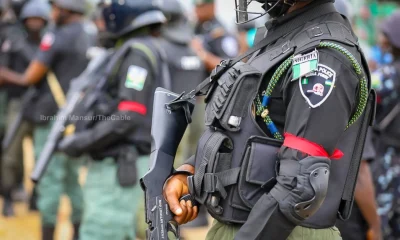
The Nigeria Police Force has explained the reasons behind the transfer of human rights activist and former presidential candidate, Omoyele Sowore, to Kuje Prison shortly after he was granted bail by the Kuje Magistrate Court in Abuja on Friday.

Sowore was initially arrested by the police on Thursday on charges bordering on incitement and alleged breach of public peace.

His arrest followed his organisation of the #FreeNnamdiKanuNow protest on Monday, despite prior warnings from the police.

He was subsequently arraigned alongside 12 others before the Kuje Magistrate Court on Friday, where he pleaded not guilty to the charges.

The court granted bail to Sowore with N500,000 and two sureties, which his legal team was working to perfect at the time of the police action.

Speaking to newsmen in Abuja shortly after the incident, human rights activist, Deji Adeyanju, accused the police of violently attacking and removing Sowore moments after his bail was granted.

See also  Good morning! Here Are Some Major News Headlines In The Newspapers Today: Benue assets recovery committee storms Ortom’s property, cart away exotic cars

Adeyanju alleged that more than 50 armed officers stormed the court premises, descended on Sowore, and took him away by force while refusing to present a valid remand order.

“Sowore had just been granted bail, and while we were conferring with him here, the police suddenly launched an attack. More than 50 officers violently descended on him and took him away by force. We don’t even know where they have taken him,” he said.

He said the officer who led the operation briefly displayed what he claimed was a remand order but refused to allow Sowore’s lawyers to inspect it.

Adeyanju said, “The officer flashed the document, and when we insisted on reviewing it, he pocketed it and ordered that they must go. When we asked where they were taking him, he said Kuje Prison. We demanded to see the remand order as endorsed by the court, but he refused.”

He further alleged that during the scuffle, the police accused Sowore of insulting the Inspector General of Police, saying, “Because Sowore called the IG useless, they must deal with him.”

See also  Police arrest two kidnappers who abducted neighbour’s 8-year-old son, demand N2.5m ransom

The lawyer said the officers tore Sowore’s shirt during the confrontation and dragged him away even as his legal team was still perfecting his bail conditions.

However, while responding to Sowore’s re-arrest via X (formerly Twitter), the Force Public Relations Officer, Benjamin Hundeyin, said the police acted within the law, adding that officers were empowered to use commensurate force to carry out their duties.

Hundeyin, who attached a remand warrant to his post, wrote, “Except we want to be mischievous, we all know that once court grants a suspect bail, it comes with the caveat that until the bail conditions are met, the suspect remains in custody.

“Where it is clearly spelt out on the remand warrant that the suspect be remanded in a correctional facility, not police custody, it is the duty of the police to hand over the suspect to the Nigeria Correctional Service, who would then process his bail conditions.

“This has always been the practice. Why should this be different? Also, as law enforcement officers, we are empowered by law to employ commensurate force to get our mandate achieved.”

See also  Police arrest 15 suspects over Abuja warehouse looting

News

EFCC says it froze Osun account over ‘fraudulent handling’ of N11bn ecological, intervention funds

Published

on

By

The Economic and Financial Crimes Commission (EFCC) has explained that it froze the bank account of the Osun state government over alleged fraudulent handling of N11 billion ecological and intervention funds.

The anti-graft agency, in a statement on Wednesday, said it has been investigating the Osun state government since March regarding the alleged mishandling of the funds.

According to the agency, some officials of the state government, including the accountant-general of the state, had been interviewed by EFCC investigators.

The agency said amid the probe, it observed that huge transfers of funds were being made from the account into different corporate entities since August 2.

“These ongoing investigations of the state government would not have warranted any placement of Post No Debit order on its account but for the precipitate and unwarranted movement of funds from the accounts to different suspicious accounts since August 2, 2026,” the statement reads.

See also  Police arrest two kidnappers who abducted neighbour’s 8-year-old son, demand N2.5m ransom

“The Commission noticed huge transfers of funds into different corporate entities and had to swiftly halt the trend by freezing the accounts from which such heavy funds are being moved.

“The EFCC’s preventive mandate is a public-inclined framework of safeguarding public funds, assets and resources.

“The Commission cannot watch idly while a state government’s account is being pillaged.”

The anti-graft agency said it is aware of the forthcoming Osun governorship election, adding that it is “uncharitable” to overlook the huge transfers of funds over the “excuse of an upcoming election”.

“The Osun State government account was frozen to save public funds from being looted,” the agency said.

In a letter dated August 5, 2026, and signed by Adenike Babalola, assistant commander of the EFCC on behalf of the director of investigation, the anti-graft agency directed First Bank not to allow withdrawals from the Osun state government’s statutory allocation account as part of an ongoing investigation.

See also  IGP orders probe into Lagos lawyer killing as police detain 3 officers

The agency instructed the bank to place a post-no-debit restriction on the account pending the conclusion of the probe.

Reacting to the development, Ademola Adeleke, Osun governor, said the state government will not accept a situation in which federal government agencies trample upon the rights of subnational governments.

Adeleke said the Osun government has been witnessing numerous sponsored attacks, including the harassment of Accord party members and the move to stall the operations of LGAs in the state.

Adeleke said he has directed the attorney-general of the state to challenge the “illegality”.

Continue Reading

News

Osun threatens lawsuit as EFCC freezes govt account 10 days to election

Published

on

By

Less than 24 hours after Governor Ademola Adeleke alleged that the Economic and Financial Crimes Commission (EFCC) was planning to freeze the state government account domiciled with First Bank, the anti-graft agency has reportedly freezed the account, according to Vanguard.

The account, reportedly used for the payment of workers’ salaries, was placed on “Post No Debit” status by the anti-graft agency.

The development came hours after Governor Ademola Adeleke raised the alarm that the EFCC was planning to freeze the state government’s accounts and those of top government officials ahead of the August 15 governorship election.

In a statement issued earlier on Wednesday by the Commissioner for Information and Public Enlightenment, Kolapo Alimi, Adeleke described the alleged move as an attempt to cripple government activities before the poll.

The governor had insisted that there was no legal basis for freezing the accounts of a state government, arguing that the EFCC lacked the statutory powers to take such action.

See also  Good morning! Here Are Some Major News Headlines In The Newspapers Today: Rivers crisis: We’ve no hands in Wike, Fubara feud – FG

However, a source reportedly told Vanguard that the account had already been restricted.

“I can confirm that the state government account has been frozen by the EFCC. It is no longer an allegation. The governor will address the press shortly to update the public on the situation,” the source reportedly told Vanguard.

The reason for the restriction was not immediately known as of the time of filing this report.

The EFCC had yet to issue an official statement on the development.

The development comes as Osun prepares for its August 15 governorship election, with the account restriction expected to generate political reactions ahead of the poll.

Meanwhile, the state’s Attorney General and Commissioner for Justice, Oluwole Jimi-Bada, had said he has the mandate of the governor to sue the Economic and Financial Crimes Commission for freezing the government accounts.

Jimi-Bada said a ‘Post no debit’ letter from the EFCC was forwarded to the management of the First Bank where Osun government accounts were domiciled on Wednesday.

See also  Police release Paul Adefarasin on bail, recover gun from cleric

The commissioner, who expressed readiness to proceed to court, said the move by the anti-graft agency may hamper government’s business, noted that Governor Ademola Adeleke was not using state funds to run its campaign for reelection.

“I have the mandate of the governor to proceed to the Federal High Court to challenge this move. EFCC can investigate the accounts but it can’t freeze the accounts without order of court.

Continue Reading

News

WAEC releases 2026 WASSCE results, withholds 167,486 candidate’s results over malpractice 

Published

on

By

The West African Examinations Council says it is withholding the results of 167,486 candidates, representing 8.59 per cent of those who sat the 2026 Computer-Based West African Senior School Certificate Examination for School candidates, over alleged examination malpractice.

This was disclosed by the Head of WAEC Nigeria National Office, Dr Amos Dangut, who announced the release of the results in Lagos on Wednesday.

The number of withheld reults, however, represents a decline from the 9.7 per cent recorded in 2025.

Dangut said the council withheld the affected results due to various infractions, including the increasing use of mobile phones in examination halls despite the existing ban and organised cheating in some schools.

“The increasing use of cell phones in the examination hall, in spite of the existing ban, and organised cheating in some schools, are other nagging issues,” Dangut said.

He added that some supervisors and invigilators found assisting candidates in malpractice had been arrested and would face disciplinary action through the relevant state ministries of education.

See also  Police debunk viral video of attack on INEC chairman’s Bauchi residence

A total of 1,959,668 candidates from 24,207 schools registered for the examination across Nigeria, Benin Republic, Côte d’Ivoire and Equatorial Guinea, while 1,950,726 candidates eventually sat for the examination.

1,200,514 candidates (61.54 per cent) obtained credits and above in at least five subjects, including English Language and Mathematics.

1,687,378 candidates (86.50 per cent) secured credits and above in a minimum of five subjects, with or without English Language and Mathematics.

The number of candidates who obtained credits in five subjects including English and Mathematics dropped by 1.42 percentage points compared with the 2025 examination.

Of the 1.2 million candidates who achieved credits in English and Mathematics:

558,883 (28.65 per cent) were male.

641,631 (32.89 per cent) were female.

Overall, 997,267 females (51.12 per cent) and 953,459 males (48.88 per cent) participated in the examination.

WAEC said 1,834,695 candidates, representing 94.05 per cent, had their results fully processed and released, while the results of 116,031 candidates (5.95 per cent) were still being processed.

See also  UPDATED: Gbajabiamila sues fake federal agency DG Adeniyi Adeyemi for N15bn over alleged defamation

The council also disclosed that 1,213 candidates with special needs participated in the examination. They included:

137 visually impaired candidates;

491 candidates with hearing impairment;

55 spastic and mentally challenged candidates; and

41 physically challenged candidates.

The 2026 examination marked the second edition of the Computer-Based WASSCE for School Candidates, following the introduction of the format by WAEC.

Dangut said the council introduced several innovations, including the Digital Examiner Mark System to improve the speed of processing results, serialisation of question papers to curb malpractice, and a new portal that allows candidates to generate e-PINs directly for checking their results.

The examination was conducted between April 24 and June 19, 2026, with 102,708 examiners involved in marking across 88 marking venues.

Dangut, who described the briefing as his third and final engagement as WAEC Nigeria National Office head, said candidates sponsored by states indebted to the council would not have their results released until the outstanding payments were cleared.

See also  Good morning! Here Are Some Major News Headlines In The Newspapers Today: Rivers crisis: We’ve no hands in Wike, Fubara feud – FG

Continue Reading

Trending News