Connect with us

Metro News

US-based Nigerian, accomplice jailed 40 years for drug, forfeits $20m

Published

on

A United States-based Nigerian, Oluwole Adegboruwa, and his accomplice, Enrique Isong, have been sentenced to 40 years combined jail term for coordinating the sales and distribution of a banned drug through the dark web across several states in the US.

According to a statement obtained on the website of the United States Attorney’s Office, District of Utah on Thursday, the US District Court also ordered Adegboruwa to forfeit the sum of $20m.

According to the statement, Adegboruwa led a syndicate of drug peddlers whom he instructed on how drugs obtained by customers through a dark web marketplace he controlled would be packaged and distributed.

Stressing on the arrest of the convict alongside Isong, it noted that the convict sold and distributed 300,000 oxycodone pills between October 2016 and May 2019 and made a sum of $9m from the illegal drug trade.

While Isong was jailed for 10 years in October, Adegboruwa was jailed for 30 years in November 2024.

See also  Aiyedatiwa pays condolence visit to Akeredolu’s family in Ibadan

The statement read, “Oluwole Adegboruwa, 54, of Las Vegas, Nevada, the main defendant and mastermind in a multi-million dollar dark web drug trafficking operation was sentenced to 30 years of imprisonment. He was also ordered supervised release for life and the forfeiture of over $20m, which is among the largest forfeitures holding a defendant financially accountable for his crimes in the history of the U.S. Attorney’s Office for the District of Utah.

“The sentence, imposed by the US District Court Judge Jill N. Parish, comes after a jury found Adegboruwa and his co-defendant Enrique Isong, 49, of Los Angeles, California, guilty in May 2024 of multiple federal crimes, including conspiracy to distribute oxycodone and money laundering. On October 23, 2024, Isong was sentenced to 10 years of imprisonment and three years of supervised release.

“According to court documents, evidence presented at trial, and statements made at Adegboruwa’s sentencing hearing, from October 2016 through May 2019, Adegboruwa sold more than 300,000 oxycodone pills on dark web marketplaces to customers throughout the United States. The jury found that Adegboruwa organised and supervised a continuing criminal enterprise that earned approximately $9,112,471 in drug proceeds.”

See also  US-based Nigerian woman risks 10-year jail for $40,980 unemployment benefit fraud

Stressing the trial process, the statement noted that the convict confessed that he controlled the sales of illicit drugs and accepted payments through cryptocurrency before converting them to local currency.

It continued, “The jury found that Adegboruwa was unquestionably in charge of the illicit narcotics operation. Each member of his enterprise served in different capacities. Some were tasked with locating and procuring pharmacy-grade pills that were then re-sold through various dark web marketplaces. Others were involved in packaging the pills and/or shipping them to customers.

“At trial, Adegboruwa admitted that he controlled sales on the dark web markets and the monetary accounts, including the cryptocurrency accounts through which the enterprise received the bulk of its profits. Adegboruwa also admitted he was the one who decided to start his online dark web drug sales operation.”

Reacting to the judgement, the DEA Rocky Mountain Field Division Special Agent in Charge, Jonathan Pullen, noted that Adegboruwa concealed profits from his criminal proceeds in cryptocurrency transactions. He noted that the DEA would ensure that drug traffickers do not have a hiding place.

See also  US-based Nigerian who died Ogun hotel bought nine drugs before death – Police

“Adegboruwa’s criminal drug enterprise was complex, sophisticated, and generated millions of dollars in profits concealed in cryptocurrency transactions. This sentencing is a stark reminder that the DEA is relentless in the pursuit of justice and that drug traffickers cannot hide their illicit activities even in the secretive expanses of the dark web,” Pullen said.

Continue Reading
Click to comment

Leave a Reply

Your email address will not be published. Required fields are marked *

Metro News

NDLEA arrests two France-bound Nigerians with 200 cocaine wraps

Published

on

By

The National Drug Law Enforcement Agency (NDLEA) says its operatives have arrested two Nigerians based in Europe with ingested 200 wraps of cocaine weighing 3.46Kg while attempting to travel from Abuja to Paris, France.

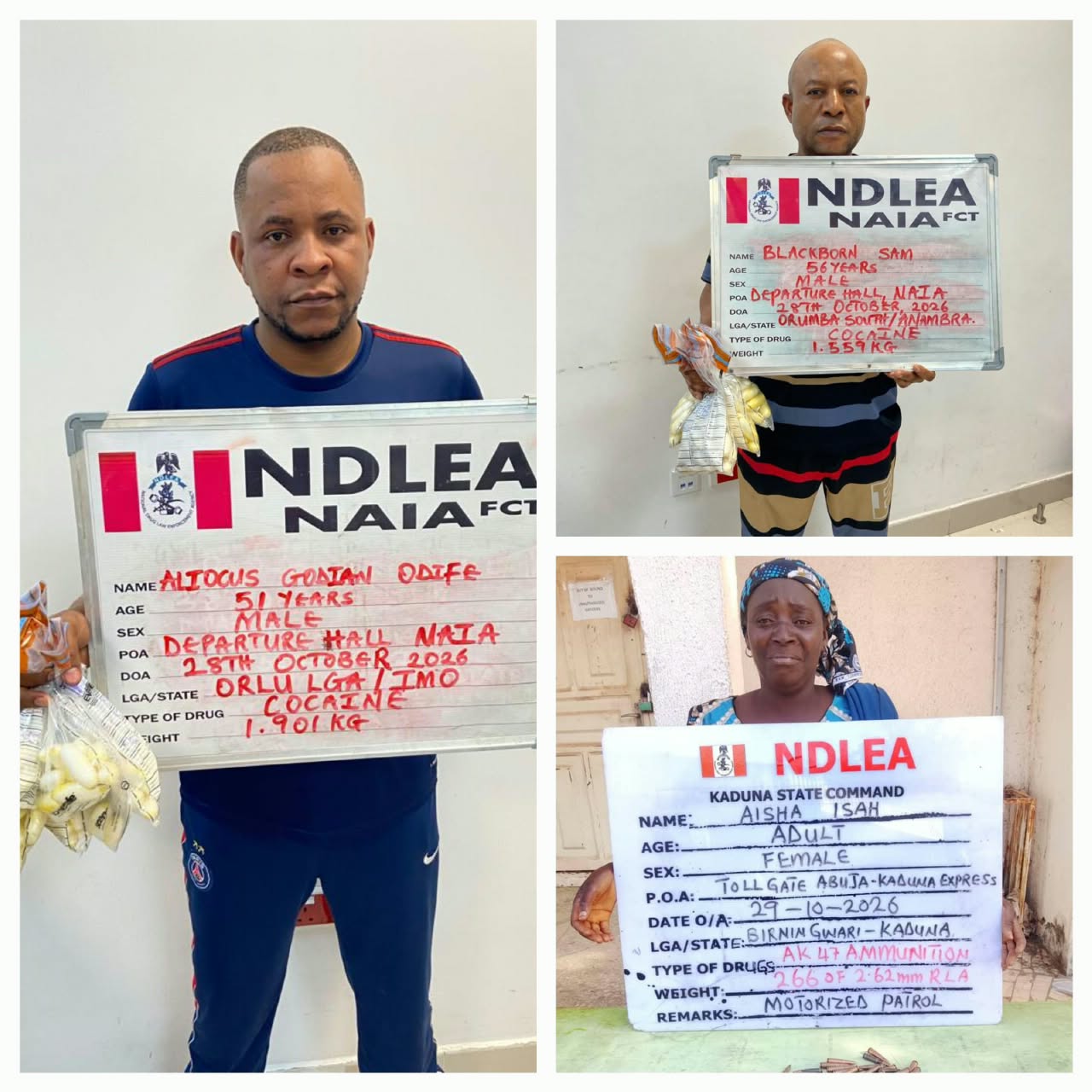
According to a statement issued on Sunday by NDLEA’s spokesperson, Femi Babafemi, the suspects, identified as Aliocus Odife and Sam Blackborn, were arrested on Wednesday, October 28, during the outward clearance of an Air France flight, AF 832, at the Nnamdi Azikiwe International Airport, Abuja.

Babafemi said the suspects, who had returned to Nigeria for holidays, were arrested after body scans confirmed that they had ingested illicit substances.

He said Odife, who lives in France and works in a factory, arrived in Nigeria on October 21 for a short holiday but was arrested while attempting to return to Europe.

Odife was said to have confessed to ingesting 110 wraps of cocaine, which he subsequently excreted under observation. The drugs weighed 1.901kg.

See also  Good morning! Nigerian Newspapers  Headlines: Security tightens noose around Oriire abductors

The statement partly read,  “Two Europe-based Nigerian ‘businessmen’ who flew home on holiday and attempted to return to Paris, France with their bellies loaded with cocaine have been arrested by operatives of the  NDLEA at the Nnamdi Azikiwe International Airport, Abuja.

“The duo, Aliocus Godian Odife and Sam Blackborn, were intercepted on Wednesday, 28th October 2026, during the outward clearance of Air France flight AF 832 from Abuja to Paris. Both men have excreted a total of 200 wraps of the Class A drug weighing 3.460 kilogrammes.

“Odife, who claims to live in France where he works in a factory, had arrived in Nigeria for a short holiday on 21st October.

“He was, however, arrested by NDLEA operatives on his return flight a few days later, when he was subjected to a body scan, which confirmed the presence of foreign objects in his stomach.

“Under interview, he admitted to having ingested 110 pellets of cocaine. He was placed under observation during which he excreted all 110 wraps, which tested positive for cocaine with a total weight of 1.901 kilogrammes.”

See also  Shaibu manipulated youth council election over governorship ambition - Obaseki

Babafemi added that his co-traveller, Blackborn, also tested positive during a body scan and confessed to swallowing 90 wraps of cocaine.

According to the agency, he excreted all the wraps under observation, with the substances weighing 1.559kg.

Meanwhile, NDLEA operatives on patrol along the Abuja-Kaduna Expressway arrested a woman, Aisha Isah, with 266 rounds of live AK-47 ammunition

Continue Reading

Metro News

Yahoo boy jailed seven years for defrauding American $205,238

Published

on

By

A Federal Capital Territory High Court in Abuja has sentenced one Nwachi Chidozie Kingsley to seven years’ imprisonment for defrauding an American woman, Nicole Kierulff Sayers, of $205,238 under false pretence.

According to a statement issued on Thursday by Dele Oyewale, head,  media & publicity of the Economic and Financial Crimes Commission (EFCC),
Justice U.P. Kekemeke of the FCT High Court, Maitama, in his judgement, also also ordered Kingsley to refund the victim the full amount.

The EFCC said Kingsley was sentenced to seven years on each of the two counts against him, with the sentences to run concurrently at the Kuje Correctional Centre, Abuja, without an option of fine.

The charges bordered on possession of a document containing false pretence and obtaining money by false pretence in connection with a purported contract with the Federal Ministry of Works and Housing.

According to the Commission, one of the charges accused Kingsley of possessing a fake notice of intent to award a contract allegedly issued in his name by the ministry. The second count accused him of obtaining $205,238 from Sayers by falsely claiming that the money was needed to finance a government contract.

See also  US-based Nigerian woman risks 10-year jail for $40,980 unemployment benefit fraud

Testifying before the court, Sayers, an American lawyer based in Oregon, United States, said Kingsley first contacted her through Facebook on her birthday.

“I know the defendant. The defendant messaged me on Facebook on my birthday and he said he was a member of the same spiritual organization as me,” she told the court.

Sayers said their conversations later developed into a romantic relationship, which made her trust Kingsley and believe his claims.

According to her testimony, Kingsley subsequently requested money to facilitate the award of a contract by the Federal Ministry of Works and Housing. She said he claimed that some men were threatening his life because he had not provided the money required to secure the contract.

The witness told the court that Kingsley supplied her with details of the purported contract, including a logo and other information, which she believed because of the emotional attachment she had developed towards him.

She said his initial request was for $15,000, which he promised to repay within 45 days. She transferred the money through a money transfer application.

See also  VIDEO/PHOTOS: Lagos govt demolishes Lekki shanties

Sayers further testified that Kingsley later introduced her to members of his family during a video call, during which they allegedly thanked her for helping him secure the purported contract.

She said she had transferred approximately $40,000 to him before travelling to Nigeria to meet him in person.

According to the witness, she arrived in Abuja in March 2022 and spent two weeks with Kingsley at his rented house in Sun City, Abuja. She said she continued the relationship because she wanted to recover her money.

Sayers alleged that Kingsley subsequently requested additional funds for various purposes, including medical emergencies, surgeries, malaria treatment and supplies for the purported government contract.

She told the court that the requests involved more than 125 transactions and that, by her estimate, she transferred well over $200,000 to him within 12 months.

The witness also said Kingsley presented a document he claimed showed that he had attempted to transfer $10,000 to her.

See also  Good morning! Here Are Some Major News Headlines In The Newspapers Today: Court stops pro-Wike lawmakers from sitting in assembly complex

According to her, he claimed that the bank had intercepted the transaction because the money was allegedly linked to the misappropriation of government funds, which he said had led to his arrest and detention.

Sayers further alleged that Kingsley asked her to provide money for his bail and for bribes connected to the purported criminal case.

She told the court that she repeatedly demanded a refund, adding that Kingsley eventually requested her bank details and promised to transfer the money the following day but failed to do so.

She said she later realised that he would not repay the money.

At the conclusion of the prosecution’s case, EFCC counsel, Fatsuma Muhammad, urged the court to convict and sentence Kingsley in accordance with the law.

In his judgment, Justice Kekemeke found Kingsley guilty on the two counts and imposed the prison terms without an option of fine. The court also ordered him to restitute the $205,238 to Sayers.

Continue Reading

Metro News

Nigerian on US Most Wanted List over $1m fraud

Published

on

By

The United States Department of Labour has named a Nigerian, Onoriode Ezewu, on the Most Wanted List over allegations of money laundering involving fraudulent unemployment benefit claims worth more than $1m.

The department’s Office of Inspector General unveiled the list on its website on Wednesday, naming 16 fugitives wanted in cases involving alleged fraud, identity theft, money laundering, labour trafficking and other offences.

According to the agency, the cases collectively involve more than $55m allegedly stolen from American taxpayers.

Ezewu’s profile on the department’s website identifies him as wanted for concealment money laundering and states that he is believed to be residing in Nigeria.

“In January 2021, Ezewu was charged with 15 counts of concealment money laundering tied to fraudulent UI and Pandemic Unemployment Assistance claims filed using stolen identities, in a scheme exceeding $1 million that also touched SBA’s Economic Injury Disaster Loan program.

“Following his arrest and initial appearance, Ezewu violated the conditions of his pre-trial release and an arrest warrant was issued,” the department said.

See also  Aiyedatiwa pays condolence visit to Akeredolu’s family in Ibadan

Announcing the list, the US Department of Labour’s Inspector General, Anthony P. D’Esposito, said the initiative was intended to intensify efforts to locate the fugitives and recover money allegedly stolen from taxpayers.

“Today we are introducing our first-ever Most Wanted List, targeting 16 fraudsters who stole more than $55 million from hardworking American taxpayers,” D’Esposito said.

He added that the agency was working with the White House Fraud Task Force to locate those listed and account for the money involved.

“In partnership with the White House Fraud Task Force, we are using every resource possible and will not stop until every one of these criminals is in handcuffs and every stolen dollar is accounted for. No more excuses. No more hiding. The hunt is on,” he added.

The department said the list was intended to mobilise members of the public, the media, online platforms and international partners to help locate the fugitives.

See also  Kidnapped female army officer yet to regain freedom – Nigerian Army

It also announced the arrest of another person on the list, Leslie Kaciban, in Hungary. Kaciban is awaiting extradition to the United States over an alleged labour racketeering scheme involving approximately `$4m in illegal kickbacks.

The department urged anyone with information about suspected wrongdoing involving its programmes or operations to contact its Office of Inspector General.

Continue Reading

Trending News