Connect with us

Business

Wale Tinubu: The serial winner with a Midas touch

Published

on


If bells could ring for every achievement, Jubril Adewale Tinubu’s would chime ceaselessly.

In fact, it has become a tradition that any time Tinubu, the Group Chief Executive of Oando Plc, appears on the scene, the bells will sound impressively in honour of the extraordinary oil and gas mogul, whose impact will resonate for generations to come.


He is one of Nigerian business moguls redefining the tapestry of the African economic sector, particularly oil and gas business.

Many are aware that Tinubu had a background in Law. But sometime in the early 1990s, the Lagos State-born serial entrepreneur found the allure of oil and gas so irresistible, thereby making him dump his first love, Law.


Thereafter, he followed his heart’s desire by floating the Ocean and Oil business organisation.

Today, the business has not only earned him fame and wealth, but has also contributed in great measures to the economic development of Africa and beyond.

Again, Tinubu shone brilliantly during the recently held Africa Energy Week, AEW, which is the African Energy Chamber’s annual event, uniting African energy leaders, global investors and executives from across the public and private sector.

Quite expectedly, all eyes were on him at the recent interactive conference, exhibition and networking event held at the Cape Town International Conference Centre, CITCC.


In a category, comprising other high-profile deals in the sector and across Africa, Oando won the award in recognition of the Company’s recently completed landmark $783 million acquisition of the Agip from the Italian Energy firm Eni on 22 August, 2024.


The Deal of the Year award, it was gathered, recognises the most transformative and impactful deal in the energy sector – honouring excellence in negotiation, strategic alignment, innovation and collaboration, while celebrating deals that drive advancements in energy and economic growth.


Receiving the award, a visibly excited Tinubu said: “ I am delighted and honoured to receive the ‘Deal of the Year’ award from Africa Energy Week.


“This award is more than just an accolade for a successful deal closure; it represents a public acknowledgement of the culmination of 30 years of grit, hard work, resilience, and sheer belief in our vision. It is a testament to my belief that with the Humans of Oando, impossible is nothing. I’d like to thank the dream team, the Humans Of Oando, our financiers, and partners for their belief and role in making this award a reality,” he said on the occasion.”

See also  OANDO @30: The success story of an iconic brand


The acquisition is the culmination of a decade of preparation, strategic planning, and unwavering commitment to a vision of becoming Africa’s first indigenous International Oil Company.


This development, no doubt, bears testimony to the fact that the outgoing year has been most remarkable on many fronts for him and the company.

First, the Company marked its 30th anniversary recently. Thereafter, it concluded its strategic plan to acquire its second IOC in a decade, Nigerian Agip Oil Company (NAOC) and step up to the role of operator.


Indeed, the year 2024, has been a good one for the oil and gas mogul.
Entrepreneurial and deal making skills are two special gifts energy tycoon is blessed with. As a young man, he worked as a lawyer at his father’s firm to hone his skills but it was not for long as a very impliable young Tinubu soon became restless.


Although he was generating a decent income from his small business, the young lawyer was actively on the lookout for bigger challenges and opportunities.

However, the landscape shifted in 1994 when Tinubu and his two friends —Mofe Boyo and Jite Okoloko— birthed Ocean and Oil Services, a small trading company in the business of supplying diesel and Low Pour Fuel Oil (LPFO) to various shipping firms and offshore exploration companies in Nigeria. Few years into their operations, the three partners bought their first vessel MT Carolina anchored in Bonny to supply diesel to off-shore companies from the Port-Harcourt Refinery. In six years, Ocean and Oil Services had grown its fleet to seven ships.

Within that short time, Tinubu emerged the new face among the oil & gas elite and caught the attention of the business world and piquing the curiosity of many eager to learn more about this rising titan.

Tinubu’s meteoric rise is fueled by the massive success of Oando’s expansion. The cornerstone of this success? Tinubu stumbled across an even bigger opportunity when in 2000, he landed a blockbuster deal with the acquisition of government controlling 40 per cent equity in the defunct Unipetrol Plc, an integrated downstream oil marketing company.

See also  CBN disowns Naira devaluation story, says it's fake news

The three friends made an audacious bid for the company. For an upstart Ocean and Oil —an oil trading and shipping company trying to find its feet in the downstream sector made the move to acquire a controlling interest in an oil & gas behemoth, it was indeed daring!

Stumbling blocks dotted their paths as a result of their youthful age (they were all less than 33 at the time). But Tinubu eventually won the confidence of all the varying factions- the investing public, labour unions, employees and the government.

Along with his team, he went to work on developing a solid business plan and a blueprint for the strategic direction of the company. Tinubu focused squarely on rejuvenating the ailing petroleum marketer.

With the gravitas you might expect of a Booker prize winner, Tinubu, two years later, took another bold step as he led the largest ever acquisition of a quoted Nigerian company with Unipetrol Plc’s purchase of Agip Nigeria Plc.

Thereafter, with another giant brand on their roster, the Group rebranded as Oando Plc and today, it has become Nigeria’s largest non-government owned company in the energy industry with a market value soared to record highs from N74 billion in 2023 to N1 trillion.

Oando is one of the many success stories coming out of Africa’s corporate space. With a load of challenges he has had to maneuver while growing Oando, Tinubu, on his part, silently contributing to the economy and cementing his standing among the global financial elite to the extent that Forbes magazine, recognizing his impressive impact, dubbed him the ‘King of African Oil’.

Tinubu’s latest deal marks a pivotal shift in Nigeria’s energy sector.
Last August, Tinubu and Oando recorded an historic milestone of a monumental deal with the Italian energy giant, ENI for the acquisition of 100% shares of Nigerian Agip Oil Company Limited.


The $783 million deal, sealed and signed at a glittering ceremony held at The Peninsula Hotel in London, cements Oando’s position as Nigeria’s leading indigenous energy solutions conglomerate.

See also  Nigerian Breweries to increase prices of beer, other products


The transaction, first announced in September 2023, promises a brighter future for the company and industry alike.

“It is rather uncanny that this acquisition comes exactly a decade after Oando’s landmark $1.8 billion acquisition of ConocoPhillips’ Nigeria interest, a transaction which incidentally made the company a Joint Venture (JV) partner on the asset alongside NNPC E&P Ltd (NEPL) and NAOC. The ConocoPhillips transaction propelled Oando’s production from approximately 4,500 barrels of oil per day to 50,000 barrels of oil per day at the time,” Tinubu said.

On the AGIP’s acquisition, he added: “Today’s announcement is the culmination of 10 years of hard work, resilience, and an unwavering belief that we would realise our ambition. It is a win, not just for Oando, but for every indigenous energy player as we take our destiny in our hands.

“This is a new dawn for the Nigerian energy sector, and we are confident that indigenous companies will play a pivotal role in this next phase of the nation’s upstream evolution. With our assumption of the role of operator, our immediate focus is on optimising the assets’ immense potential in contributing to our strategic objectives, whilst complementing the nation’s plan to boost production outputs.”


For those who think Tinubu is leaning on his political connections with his uncle, Bola Tinubu as Nigeria’s President in achieving these great milestones, they need to check themselves or see a shrink. Being a good entrepreneur or successful business owner doesn’t exactly mean you’re a dealmaker. But Tinubu combines the three. In all, Tinubu has exceeded expectations.


He has successfully built an empire with a verifiable trajectory. When he acquired Unipetrol’s assets in 2000, very few competitors and contemporaries gave him any chance of success. Now, they take him very seriously.


He’s stated that someday, Oando is going to be Africa’s first oil major. It seems like an unrealistic ambition, but when it is Wale Tinubu speaking, just believe as all pointers show that the billionaire energy tycoon deserves and has earned his flowers!

Continue Reading
Click to comment

Leave a Reply

Your email address will not be published. Required fields are marked *

Business

Wema Bank launches Hackaholics Accelerator 2026 Cohort with ten startups

Published

on

By

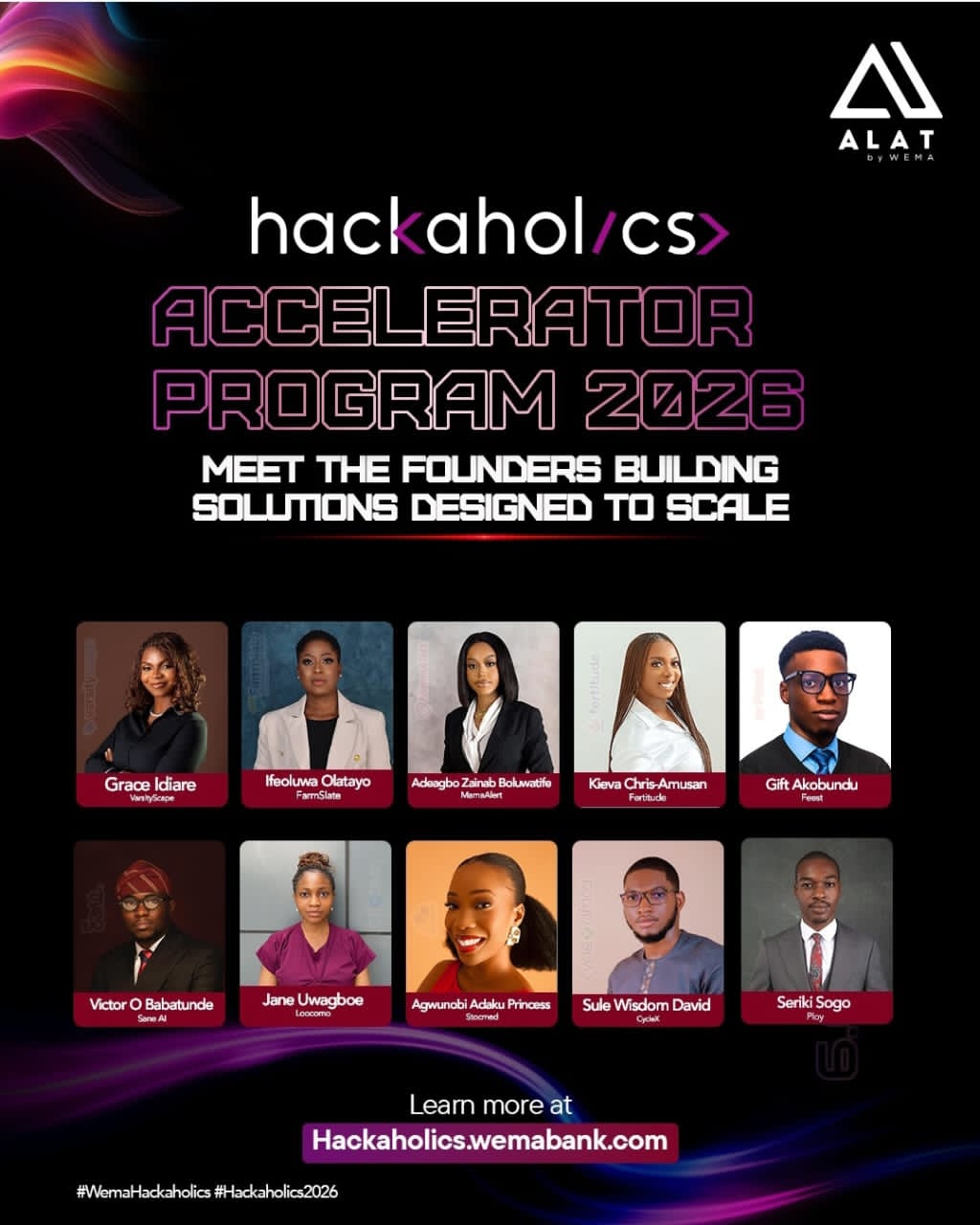
Wema Bank, Nigeria’s most innovative bank and the pioneer of Africa’s first fully digital bank, ALAT, has launched the 2026 Hackaholics Accelerator Program, welcoming ten startups into the cohort.

The Hackaholics Accelerator, a selective growth program under Wema Bank’s Hackaholics platform, is designed to help promising Nigerian startups strengthen their business foundations and prepare for sustainable scale and investment.

After six years of driving innovation through Hackaholics, Wema Bank is extending its support beyond ideation and competition into hands-on startup building through Hackaholics Accelerator. The initiative provides founders with the structure, mentorship, and ecosystem access they need to turn strong ideas into viable, scalable businesses.

The 2026 cohort comprises ten startups in total, drawn from the top 10 performing finalists from Hackaholics 6.0. The startups include Farmslate, Ploy, Stocmed, Feest (Chao), Varsityscape, MamaAlert, Sane, Cyclex, Kieva, and Loocomo.

Commenting on the evolution of Hackaholics and the second edition of its Accelerator program, MD/CEO of Wema Bank, Moruf Oseni, said it reflects the Bank’s commitment to supporting founders beyond ideation and helping promising innovations grow into sustainable businesses.

See also  Oando Boss Adewale Tinubu Receives Energy Times GCEO of the Year Award

“Over the past six years, Hackaholics has grown into more than a competition; it has become a platform that reveals the depth of innovation and entrepreneurial potential that exists across Nigeria,” Oseni said. “With this second edition of Hackaholics Accelerator, we are taking the next step by supporting founders beyond the ideation stage and into the process of building sustainable businesses.

The startups selected for this cohort represent some of the most promising solutions emerging from the Hackaholics ecosystem, and we are committed to helping them refine their models, strengthen their foundations, and scale their impact.”

Speaking on the ten startups selected for the cohort, Babatunde Mumuni, Chief Transformation Officer, Wema Bank, added that the Accelerator will guide founders through a structured process to strengthen their businesses and prepare them for sustainable growth.

“The startups selected for this cohort already have strong foundations, with products already in market, early traction, and clear potential for growth,” Mumuni said. “Each of the selected startups brings a unique solution to real challenges across different sectors. What Hackaholics Accelerator provides is the environment to strengthen those foundations through hands-on mentorship, strategic guidance, and access to the right networks. Over the course of the program, we will work closely with these founders to refine their models, deepen market traction, and prepare them for sustainable scale.”

See also  Suspicious inflows: $26bn from unknown sources passed through Binance Nigeria in one year, says Cardoso

All 10 startup founders will undergo a series of training sessions led by industry experts across key areas critical to startup growth. Facilitators for the programme include the Chief Transformation Officer, Corporate Transformation & Innovation, Wema Bank, Babatunde Mumuni; Head, Strategy & Investor Relations, Wema Bank, Femi Akinfolarin; Head, Data Transformation, Wema Bank, Olamide Jolaoso; and Team Lead, Corporate Social Investment, Wema Bank, Oluwatoyin Adetunji.

Other facilitators include the Managing Director, Impact Hub Lagos, Idowu Akinde; Managing Director, B4B Partners, Napa Onwusa; Startup Advisor and Scout, Onaopemipo Dara; Mentor at Google for Startups, Rosemond Phil-Othihiwa; Head of Growth, Africhange, Tega Ogigirigi; and Startup Advisor and Mentor, Ademola Adewuyi.

Hackaholics Accelerator is supported by Wema Bank’s broader innovation infrastructure, including IDEAx Labs, the Bank’s innovation and venture platform, and its corporate venture programme, which focuses on enabling startup growth through partnerships, infrastructure, and capital access.

Since its launch in 2019, Hackaholics has grown into one of Nigeria’s most influential youth innovation platforms, attracting over 15,000 applicants and supporting hundreds of digital solutions across multiple industries.

See also  Nigeria generated N1.5trn from VAT in Q2 2024 — NBS

Through the Hackaholics initiative, Wema Bank has disbursed over $400,000 in funding to young innovators and startup founders across Nigeria.

Startups, such as Feegor, Myitura, and Bunce are among those that have participated in previous editions of the program, reflecting the Accelerator’s focus on supporting growth-ready companies across diverse sectors. This second edition builds on that progress by helping startups move decisively from innovation to growth.

Continue Reading

Business

Banks to charge 7.5 VAT for mobile transfer, PoS transaction fees

Published

on

By

Banks are set to commence the deduction of 7.5 percent value-added tax (VAT) on banking services, including point of sale (POS) transaction fees, mobile banking transfer fees, from January 19. 

In an email to customers, Moniepoint Microfinance Bank said the charge stems from a government-endorsed regulatory change.

According to reports, the VAT is charged on the N50 stamp duty and does not affect the actual amount being transferred or withdrawn.

The proceeds of the charge will be remitted to the Nigerian Revenue Service (NRS).

“We would like to inform you of an upcoming government-endorsed regulatory change regarding Value Added Tax (VAT),” Moniepoint said.

“From Monday, 19 January 2026, we are required to collect a 7.5% VAT, to be remitted to the Nigerian Revenue Service (NRS) (formerly known as the Federal Inland Revenue Service).

“VAT will apply to certain banking services that include: electronic banking charges such as POS transaction fees, mobile banking fees (transfers), USSD transaction fees, POS activation fee, card issuance fee and Moniebook subscription.”

See also  Herbert Wigwe: We celebrate his humanity and kindness- Wale Tinubu

According to the bank, the charge also applies to other fees, such as loan processing and documentation fees.

“Services that DO NOT attract VAT include: interest on loans and advances, and interest on deposits and savings,” Moniepoint said.

“Please note: This is not a price increase by Moniepoint. Moniepoint is required to collect and remit VAT to the Nigerian Revenue Service (NRS).

“The NRS has communicated a deadline of 19th January for all financial institutions (commercial banks, microfinance banks and electronic money transfer operators) to start collecting and remitting VAT.”

The bank clarified that VAT applies only to banking or service fees and not to interest, adding that the charge will be listed separately on transaction reports and statements.

The new tax laws retain the VAT rate at 7.5 percent.

Continue Reading

Business

Wema Bank Launches Upgraded Version of ALAT Banking App

Published

on

By


…introduces Voice Banking, Tap and Pay and Uptime Prediction

Wema Bank, Nigeria’s most innovative bank and pioneer of Africa’s first fully digital bank, ALAT, has launched the upgraded version of its flagship digital banking platform, ALAT by Wema. Designed as the next phase in digital banking, the upgraded version of ALAT delivers a smarter, faster, and more intuitive experience, reinforcing Wema Bank’s leadership in technology-driven financial services.


Tagged ALAT: The Evolution, the upgraded version represents a significant advancement in how customers interact with their bank.


It enables seamless banking through intelligent features such as voice banking (called SAW), which allows customers to carry out banking activities using natural voice commands, reducing friction and improving accessibility. It also introduces Tap and Pay for quick, secure, and convenient contactless transactions, alongside uptime prediction that enhances transparency, reliability, and confidence around service availability.


Together, these innovations are designed to simplify everyday banking while anticipating customer needs in real time, reinforcing Wema Bank’s commitment to trust, efficiency, and customer-centric digital experiences.

See also  First commercial vessel berths at Lekki deep seaport


Announcing the upgraded version, the Managing Director and Chief Executive Officer of Wema Bank, Mr. Moruf Oseni, said, “ALAT: The Evolution is more than an upgrade. It is a clear demonstration of our commitment to redefining digital banking in Africa.

” By understanding the future of banking and listening closely to our customers, we have upgraded ALAT by Wema to a digital banking platform that is smart, intelligent and dependable.

“This evolution reinforces our promise to deliver innovation that genuinely enhances how people live, work, and transact everyday.”


He added that migrating to the upgraded app is seamless. “Existing customers can simply visit the Google Play Store or Apple App Store to update their existing ALAT app and sign-in with their existing login details (All their account information and transaction history remain intact on their profile and they will also gain access to new features that make banking faster, more intuitive, and more reliable).

See also  Tinubu's presidency: Nigerians should hope for economic prosperity and transformation - Wale Tinubu


For new customers, all they have to do is visit the Google Play Store or Apple App Store to download ALAT by Wema app and click the Get Started icon to onboard seamlessly.


Speaking on the technology in the upgraded ALAT by Wema, Mr. Olusegun Adeniyi, Chief Digital Officer at Wema Bank, explained, “With ALAT: The Evolution, we set out to enhance not just functionality but the overall banking experience. By integrating voice banking, contactless payments, and predictive reliability, we are delivering a platform that is built on powerful technology and responds intelligently to customer needs. This upgrade reflects our long-term digital vision to create a digital bank that is adaptive, intuitive, and consistently available.”


Built on speed, intelligence, and user-centric design, ALAT: The Evolution redefines everyday banking through intuitive features such as voice-enabled transactions, contactless payments, and predictive service reliability. Designed to anticipate customer needs in real time, the platform delivers a smarter, more seamless, and dependable digital banking experience that reflects Wema Bank’s vision for the future of finance.

See also  CBN disowns Naira devaluation story, says it's fake news


With the upgraded version of ALAT, Wema Bank continues to strengthen its position as a digital-first institution, delivering innovative solutions that empower individuals and businesses to bank with confidence in an increasingly digital economy.

Continue Reading

Trending News