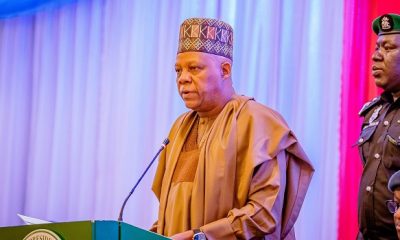
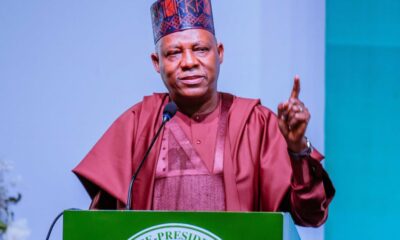
Vice-President Kashim Shettima on Tuesday addressed the 79th session of the United Nations general assembly in New York.
Below is the full text of his speech.
Mr. President,
As you assume the leadership of this august Assembly, our world is confronted by profound moral questions that will require more than the habitual remarks from this elevated podium to resolve. There are questions about the ultimate purpose of our Organisation, the United Nations itself, and how it can remain relevant and resilient.
2. It is with these sentiments that I convey to you the warm and fraternal greetings of my countrymen and women, and to congratulate you on your assumption of the Presidency of this Assembly. Let me assure you of the full cooperation of my delegation in discharging your onerous responsibilities during your tenure. In the same vein, I wish to extend my appreciation to your predecessor, His Excellency, Dennis Francis, for the many remarkable achievements recorded during his stewardship.
3. It gives me particular pleasure to commend His Excellency, António Guterres, the Secretary-General of the United Nations, for his commitment to the cause of peace and development, and the democratisation of the United Nations to reflect the need to correct the historical injustice that has been done to Africa. I am also delighted to note the steadfast support given to the Secretary-General by our own sister and compatriot, Amina Mohammad, Deputy Secretary-General, while sharing the burden of responsibility in leading a complex organisation like the United Nations.
Mr. President,
4. The theme of this year’s General Assembly leaves us in no doubt that there is still work to be done to bridge the gap between aspirations and the realities confronting our world today. It also underscores the need to remind ourselves that the United Nations stands for inclusiveness – anchored on the tripod of peace, sustainable development and human rights.
5. Today, these pillars of our organisation are threatened. They risk being broken by the relentless pursuit of individual national priorities rather than the collective needs of the nations that are assembled here today. While commitment to multilateralism offers us the surest guarantee of global action to address the existential challenges we face, singularity and nationalism are undermining the aspirations towards the peaceful and collective resolution of such challenges.
6. From last year’s summit, and indeed from previous years, we have carried over the numerous challenges of terrorism, armed conflict, inequality, poverty, racial discrimination, human rights abuses, food crises, hunger, irregular migration, piracy, global pandemics, hyper-inflation, nuclear proliferation, grinding debt burden, climate change, and a host of other vexations. The continued manifestation of these challenges testifies to our failings rather than to any lofty achievements on our part. Billions of dollars are being committed to the prosecution of wars and the fanning of the embers of conflict.
7. Yet, we always recoil from bringing out the resources we need to build peace and to deliver life’s necessities to people. The question of governance is at the heart of our problems – and also the solution to them. We recognised this in Nigeria when on 12th June this year, we celebrated a quarter of a century of unbroken democratic rule. We are no less proud of this achievement than the fact that during the last two decades, a sustained process of democratisation has swept over Africa.
8. However, the return of unconstitutional changes of government and forceful military take overs in some countries of the Sahel underscore the fragility of democracy when it is not backed by economic development and sustained peace and security. It is this fragility, rather than the milestones that democratic governance has achieved in Africa, that should matter most in our deliberations at this and other High-Level Segments of the 79th Session of the General Assembly. While we abhor all forceful changes of government, we can also recognise the impatience in cities and villages at the sometimes slow and grinding turn of the wheel of democracy.
9. Our people need employment. They need decent livelihoods. They desire good and affordable education and healthcare for their children and families. They need to live in healthy, safe and secure environments. They need hope and they need opportunity. They desire to live in peace and tranquillity, to pursue whatever gives them happiness and contentment. When governments fail to deliver, the people are bound to question the utility of democracy and other ideals, like rule of law.
10. The global debt burden undermines the capacity of countries and governments to meet the needs of their citizens. Creeping trade barriers and protectionist policies are destroying the hopes for prosperity of peoples and nations. Unbridled competition rather than cooperation is discouraging incentives and driving away investments.
11. Above all, general insecurity is driving people into unprecedented hardship and misery that in turn, affect the people’s confidence in democracy. It is the duty of the international community to bring back confidence in democratic rule and constitutional order, by paying more attention to the needs and aspirations of the people, rather than paying lip service to human rights, sustainable development and peace. We need the substance of democracy, not just the form.
Mr President,
12. We cannot build durable societies with the threat of terrorism, banditry and insurgency growing in our countries and regions. Indeed, violent extremism remains an existential threat to both national and international peace, security and development. We are making concerted efforts to contain and rollback this threat. The High-Level African Counter-Terrorism Meeting hosted by Nigeria in April 2024 and its outcome – “The Abuja Declaration” – promises to provide solutions to the challenges presented by terrorists and insurgents.
Mr. President,
13. Climate change is a driver of insecurity, which also poses a veritable challenge to sustainable development. A few weeks ago, large areas of my country were inundated by seasonal flood waters, including one of our largest cities, Maiduguri, in the North-East. Other parts of Nigeria also experienced similar tragedies, occasioning the loss of lives and property.
14. We need not remind ourselves to remain faithful to the implementation of the commitments that we all gave voluntarily at the various COP Meetings. Failure to do so is merely to postpone the inevitable. No country is immune from the effects of climate change.
15. It is better that we cooperate and collaborate to meet this ever-increasing challenge rather than remaining in our shells, waiting for the inevitable to happen. A common challenge requires a common solution. Nigeria stands ready to meet her obligations in terms of mitigation and adaptation measures nationally and regionally, with the active participation of other countries and international partners.
Mr. President,
16. Conflict prevention is the main reason why the UN exists. But the task of prevention becomes all the more difficult when conflict becomes normalised, when even the condemnation of violence and civilian casualties, and calls for a ceasefire, are somehow regarded as controversial.
17. As we emphasised at the Abuja High-Level Ministerial meeting, we must renew our focus on conflict prevention. Indeed, addressing the root causes of conflicts is often the first step towards providing long-term solutions. Clearly, some of the root causes of conflicts are social in nature, including poverty, hunger, ignorance, inequality and exclusion, as well as other forms of injustice. In Sudan, other parts of our continent and further afield, foreign actors are exacerbating those tensions to prolong conflict and deepen the suffering of innocent people.
18. Today, we are all witnesses to the heart-wrenching situation in Gaza and other Palestinian Territories. We cannot discuss war and peace, conflicts and reconciliation or humanitarian imperatives today without reflecting on the Israeli-Palestinian conflict that has been raging since 7th October last year.
19. Of course, the conflict predates this period and has been simmering for a better part of half a century. What this tells us is that the international community has failed to live up to the spirit and aspirations of the United Nations to rid the world of inequality, violence and domination of one people by another. Justice is antithetical to revenge.
20. Freedom is an inalienable right and a natural entitlement that cannot be denied to any people. The Palestinian people deserve their independence. They deserve to have a home of their own on territories already recognised by this very Assembly and by international law, which is being routinely ignored. Nigeria continues to urge efforts to bring back on track the ‘two state solution’ that offers the prospect for a new beginning for the region.
21. Nigeria reaffirms its commitment to supporting United Nations Peacekeeping Operations. We recognise the need for Africa to build strong and professional armies to meet the multiple challenges we face. Consequently, we reiterate the call for international support to operationalise the African Standby Force, in addition to the provision of requisite support and resources to ensure the upgrade, take-off and effectiveness of a Centre of Excellence on issues of counter-terrorism in Africa.
Mr. President,
22. Reform of the Security Council is critical if the UN is to strengthen its relevance and credibility in our rapidly changing world. Some permanent members of United Nations Security Council have offered encouraging if tentative indications of support on the issue of reform of the Council. We welcome the change in tone and urge an acceleration in momentum to the process.
23. The Security Council should be expanded, in the permanent and non-permanent member categories, to reflect the diversity and plurality of the world. We fully support the efforts of Secretary-General Guterres in this regard.
24. Africa must be accorded the respect that it deserves in the Security Council. Our Continent deserves a place in the permanent members category of the Security Council, with the same rights and responsibilities as other Permanent Members.
Mr. President,
25. Your assumption of stewardship of the General Assembly presupposes that you will be seized with the progress of the implementation of the UN’s Sustainable Development Goals. We note that most developing countries are significantly behind in the achievement of these Goals, largely due to a lack of resources available to finance their implementation and the burden of unsustainable external debt.
26. It is our expectation that the adoption of the “Pact for the Future” will change the narrative, reposition economies and translate into concrete measures that provide solutions to the challenges faced by developing and least developed countries. This is particularly significant in our region and the Sahel, where human development indices are low and depressing.
27. It is for this and other reasons that we reiterate the call by countries, especially of the global South, for reform of the international financial architecture and promotion of a rules-based, non-discriminatory, open, fair, inclusive, equitable and transparent multilateral trading system.
28. We are aware of the debilitating impacts of corruption on global prosperity and national progress. Proceeds of corruption and illicit financial flows constitute a huge chunk of resources needed for sustainable development. The recovery and return of such funds to States of origin is a fundamental principle of the United Nations Convention against Corruption.
29. Therefore, the international community must promote practical measures to strengthen international cooperation to recover and return stolen assets and to eradicate safe havens that facilitate illicit flows of funds from developing countries to the developed economies.
30. There is also the urgent need to promote fair and inclusive tax regimes in the world. Nigeria helped introduce the resolution on “Promotion of inclusive and effective international tax cooperation at the UN”. We acknowledge the progress made in the adoption of the terms of reference of the UN Framework Convention on Tax Cooperation. We should deepen this initiative and work towards a UN Framework Convention on Tax Cooperation.
31. Similarly, we must ensure that any reform of the international financial system includes comprehensive debt relief measures, to enable sustainable financing for development. Countries of the global South cannot make meaningful economic progress without special concessions and a review of their current debt burden.
32. My government pays due regard to the imperatives of creating a conducive national environment for investment and the ease of doing business. Last year, I signed four Executive Orders to curb double taxation. I also established the Presidential Taskforce on Review of Fiscal Policy and Tax Reform. These measures are geared towards not only boosting investor confidence in Nigeria, but also to ensure investors make reasonable profit from their investments.
Mr. President,
33. While the world is transitioning into the Fourth Industrial Revolution, Africa remains energy deficient. The push for the accelerated implementation of SDG 7: “Affordable and Clean Energy”, therefore, must take into account Africa’s precarious situation. Nigeria believes that natural gas remains central to the search for solutions to the energy challenges that Africa and the international community face. Access to affordable, reliable, cleaner sources of energy is more than an environmental or developmental issue. It is a key factor in social peace and international security.
Mr. President,
34. Nigeria remains unwavering in its commitment to SDG 13: Climate Action, including the net zero ambition and transition from fossil fuel energy to clean energy. As a demonstration of this commitment, I established the Presidential Committee on Climate Action and Green Economy Solutions and appointed a Special Presidential Envoy on Climate Action.
35. We will redouble our efforts to address the challenges posed by climate change, including the urgent need to transition from fossil fuel energy. Yet such commitments must be juxtaposed with the principle of Common but Differentiated Responsibilities and the relevant provisions of the Paris Climate Agreement back in 2015. The Paris Agreement provided for developed countries to take the lead in the quest to achieve net zero and to offer support, including finance, to developing countries for the actualisation of the climate change goal.
36. Worthy of note is the ‘loss and damage funding for vulnerable countries’ secured at COP 27 in Egypt and expanded in COP 28 in the United Arab Emirates. It is our expectation that this year’s 79th Session of the UN General Assembly and the upcoming COP 29 in Azerbaijan this November, will go a step further by providing developing countries, especially African countries, with access to the loss and damage funds, including the 100 billion dollars pledged by developed countries to mitigate the negative impacts of climate change.
Mr. President,
37. In this age of digital innovation, we must address the emerging divide between the Global South and the Global North, which, with the evolution of artificial intelligence, risks becoming wider still. The UN should work towards eliminating barriers to digital economy in Africa, such as high costs of Internet services and intellectual property rights.
38. Moreso, there is a need to work towards common global standards to regulate crypto-currency trading platforms. This is the most effective way to provide confidence in these new markets and limit the potential for instability. Our own experience in Nigeria, as in other countries, shows that new technologies, when not properly regulated, can facilitate organised crime, violent extremism and human trafficking. In our own case, the trading of crypto-currency helped fuel speculation and undermined macro-economic reforms.
39. Separately, we have also witnessed, in rich and poor countries alike, the corrosive impact of unfiltered hate speech and fake news across social media. There is much more that we could and should do, together, to strengthen those guard rails that will help release the most progressive elements of the new technologies shaping our world – and curb those more destructive tendencies.
Mr. President,
40. We are particularly mindful of the imperatives of achieving the advancement of youth and women as a factor in national development, peace and security. Nigeria has developed its own National Action Plan on Women, Peace and Security, as well as a National Action Plan on Youth, Peace and Security, to ensure the participation of both women and youth in the peace and security sector.
41. The “Summit of the Future” cannot be deemed successful without setting clear, ambitious and achievable developmental goals to address the various challenges facing our youth. In line with this aspiration, my government will continue to invest in Nigerian youth through initiatives like the revitalisation of the National Youth Investment Fund for 2024, focused on youth empowerment and entrepreneurship.
Mr. President,
42. As much as the global family still grapples with the crippling consequences of the COVID-19 pandemic, the greatest lesson that we have learnt is never again to take any health situation with levity. In line with SDG 3, we must continue to work together to ensure the good health and well-being of all. There is no disease that should be relegated to the background due to some perceived classification of their seriousness or importance.
Mr. President,
43. Migration is a complex and polarising issue that impacts on rich and poor countries alike. Nigeria is a country of origin, transit and destination. We are a major stakeholder in the global migration dynamic, and understand the challenges and benefits it brings. Accordingly, I wish to reiterate our support for the Global Compact for Safe, Orderly and Regular Migration (GCM). The GCM, which all of us should continue to support, represents our collective efforts at providing major safeguards for the treatment of migrants.
Mr. President,
44. I will conclude by reaffirming Nigeria’s steadfast commitment to the deepening of multilateralism, just as we did sixty-five years ago on this podium when we joined the United Nations as the 99th Member-State. We remain committed to that “desire to remain friendly with all nations and participate actively in the works of the United Nations”, as expressed by our founding Prime Minister, Sir Abubakar Tafawa Balewa.
45. It is my hope that our deliberations this year will result in solutions that would address our collective challenges and accelerate the attainment of the Sustainable Development Goals, as well as the advancement of peace and human dignity for the sake of present and future generations.
I thank you.







 News4 years ago
 Privacy5 years ago
 News5 years ago

 News5 years ago
 Opinion5 years ago
 News5 years ago
 Sports5 years ago