Connect with us

Metro News

Blood Money: Understanding the link between illegal mining and banditry

Published

on


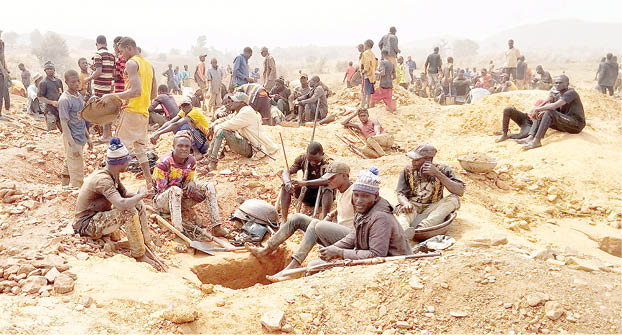
Niger and Zamfara are among the few states in the North-west and North-Central regions, endowed with huge deposits of minerals and other natural resources, and for years, several communities in the two states have been into local mining as their second source of livelihood, after farming.


Weekend Trust investigations revealed that the two states are endowed with several minerals, including talc, gold, ball clays, silica, sand, marble, copper, iron, felspar, lead, kaolin, casserole, columbine, mica, quartzite, and limestone, among others.


Participation in the local mining in those communities has become the norm among the people, as every household is actively engaged in one aspect of mining or the other, depending on the capability or economic status of the family.


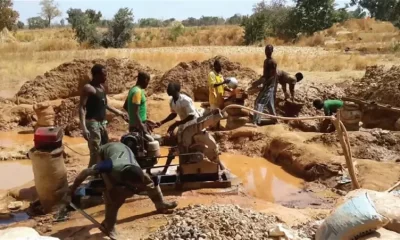
Each household engages in the activities, ranging from digging the pits, stone grinding, thrashing, or washing the sand in search of natural resources, particularly gold. Very few among the locals serve as agents of the major gold dealers.


Residents conduct mining locally, taking their gold and other minerals to places like Lagos, Port-Harcourt and sometimes to countries like Ghana and Benin Republic, among others, for onward sale to major dealers. On some occasions, the dealers visit the two states to buy gold and other minerals directly from the miners or through their agents.


The link between gold mining and banditry

Until the emergence of banditry in the two states, local mining had been taking place in several communities in Niger and Zamfara states without much negative impact, apart from the major hazard of mining pits’ collapse.


Even after the incidents of banditry started in the two states, initially, there was no link between the mining activities and the violent act. While the criminals were kidnapping for ransom, engaging in cattle rustling and carrying out attacks on villages and towns, the residents on the other hand, concentrated on mining and farming as their sources of livelihood.

See also  Politicians are sponsors of banditry- Uzodinma


In Zamfara State, it was gathered that the link between banditry and mining emanated from the miners, who developed the habit of killing one another in the course of their activities.


Alhaji Yusuf Bello, a local miner in Mutunji village, Maru Local Government, told Weekend Trust that, “Sometimes when a miner gets expensive gold, his colleagues connive and kill him in order to take away the gold. You know they carry Dane guns for protection because most of the mining sites are located in remote areas.


“However, as humans, sometimes they envy their colleagues whenever they get huge gold. So, at times, they kill their colleagues with a view to taking away the expensive mineral they have found.


“This is how killings among the miners started, and that was also the starting point of banditry in this part of the country. Both banditry and mining are about getting money,” he said.


It was learnt that after the bandits have rustled cattle and other animals and birds in the villages and towns, they will then compel the people to sell other properties to pay ransom for their loved ones to regain their freedom. Then, the bandits realised that whenever they demanded ransom, the relatives of their victims always asked to be given some days to enable them to sell their gold to pay.


This is said to have made the bandits change their tactics by using informants among the locals to know who had gold or any expensive mineral in the communities, so that he or his relatives would be abducted.

See also  WTO seeks to empower vulnerable Nigerians- Okonjo- Iweala


According to Idris Musa, a resident of Ruwan Dorawa village: “It is through this method that the bandits got to know that most of those that were paying ransom as and when due to free their loved ones, were from the gold mining families.


“That is how the bandits got attracted to mining activities. They got to understand that a lot of money was being made from it. The bandits, therefore, engaged in mining in many ways,” he further explained.


He said currently, most of the mining sites in the state are either owned or controlled by bandits’ leaders, recalling that “about three months ago, one of the bandit kingpins, Kachalla Halilu, allegedly got gold worth N150 million in Kanye village, Anka Local Government Area of Zamfara State.


“Kachalla focuses more on mining than banditry nowadays. He has hired dozens of local miners who are currently working for him at various mining sites across the state. Also, in Mada village, Gusau Local Government Area, more than half of the mining sites operating in Fegin-Mahe and Ajiya villages and parts of Zurmi Local Government Area are said to be owned and controlled by bandits’ leaders.


Muhammad Sanusi, a resident of Zurmi town, told Weekend Trust that, “We always wonder why the local mining continues in this part of the state despite the security challenges we are facing. You will never hear that bandits attacked mining sites in this area.


“But the bandits have launched several attacks on villagers, abducting and killing scores of people besides the large number of domestic animals and other belongings they cart away or destroy. This is to tell you that there is a strong link between the bandits and miners,” he said.

See also  Supreme court now has 11 justices as Amina Augie retires


Also, a resident of Tsafe town, Iliyasu Abubakar, alleged that the famous bandits’ leaders, Bello Turji and Ado Alleiro, were involved in mining activities. They are said to own mining sites in Maru, Bukkuyyum, Maradun and Tsafe local government areas, among other places.


Also, checks in Dansadau district indicated that there are no fewer than 18 villages where bandits are carrying out mining activities, with another 18 villages in Zurmi Local Government, while in Birnin Magaji, the residents have entered an agreement with a bandit kingpin, Dan Karami, to control all the mining sites in Gotal and Shamshalle villages and allow them to live in peace.


Sometime in September last year, one of the bandits’ leaders in the state, Damina, placed a levy of N200 million on the people of Mutunji village in Maru, after he heard about a huge amount of gold scooped by one of the local miners in the village. And when the people failed to pay the levy, Damina abducted 150 members of the community, Weekend Trust gathered.


It was further gathered that virtually all the bandits’ leaders operating in Zamfara State are into illegal mining activities to get more money to buy sophisticated weapons, in order to sustain their operations.


Having realised the strong link that exists between banditry and mining, the Zamfara State Governor, Dauda Lawal, in January this year, signed an Executive Order prohibiting traditional rulers from issuing consent letters for mining across the state.


Continue Reading
Click to comment

Leave a Reply

Your email address will not be published. Required fields are marked *

Metro News

Nigerian-British grandma arrested with 13kg cocaine concealed in plantain peels at Lagos airport

Published

on

By

Operatives of the National Drug Law Enforcement Agency (NDLEA) have arrested one Mrs Mary Barek, a 67-year-old Nigerian-British grandmother, for allegedly attempting to smuggle 13 kilograms of cocaine concealed in fake plantain peels through the Murtala Muhammed International Airport, Lagos.

According to the agency, the suspect, who works as a caregiver in the United Kingdom, was arrested at the departure hall of Terminal 2 of the airport on Sunday, June 28, while attempting to board a Virgin Atlantic flight to London.

Femi Babafemi, the NDLEA Director of Media and Advocacy, in a statement released on Sunday, said a thorough search of the suspect’s luggage led to the discovery of 31 large wraps of cocaine disguised as hands of plantain and packed alongside other food items.

Babafemi said, “A thorough search of her bags resulted in the discovery of 31 big wraps of cocaine which were packaged to appear like plantain hands, weighing a total of 13 kilograms. In her statement, the elderly woman admitted full ownership of the recovered cocaine exhibits.”

See also  Buhari gave orders to seven Northwest governors to end banditry

The NDLEA also announced the arrest of a 45-year-old PhD student at the University of Putra, Malaysia, Nwabueze Felix Onyeka, over an attempt to export cocaine concealed inside cartons of Orijin Bitters bound for Kuala Lumpur.

Onyeka was arrested in Ekwusigo Local Government Area of Anambra State on June 29 after investigators traced him as the alleged leader of a drug trafficking syndicate.

Babafemi disclosed that operatives had earlier intercepted 36 parcels of cocaine weighing 5.80 kilograms hidden within the walls of nine cartons of the herbal drink that formed part of a consolidated cargo destined for Malaysia.

According to him, four suspects were initially arrested in Lagos during investigations, including the cargo agent, Alalade Taiwo Azeez; the driver who conveyed the consignment, Ndem Ogbonna Kelechi; a trader at ASPANDA Market, Trade Fair Complex, Okeke Tochukwu Chimezie; and Igwilo Chidi Henry, who allegedly supplied the cartons used to conceal the drugs.

Babafemi said, “The efforts eventually paid off, leading to the unmasking of Nwabueze hiding in his village Aziora, Ozubulu, Anambra State as the leader of the syndicate.”

See also  Shettima visits survivors of Maiduguri bombings at UMTH

In Taraba State, the NDLEA said its operatives arrested a 30-year-old suspect, Daniel Harrison Ugwuoke, along the Zaki-Biam Road in Wukari Local Government Area on Saturday, July 4.

The agency said 43,980 capsules of Tramadol were recovered from two vehicle fuel tanks specially modified to conceal the drugs.

Similarly, NDLEA operatives arrested Boniface Agu, 65, and Monday Nwaeze, 50, during a raid in Gwantu Local Government Area of Kaduna State on July 2, where they allegedly recovered 1.7 kilograms of methamphetamine.

In Ebonyi State, a 65-year-old suspect, Francis Ifara Eja, was arrested with 231.7 kilograms of skunk at Ikwo on July 4, while a 75-year-old suspect, Alhaji Babani, was apprehended with 15 kilograms of skunk at Kurgwi in Qua’anpan Local Government Area of Plateau State on July 3.

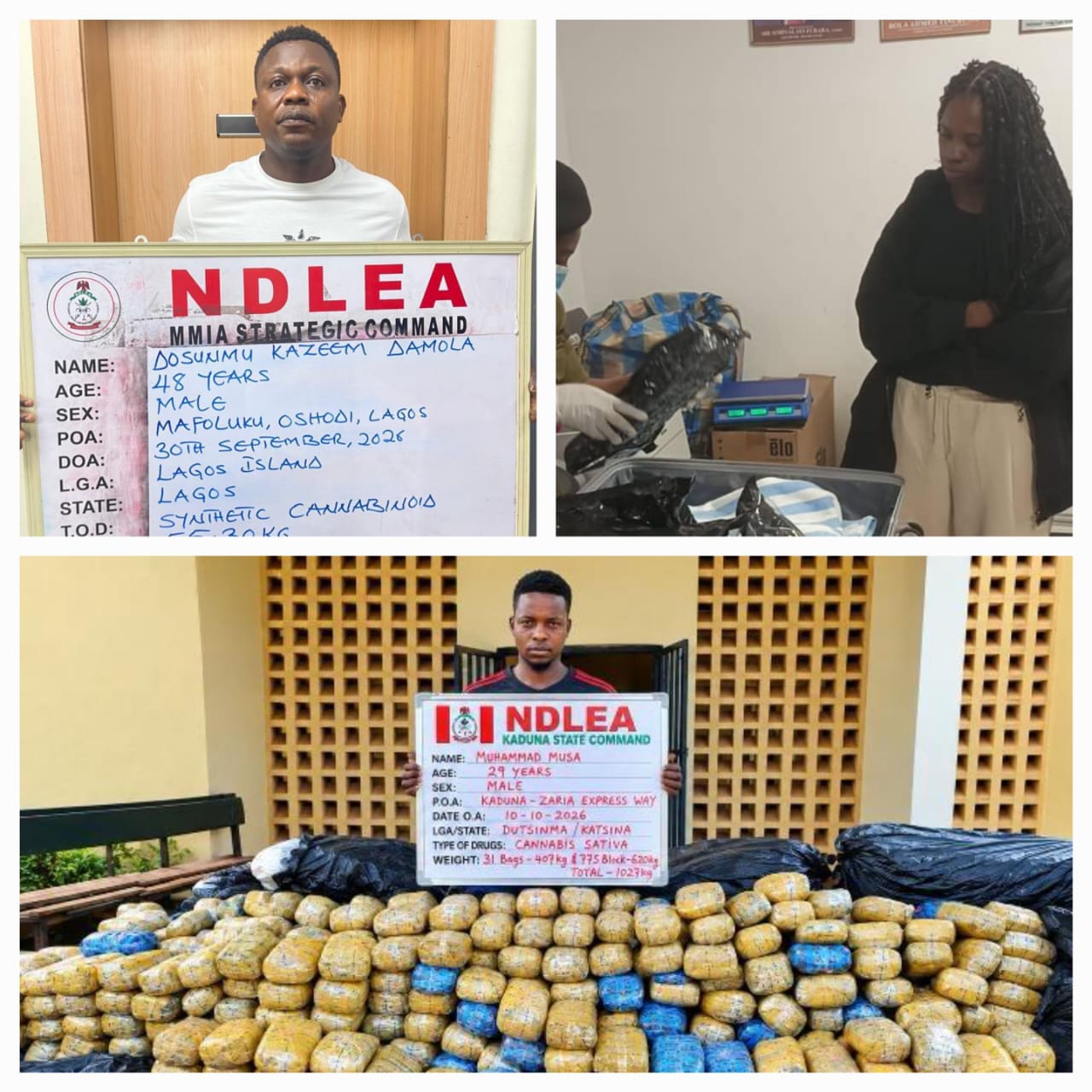
The agency also reported that two suspects, Dahiru Mohammed, 65, and Isiya Lawan, 36, were arrested in Gombe State on July 1 with 587 blocks of cannabis sativa weighing 556 kilograms at Kuri village in Yamaltu-Deba Local Government Area.

See also  Tinubu visits Birnin Gwari in Kaduna, promises to end banditry

Beyond enforcement operations, the NDLEA said its commands nationwide sustained the War Against Drug Abuse (WADA) campaign through sensitisation programmes in schools, workplaces, worship centres and communities.

According to Babafemi, the awareness activities were conducted at Girls Secondary School, Abagana, Anambra State; Government Technical College, Obe, Enugu State; Adeola Odutola College, Ijebu Ode, Ogun State; and the FCE Staff Demonstration School, Kabuga, Kano State, among other locations.

Commending officers involved in the recent operations, the Chairman and Chief Executive Officer of the NDLEA, Brig. Gen. Mohamed Buba Marwa (retd.), praised the commands for combining enforcement with public enlightenment.

According to Babafemi, the NDLEA chairman “commended the officers and men of MMIA, Taraba, Kaduna, Ebonyi, Plateau, and Gombe Commands for the arrests and seizures,” noting that “their drug supply reduction efforts balanced with WADA sensitisation activities,” while charging them and other officers across the country to continue to raise the operational bar.”

Continue Reading

Metro News

NDLEA intercepts N12.3bn illicit drug consignment imported from Canada

Published

on

By

Operatives of the National Drug Law Enforcement Agency (NDLEA) have intercepted a large consignment of Canadian loud, a strain of cannabis, from Toronto, worth N12,397,500,000 in street value.

Femi Babafemi, NDLEA’s director of media & advocacy, in a statement on Sunday,  said operatives had been tracking and monitoring a container laden with the drugs for over four weeks.

He said that the container, which had 195 big sacks of Canadian loud, was eventually interdicted on June 23, 2026.

“A total of 4,959 kilograms of the illicit drug was recovered from the container during a joint examination of the shipment by officers of the Apapa strategic command of the agency, men of the Nigeria Customs Service, other security agencies, and ports stakeholders at the Apapa ports complex in Lagos,” the statement reads.

“The large illicit drug consignment which was loaded into a 40ft container comprising a Ford and a Nissan vehicle came under NDLEA tracking and monitoring system since 25th April 2026 when it arrived Toronto, Canada via truck, Montreal via rail on 29th April, Tanger Med Morocco on 11th May, loaded on another vessel on 23rd May before arriving Tincan port Lagos on 4th June and discharged there 5th June before the container eventually left Tincan and arrived Apapa port on Monday 22nd June.”

See also  Politicians are sponsors of banditry- Uzodinma

Similarly, officers of the agency in the Federal Capital Territory, in collaboration with their colleagues in Anambra state, unraveled a syndicate that plants illicit drugs in the luggage of unsuspecting passengers in motor parks.

“Their trick came to the fore when operatives in Abuja intercepted a consignment of methamphetamine in a Sienna bus coming from Nnewi, Anambra state, at Abaji, FCT on June 20, 2026,” the statement added.

“During a search of the bus, a waybill package was recovered containing whitish substances suspected to be methamphetamine concealed inside a black nylon bag, which was also put into another sack of clothes with the phone number of the receiver written on it.

“A follow-up operation conducted on the same day led to the arrest of the supposed receiver of the waybill, Gloria Peter, at Utako Motor Park.

“Peter, however, vehemently denied knowledge and ownership of the package in her luggage.”

NDLEA said that led to the swift arrest of the loaders of the Sienna bus in Nnewi, where one of them revealed that the drug package was put into the woman’s bag by him on the directive of Abdurrazak Isah, driver of the bus.

See also  EFCC arrests two Chinese nationals, six Nigerians for ‘illegal mining’ in Ogun

The agency said the loader’s revelations made the driver open up, mentioning one of his passengers, Onyebuchi Victor Okoye, as the actual owner of the drug.

“Onyebuchi was then picked up at Utako, FCT, during another follow up operation. The illicit consignment weighed 467.7grams,” the statement said.

Babafemi said that the agency would continue its sensitisation and enlightenment programmes across schools, worship centres, including the War Against Drug Abuse (WADA) enlightenment lectures for students and staff of workplaces, and communities.

He said that the agency’s WADA lecture were taken to schools across, Yobe, Lagos, Kano, Kogi and Enugu states.

Continue Reading

Metro News

NDLEA arrests China-bound businesswoman with 7.5kg consignment of cocaine at Lagos airport

Published

on

By

Operatives of the National Drug Law Enforcement Agency (NDLEA) have arrested a 38-year-old businesswoman, Iwebema Ogechi Peace, following the discovery of a large consignment of cocaine concealed in false bottom of her luggage.

According to a statement by NDLEA spokesperson, Femi Babafemi, the businesswoman was on her way to Beijing, China, aboard a Qatar Airways flight through the Murtala Muhammed International Airport (MMIA) Ikeja Lagos.

Babafemi said Iwebema, who claimed she travels to China to buy items for sale in Nigeria, was arrested on Sunday 21st June 2026 at the departure hall of terminal 2 of the Lagos airport based on credible intelligence.

A search of her check-in luggage led to the discovery of four large parcels of cocaine concealed in false bottom professionally created in her bag.

The parcels of the class A drug found hidden in the bag have a combined weight of 7.5 kilograms.

See also  Bashir Tofa, MKO Abiola’s opponent in 1993 dies
Continue Reading

Trending News