Connect with us

News

Huge crowd gather as Iran buries late president at shrine in home city of Mashhad

Published

on


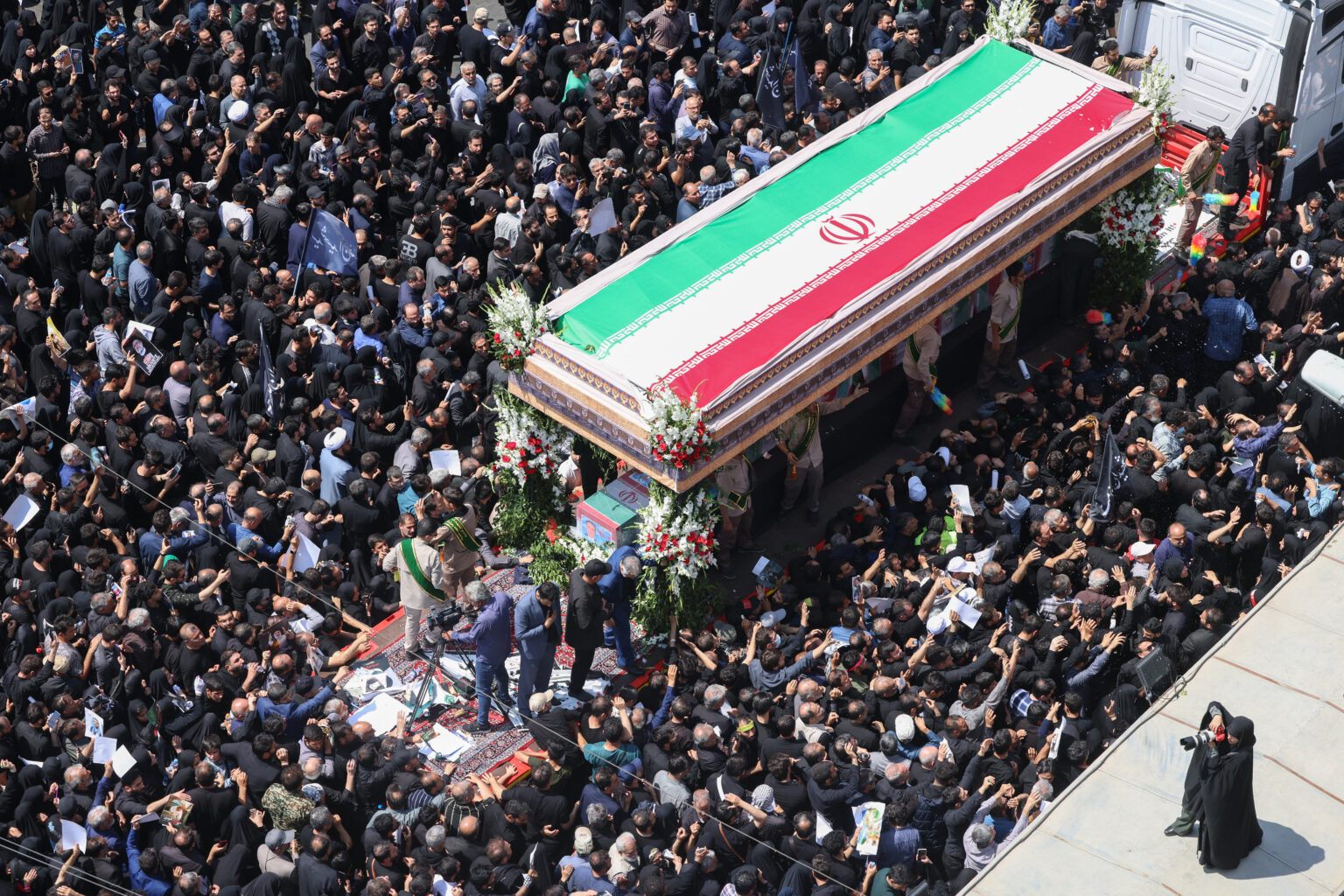
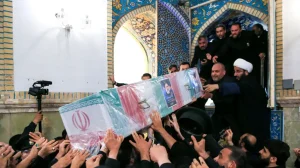
Iran’s late President, Ebrahim Raisi, has been buried in his home city of Mashhad, four days after he was killed in a helicopter crash.

The 63-year-old hard-line cleric was laid to rest in the holy shrine of Imam Reza, a revered figure in Shia Islam.


TV pictures showed large crowds gathered in one of the north-eastern city’s main streets ahead of the ceremony.


Seven other people died in Sunday’s crash during bad weather in Iran’s mountainous north-west.


They include Raisi’s foreign minister, Hossein Amir-Abdollahian, 60, who was buried on Thursday at the Shah Abdol-Azim shrine in Rey, a southern suburb of the capital Tehran.
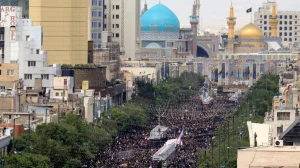
Large crowd as Raisi is buried

Acting President Mohammad Mokhber, who will serve until an election is held on 28 June, was present there to make preparations for the burial.


Ebrahim Raisi’s burial at the gold-domed Imam Reza Shrine – a memorial to the eighth Shia imam – which is considered the holiest in Iran, came after three days of ceremonies elsewhere.


State media described Thursday’s event as “historic”, while Mashhad’s mayor was quoted as saying that “three million mourners” had attended – a figure almost equal to the city’s entire population.


Earlier, thousands also turned out to watch his coffin being driven through the eastern city of Birjand, where Raisi had been the representative to the Assembly of Experts.

See also  Israel attacks Iran’s nuclear facilities, kills top scientists, military commanders

On Wednesday, leaders and other dignitaries from the country’s allies and neighbours attended a commemorative event in Tehran.

Also present were representatives of the so-called “Axis of Resistance”, a loose network of armed groups which receive Iranian weapons, training and funds.


They included the political leader of the Iran-backed Palestinian armed group Hamas, Ismail Haniyeh, the deputy secretary-general of Lebanon’s Hezbollah movement, Naim Qassem, the spokesman of Yemen’s Houthis, Mohammed Abdulsalam, and the head of Iraq’s paramilitary Popular Mobilisation Forces, Faleh al-Fayad.


Senior Western officials were noticeably absent from the ceremony, reflecting their countries’ strained relations with Iran.


Iran’s Supreme Leader, Ayatollah Ali Khamenei, also led prayers for those killed.
“[The president’s death] was a difficult issue for us, but the Iranian nation will turn this bitter incident into an opportunity,” he told the speaker of Lebanon’s parliament, Nabih Berri.

Raisi was close to the 85-year-old supreme leader, who is the ultimate authority in the Islamic Republic, and was widely seen as a potential successor.

Tens of thousands of people have taken part in the funeral processions in recent days, which the government and state media have portrayed as demonstrations of national unity.


“How do I find someone like him? I’m really worried about that,” Mohsen, a cleric from Qom, told AFP news agency at Wednesday’s funeral procession in Tehran. “As far as I know, we don’t have anyone of his stature.”

See also  Helicopter Crash: Iranians pay last respects to President Raisi

Civil servant Ali Mousavi-Nejad, said the presence of so many people “sends a message to the enemies of the revolution”.


However, many more people have stayed at home, with some even celebrating the president’s death despite prosecutors warning that they could face prosecution.


Millions despised Raisi for overseeing the deadly crackdown on the “Woman, Life, Freedom” protests that erupted in 2022, a year after he took office.


He also faced calls for an international investigation into his alleged role on the “death committee” which ordered the mass executions of political prisoners in the 1980s.


His time as president will also be remembered for a deepening economic hardship and an unprecedented direct military confrontation with Israel last month, which raised fears of a regional war.


A female student, who took part in the protests two years ago, told the BBC: “People are so happy. Most of them are wearing white or bright colours and smiling at each other.”


“The image they keep showing to the world [is] that we’re all sad, that we loved him. But it isn’t true.”


She added: “Today, when I attended my classes, there was a big banner of his face in the university’s main hallway. And the students would show the middle finger to his picture.”

See also  53 killed, 63 injured as Israeli strike hits girls’ school in Iran


The student also said the streets of Tehran were “full of security patrols” to deter protests or celebrations.


Hadi Ghaemi, the director of the US-based Center for Human Rights in Iran (CHRI) advocacy group, said Raisi’s death should not be exploited to further crack down on civil society.


“Raisi was a pillar of a system that jails, tortures, and kills people for daring to criticize state policies,” he said. “His death has enabled him to escape being held accountable for his many crimes and the state’s atrocities committed under his rule.”

Iranian authorities say they are still investigating what caused the helicopter crash in which he died.


Officials have said the aircraft – a decades-old, US-made Bell 212 – hit a mountainside as it flew to the north-western city of Tabriz in fog and heavy rain.


Raisi was travelling with Amir-Abdollahian, the governor of East Azerbaijan province, Malek Rahmati, and Tabriz’s Friday prayer leader, Ayatollah Mohammad Ali Al-e Hashem, as well as the head of the presidential security team and the helicopter’s three crew following the inauguration of two dams on the border with Azerbaijan.

News

EFCC says it froze Osun account over ‘fraudulent handling’ of N11bn ecological, intervention funds

Published

on

By

The Economic and Financial Crimes Commission (EFCC) has explained that it froze the bank account of the Osun state government over alleged fraudulent handling of N11 billion ecological and intervention funds.

The anti-graft agency, in a statement on Wednesday, said it has been investigating the Osun state government since March regarding the alleged mishandling of the funds.

According to the agency, some officials of the state government, including the accountant-general of the state, had been interviewed by EFCC investigators.

The agency said amid the probe, it observed that huge transfers of funds were being made from the account into different corporate entities since August 2.

“These ongoing investigations of the state government would not have warranted any placement of Post No Debit order on its account but for the precipitate and unwarranted movement of funds from the accounts to different suspicious accounts since August 2, 2026,” the statement reads.

See also  Helicopter Crash: Iranians pay last respects to President Raisi

“The Commission noticed huge transfers of funds into different corporate entities and had to swiftly halt the trend by freezing the accounts from which such heavy funds are being moved.

“The EFCC’s preventive mandate is a public-inclined framework of safeguarding public funds, assets and resources.

“The Commission cannot watch idly while a state government’s account is being pillaged.”

The anti-graft agency said it is aware of the forthcoming Osun governorship election, adding that it is “uncharitable” to overlook the huge transfers of funds over the “excuse of an upcoming election”.

“The Osun State government account was frozen to save public funds from being looted,” the agency said.

In a letter dated August 5, 2026, and signed by Adenike Babalola, assistant commander of the EFCC on behalf of the director of investigation, the anti-graft agency directed First Bank not to allow withdrawals from the Osun state government’s statutory allocation account as part of an ongoing investigation.

See also  Good morning! Nigerian Newspapers Headlines This Wednesday morning: Many insurgents killed as troops repel attack on military base

The agency instructed the bank to place a post-no-debit restriction on the account pending the conclusion of the probe.

Reacting to the development, Ademola Adeleke, Osun governor, said the state government will not accept a situation in which federal government agencies trample upon the rights of subnational governments.

Adeleke said the Osun government has been witnessing numerous sponsored attacks, including the harassment of Accord party members and the move to stall the operations of LGAs in the state.

Adeleke said he has directed the attorney-general of the state to challenge the “illegality”.

Continue Reading

News

Osun threatens lawsuit as EFCC freezes govt account 10 days to election

Published

on

By

Less than 24 hours after Governor Ademola Adeleke alleged that the Economic and Financial Crimes Commission (EFCC) was planning to freeze the state government account domiciled with First Bank, the anti-graft agency has reportedly freezed the account, according to Vanguard.

The account, reportedly used for the payment of workers’ salaries, was placed on “Post No Debit” status by the anti-graft agency.

The development came hours after Governor Ademola Adeleke raised the alarm that the EFCC was planning to freeze the state government’s accounts and those of top government officials ahead of the August 15 governorship election.

In a statement issued earlier on Wednesday by the Commissioner for Information and Public Enlightenment, Kolapo Alimi, Adeleke described the alleged move as an attempt to cripple government activities before the poll.

The governor had insisted that there was no legal basis for freezing the accounts of a state government, arguing that the EFCC lacked the statutory powers to take such action.

See also  Iran’s supreme leader Ayatollahmay have been killed, says Netanyahu

However, a source reportedly told Vanguard that the account had already been restricted.

“I can confirm that the state government account has been frozen by the EFCC. It is no longer an allegation. The governor will address the press shortly to update the public on the situation,” the source reportedly told Vanguard.

The reason for the restriction was not immediately known as of the time of filing this report.

The EFCC had yet to issue an official statement on the development.

The development comes as Osun prepares for its August 15 governorship election, with the account restriction expected to generate political reactions ahead of the poll.

Meanwhile, the state’s Attorney General and Commissioner for Justice, Oluwole Jimi-Bada, had said he has the mandate of the governor to sue the Economic and Financial Crimes Commission for freezing the government accounts.

Jimi-Bada said a ‘Post no debit’ letter from the EFCC was forwarded to the management of the First Bank where Osun government accounts were domiciled on Wednesday.

See also  Good morning! Nigerian Newspapers  Headlines: Trump: US-Iran deal will be signed Sunday, Strait of Hormuz to reopen immediately

The commissioner, who expressed readiness to proceed to court, said the move by the anti-graft agency may hamper government’s business, noted that Governor Ademola Adeleke was not using state funds to run its campaign for reelection.

“I have the mandate of the governor to proceed to the Federal High Court to challenge this move. EFCC can investigate the accounts but it can’t freeze the accounts without order of court.

Continue Reading

News

WAEC releases 2026 WASSCE results, withholds 167,486 candidate’s results over malpractice 

Published

on

By

The West African Examinations Council says it is withholding the results of 167,486 candidates, representing 8.59 per cent of those who sat the 2026 Computer-Based West African Senior School Certificate Examination for School candidates, over alleged examination malpractice.

This was disclosed by the Head of WAEC Nigeria National Office, Dr Amos Dangut, who announced the release of the results in Lagos on Wednesday.

The number of withheld reults, however, represents a decline from the 9.7 per cent recorded in 2025.

Dangut said the council withheld the affected results due to various infractions, including the increasing use of mobile phones in examination halls despite the existing ban and organised cheating in some schools.

“The increasing use of cell phones in the examination hall, in spite of the existing ban, and organised cheating in some schools, are other nagging issues,” Dangut said.

He added that some supervisors and invigilators found assisting candidates in malpractice had been arrested and would face disciplinary action through the relevant state ministries of education.

See also  Israel killed nine Iranian nuclear experts, military says

A total of 1,959,668 candidates from 24,207 schools registered for the examination across Nigeria, Benin Republic, Côte d’Ivoire and Equatorial Guinea, while 1,950,726 candidates eventually sat for the examination.

1,200,514 candidates (61.54 per cent) obtained credits and above in at least five subjects, including English Language and Mathematics.

1,687,378 candidates (86.50 per cent) secured credits and above in a minimum of five subjects, with or without English Language and Mathematics.

The number of candidates who obtained credits in five subjects including English and Mathematics dropped by 1.42 percentage points compared with the 2025 examination.

Of the 1.2 million candidates who achieved credits in English and Mathematics:

558,883 (28.65 per cent) were male.

641,631 (32.89 per cent) were female.

Overall, 997,267 females (51.12 per cent) and 953,459 males (48.88 per cent) participated in the examination.

WAEC said 1,834,695 candidates, representing 94.05 per cent, had their results fully processed and released, while the results of 116,031 candidates (5.95 per cent) were still being processed.

See also  BREAKING: Iran launches missile attacks on Israel

The council also disclosed that 1,213 candidates with special needs participated in the examination. They included:

137 visually impaired candidates;

491 candidates with hearing impairment;

55 spastic and mentally challenged candidates; and

41 physically challenged candidates.

The 2026 examination marked the second edition of the Computer-Based WASSCE for School Candidates, following the introduction of the format by WAEC.

Dangut said the council introduced several innovations, including the Digital Examiner Mark System to improve the speed of processing results, serialisation of question papers to curb malpractice, and a new portal that allows candidates to generate e-PINs directly for checking their results.

The examination was conducted between April 24 and June 19, 2026, with 102,708 examiners involved in marking across 88 marking venues.

Dangut, who described the briefing as his third and final engagement as WAEC Nigeria National Office head, said candidates sponsored by states indebted to the council would not have their results released until the outstanding payments were cleared.

See also  Good morning! Newspaper Headlines Today: Ibas meets Tinubu, EFCC chair in Aso Rock

Continue Reading

Trending News