Connect with us

Lifestyle

Nigerians suffer unbearable cost of living as inflation reaches record high

Published

on


Nigeria’s cost of living crisis is heaping misery on the citizens with inflation soaring amidst failing efforts by the monetary and fiscal authorities to stabilise the national currency’s exchange value and to review workers’ wages.


Rising prices have taken many essential items, including food and housing, beyond the reach of millions of citizens across the country, as highlighted by market survey.


Record Inflation
In April, Nigeria’s inflation rate surged to 33.69 per cent, according to the National Bureau of Statistics (NBS) marking the 11th consecutive increase on President Bola Tinubu’s watch. The 0.49 per cent increase over the figure recorded in March is the highest since 1999 and the fourth-highest since Q1 1996.


Year-on-year, the rate jumped by 11.47 per cent compared to April 2023, while month-on-month, April 2024 saw a 2.29 per cent increase, slightly lower than March’s 3.02 per cent.


The surge was driven by rising prices of food, non-alcoholic beverages, housing, utilities, clothing, and transportation.


Food inflation in March hit 40.53 per cent, with Kogi, Kwara, and Ondo experiencing the highest rates, and Nasarawa, Adamawa, and Bauchi seeing slower increases.


Urban inflation reached 36.00 per cent, while rural inflation stood at 31.64 per cent in April.


Food prices in Minna
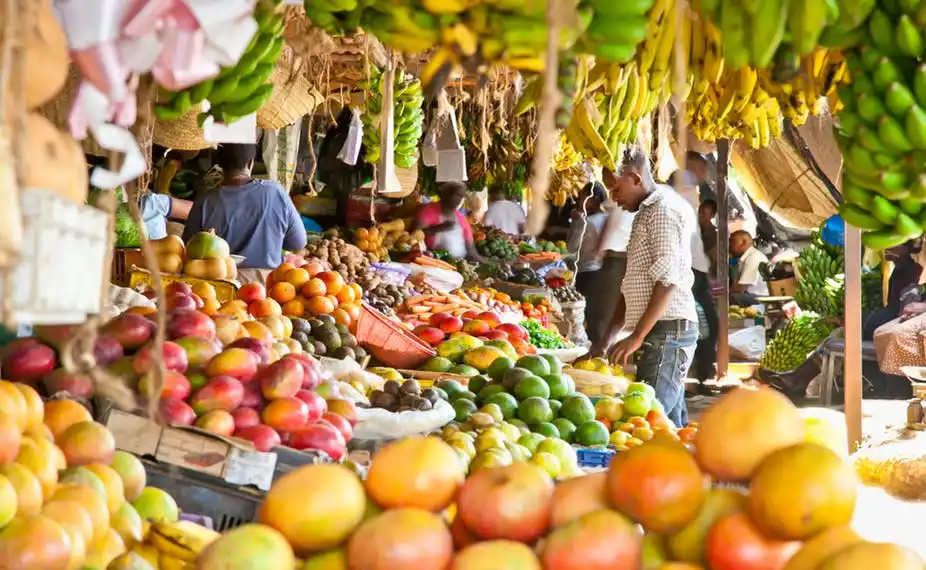
A market survey in Minna, Niger State indicated a continuing nearly daily rise in food prices.


A “mudu” (bowl measure) of rice, which cost N1,200 last month, was selling at N1,900 when our reporter visited the central market in the state capital on Monday. Similarly, the same quantity of beans sold for N1,700, with traders noting that the price was N800 last month.

See also  Three UK-based Nigerians extradited to US over $5 million Internet fraud


Millet has also experienced a substantial hike in price, from N350 to N900-N950 per mudu and N48,000 per bag over the month.

The prices of palm oil, groundnut oil, garri, maize and sugar have all seen significant increases within the period, underscoring the economic challenges facing the residents of Minna.


Residents decry rising prices
Halima Abubakar, a classroom teacher in Minna, said her salary no longer covers her basic needs.


“A teacher’s salary is so small that it doesn’t cover one’s needs,” she lamented. She said she has been affected most by the rising food prices.


“Sometimes the prices of food items change twice in a day,” she lamented.

Leonard Ogwezi, a building materials dealer in the city, said rising prices had left him unable to replenish his stock.


“Inconsistency in prices causes losses in business,” he said. “I normally buy three bags of nails, but now it’s two.”


A civil servant in the state, Abubakar Kuta, said his living standards have fallen. “We buy 10 measures of rice for N7,000 or less, but now the same quantity costs as much as N23,000.”


Mr Kuta said he used to visit his hometown every weekend but has now reduced his visits to twice a month “due to high transportation costs.”


Nigerian workers struggling
Workers across Nigeria are angry that wages have remained static despite the hyper-inflationary trend, with the government and labour yet to agree on a new national minimum wage.

See also  Nigeria introduces 7.5% VAT on crypto transactions


Evans Emmanuel, a Facebook user, expressed his exasperation on the situation, saying: “I read yesterday that inflation in Nigeria is at a massive 33.69%, and the Federal government is offering 48,000 Naira per month minimum wage to their workers.


“I had thought the first people you should be concerned with should be your own workers. Other institutions in the private sector had at that time reviewed upward their staff remuneration except the very government that caused the hardship through that off-hand policy.”


Other Nigerians are also groaning. “As a student, the price changes have hit hard,” Eniola Brown, a student at the University of Ilorin, Kwara State, lamented. “What used to cost N150 now demands N300, doubling my daily expenses, including transport and other things.”


Miss Brown, who is also an entrepreneur, said inflation has affected her sales. “Low sales plague my business,” she said in a Facebook post. “Customers demand refunds due to sudden price hikes caused by currency fluctuations.”


She said the economic squeeze has forced her to reassess her lifestyle. “Luxuries are a thing of the past, I’m cautious with spending, prioritising essentials over indulgences.”


Food crisis threatens millions across Africa
Recent findings by the Cadre Harmonisé (CH) report, a collaborative effort involving the International Rescue Committee (IRC) and other international organisations, depict a grim scenario for millions across West and Central Africa.


Noting that 52 million people face the risk of food insecurity during the upcoming lean season from June to August, the report called for urgent action to avert catastrophic consequences.

See also  Indian police bust ‘notorious’ international drug cartel, nab 2 Nigerians, Ivorian


A particular concern cited by the report on Nigeria is where it said 31.8 million people, constituting 16 per cent of the analysed population, are at the risk of hunger and malnutrition.


The situation is further exacerbated in the northern states of Sokoto and Zamfara, where over 15 per cent of children endure acute malnutrition.


This looming crisis stems from a confluence of factors including insecurity, climate change and deteriorating macroeconomic conditions.


Inflation rates, which soared to 21 per cent across the region in January 2024, have also compounded the challenges, pushing essential goods beyond the reach of many.


Expert calls for economic diversification
Samuel Nzekwe, a former president of the Association of National Accountants of Nigeria (ANAN) said Nigeria needs to “diversify the economy and cultivate an environment conducive to the growth of crucial sectors.”


Mr Nzekwe, who spoke at a gathering of accountants in Ota, Ogun State, earlier this year, said it is a practical means of combatting the inflationary trend.


“Reducing our reliance on oil and broadening the scope of our economy would enable the productive sector to thrive, thereby curbing inflation and alleviating pressure on our currency.”


“With sufficient security measures in place, food production could increase, potentially leading to exports and earning foreign exchange, consequently significantly reducing the nation’s inflation rate.


“To slow the upward trajectory of inflation and stabilise the Naira, the nation must focus on cultivating other areas where it possesses a competitive advantage.”

Lifestyle

Popular lewd lyrics musician St. Janet is dead

Published

on

By

The Nigerian entertainment industry was thrown into another round of  mourning on Sunday morning following the News of the death of popular lewd lyrics music act and Highlife musician, Iyun Janet Ajilore, better known as St. Janet.

According to publisher and socialite, Otunba Femi Davies, who announced her death in a post shared on his Facebook page, the St. Janet died on Saturday after a brief illness.

Davies wrote, “St Janet (Iyun Janet Ajilore), a popular Nigerian Juju and Highlife musician known for her vibrant live performances, energetic stage presence and socially unfiltered party tracks, is dead. She died after a brief illness on Saturday.”

St. Janet was widely celebrated for her energetic performances and unique style, which earned her a loyal fan base within Nigeria’s Juju music community and beyond.

Throughout her career, she became a familiar figure at social events and celebrations, captivating audiences with her lively stagecraft and party-themed songs that resonated with many music lovers.

See also  THE BLACK SHEEP: 33 Nigerians on trial in Texas for romance scams

Her contributions to the Juju and Highlife genres helped cement her place among notable entertainers in the industry.

Since news of her death emerged, tributes have continued to pour in from fans, colleagues and admirers, many of whom have described her as a talented entertainer whose music brought joy to countless people and occasions.

Continue Reading

Lifestyle

Osogbo stands still as cultural icon Ifáyẹmi Ọ̀ṣúndàgbonù Elebuibon marks 79th birthday in grand style

Published

on

By

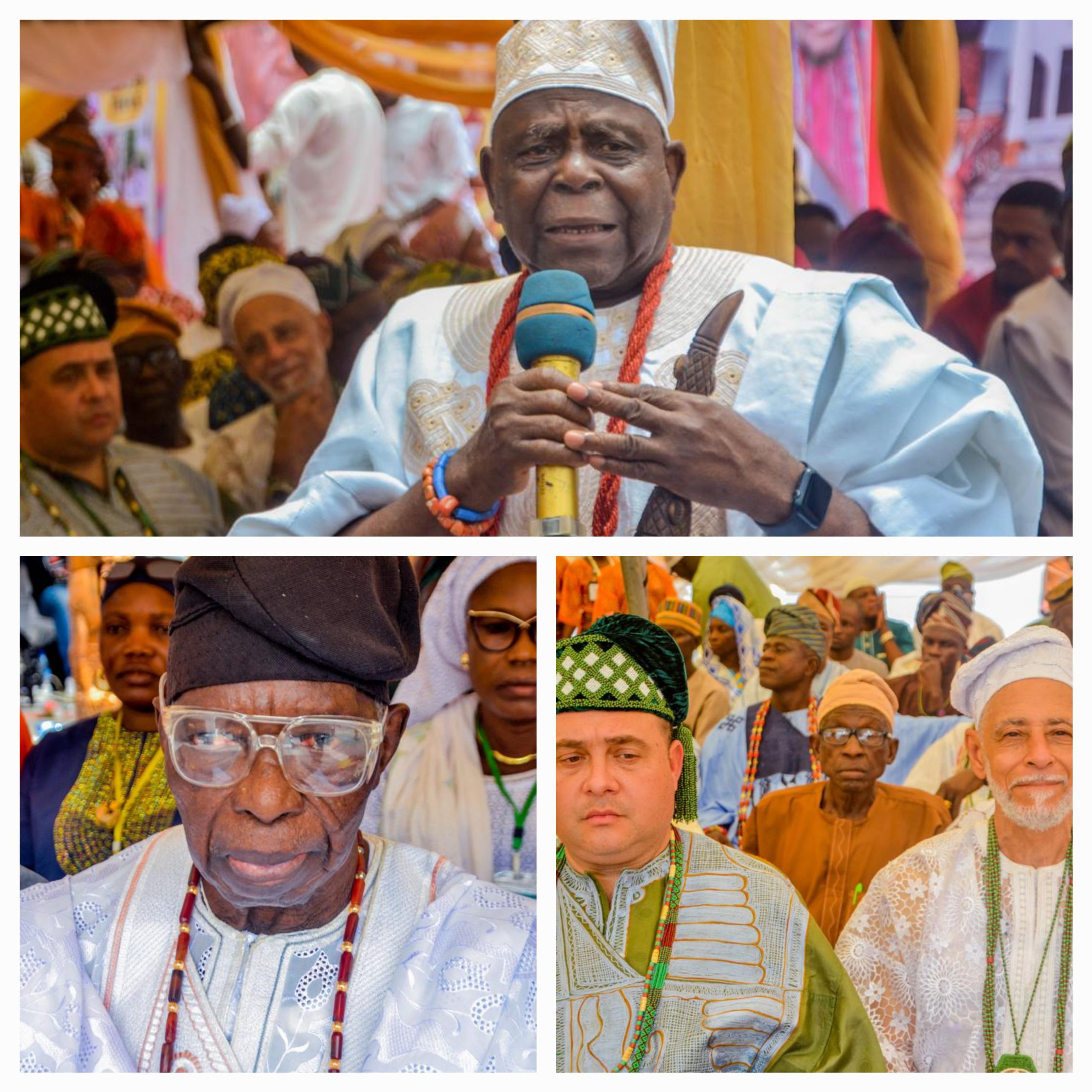
The ancient city of Osogbo came alive on July 25 as renowned Ifa priest, scholar, and cultural custodian, Ifáyẹmi Ọ̀ṣúndàgbonù Elebuibon, marked his 79th birthday with a remarkable three-in-one celebration that drew dignitaries, traditional rulers, entertainers, and admirers from across the globe.

The event featured a grand birthday celebration, the dedication of The Ancient Philosophy International Event Centre and Ogbe Yonu Temple, alongside a housewarming ceremony and awards presentation in honour of the revered Araba Awo of Osogboland and Olú Ìṣẹ̀ṣe.

The event witnessed a strong presence of traditional rulers, including the Ataoja of Osogbo, Timi of Ede, Olufon of Orolu, and Alayemore of Ido Osun, alongside several other Obas who graced the occasion in honour of the Ifa icon.

The entertainment industry was also well represented, with veteran actor Chife Lere Paimo (Eda Onile Ola) leading the list. Others included Oyinda Duroladipo, members of the Association of Nigerian Theatre Arts Practitioners (Osun State chapter), filmmaker Amb. Kunle Afod, actress Toyin Adegbola, Oyin Adegbenro, and Olaniyan Tosin, among many others.

See also  Good morning! Here Are Some Major News Headlines In The Newspapers Today: Nigerians troop out to elect a new president today

The celebration also attracted notable socialites and cultural figures, including Chife Mrs Nike Okundaye (Nike Art Gallery), Chife Akintunde Ayeni (Yemkem), Olalekan Fabilola Masoyinbo, Tayo Bello (Wasere), Shina Ayomi Daniel (Oju Abuja), Tunde Daudu, Singapore, and several other prominent personalities who added colour and prestige to the occasion.

The political class was not left out, with the All Progressives Congress (APC) gubernatorial candidate, Bola Oyebamiji, in attendance. He was joined by Ibrahim Taofeek Kayode and other stakeholders who came to celebrate the global cultural icon.

Ifáyẹmi Ọ̀ṣúndàgbonù Elebuibon remains a towering figure in the preservation of Yoruba heritage. A writer, poet, linguist, and globally respected Ifa priest, his contributions to cultural scholarship and spiritual practice continue to resonate across continents.

With the unveiling of new cultural institutions and the overwhelming turnout of dignitaries, the 79th birthday celebration stands as a powerful testament to his enduring legacy and influence.

Continue Reading

Lifestyle

Jubril Adewale Tinubu @59: Rich in Fortune, Richer in Humanity

Published

on

By

Adebayo Adeoye

There are men who announce their greatness with noise, and then there are those whose achievements speak so thunderously that fanfare becomes unnecessary. Jubril Adewale Tinubu — “Wale” to friends, family, and the many who hold him in deep admiration — belongs firmly in the latter category.

As he marks another year of a life lived with uncommon purpose and quiet distinction, it is only fitting that the world pauses, if only for a moment, to celebrate a man whose footprints are etched permanently on the landscape of Nigeria’s economic history.

Wale Tinubu’s journey reads like the kind of story that inspires a generation. Armed with a Bachelor of Laws degree from the University of Liverpool and a Master of Laws from the prestigious London School of Economics, where he specialised in International Finance and Shipping, he returned to Nigeria not merely to practise law, but to build an empire.

He began his career at the family law firm, K. O. Tinubu & Co., sharpening his instincts in corporate and petroleum law — skills that would later serve as the bedrock of something far bigger than anyone could have imagined.

See also  Major News Headlines In The Papers Today: Senate to debate CBN money withdrawal limit policy Tuesday

In 1994, with vision as his compass and tenacity as his fuel, he founded Ocean and Oil Group — a modest oil trading and shipping outfit that he would, over the next three decades, transform into Oando PLC, Sub-Saharan Africa’s foremost integrated indigenous energy group. It is the kind of achievement that defies easy description.

Forbes Magazine captured it best in its 2011 edition, crowning him “The King of African Oil” — a title that, even years later, sits comfortably on his broad shoulders. In 2007, the World Economic Forum in Geneva named him a Global Young Leader, placing him in the exclusive company of the world’s most consequential minds under the age of 41.

Yet, what truly separates him from the ordinary captains of industry is the humanity he brings to his enterprise. His leadership of Oando has never been merely about barrels of oil or bottom lines. It has been about people — about building local capacity, championing indigenous talent, and proving, with every quarterly result and every community touched, that African businesses can compete and win on the global stage.

See also  Wanted bandit kingpin Bello Turji hasn’t surrendered, says DHQ

For the young Nigerian entrepreneur staring at a blank page and a bold dream, Wale Tinubu is living proof that it is possible.

Beyond the boardroom, his philanthropic instincts have left an indelible mark. Through the Oando Foundation, he has positively impacted over 500,000 Nigerian children through school adoption programmes, digital learning initiatives, and teacher training — a legacy that no balance sheet can fully capture.

In a world where success often breeds aloofness and privilege can create distance, Tinubu remains refreshingly accessible and profoundly humane. His interactions with people are marked by warmth, sincerity and a genuine interest in the welfare of others.

Whether dealing with friends, associates or even casual acquaintances, he has consistently demonstrated that true greatness lies not in the accumulation of material possessions but in the ability to uplift and inspire those around us.

Many who know him count themselves fortunate to have encountered him. Indeed, there is a recurring sentiment among those within his circle that destiny smiled kindly on them the day their paths crossed with his.

See also  Hardship: Nigerians suffering consequences of Buhari’s policies, says Oshiomhole

Such is the effect of a man whose benevolence transcends social and professional boundaries.

At 59, JAT as fondly called stands as a compelling reminder that a life of impact is measured not solely by personal accomplishments but also by the positive difference one makes in the lives of others. His journey thus far reflects purpose, compassion and an abiding commitment to humanity.

On this occasion of his birthday, the tributes are many and deserved. He is being celebrated as “one of the significant contributors to Africa’s economic growth and development.” But perhaps the greatest tribute comes not from statesmen or magazine covers, but from the young entrepreneurs across the continent who look at Tinubu and dare to dream bigger.

Continue Reading

Trending News