The Supreme Court will on Thursday, settle the legal dispute that has been trailing the presidential election that was held in the country on February 25.
Though five petitions were initially entered against the declaration of President Bola Tinubu of the ruling All Progressives Congress, APC, as the winner of the presidential contest that involved 17 candidates, however, only three of the petitions made it to the apex court.
Whereas two of the petitions were withdrawn before they could even be heard by the Presidential Election Petition Court, PEPC, that held its proceedings at the Abuja Division of the Court of Appeal, of the three petitions that were entered at the Supreme Court, only two of them made it to the last lap of the litigation.
A seven-man panel of the apex court had last Monday, dismissed the case the Allied Peoples Movement, APM, instituted to nullify President Tinubu’s election victory, after the party reluctantly withdrew its appeal which the panel insisted was academic and of no useful legal purpose.
Consequently, the surviving appeals were the ones filed by a former Vice President and candidate of the Peoples Democratic Party, Alhaji Atiku Abubakar, as well as his counterpart in the Labour Party, LP, Mr. Peter Obi.
The apex court reserved the to appeals for judgement after all the parties adopted their final briefs of argument past Monday.
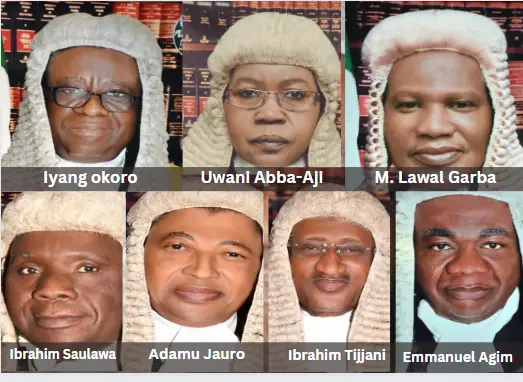
Meanwhile, Vanguard, in his report, examines the profile of the seven Justices of the Supreme Court that will determine the fate of Tinubu, Atiku and Obi, tomorrow.
Justice John Inyang Okoro
Justice Okoro is the head of the panel that will decide the petitions seeking to remove President Tinubu from office.
He was born on July 11, 1959 in Nung Ukim, Ikono Local Government Area of Akwa Ibom State.
He attended Methodist School, Nung Ukim from 1965-1972, Boys High School, Oron from 1973-1977, School of Arts &Science, Uyo 1979-1981 and the University of Lagos from 1981-1984.
He attended the Nigerian Law School, Lagos and was called to the Nigerian Bar in 1985.
Justice Okoro started his legal career as Magistrate Grade 11 in 1986 and rose through the Magisterial Cadre culminating in his promotion to the post of Chief Magistrate Grade 1 in 1996.
He was then appointed a Judge of the High Court of Akwa Ibom State from 1998-2006. His Lordship was elevated to the Court of Appeal in 2006 and served in that capacity up to 2013.
He has over the years served in different capacities and bodies, including; Member, Election Petition Tribunal, Kano, 1998, Member, Governorship and Legislative Houses Election Petition Tribunal, Ondo State, 2003, Member, Governorship and Legislative Houses Election Petition Tribunal No.2 Delta State, 2003.
He has also attended several seminars, workshops and conferences both locally and internationally.
Justice Okoro was elevated to the Supreme Court on November 15, 2013.
He is currently the fourth most senior justice of the court.
Justice Uwani Musa Abba-Aji
Justice Abba Aji is the most ranking female jurist on the apex court bench and the only female of the panel.
She was born on November 7, 1956, in Gashua, Yobe State. She attended Central Primary School Gashua and Government Girls Secondary School Maiduguri for her Primary and Secondary Education between 1961 and 1972.
She obtained a Diploma in Law from Ahmadu Bello University Zaria in 1976 and subsequently, an L.L.B Hons from the same institution in 1980. She was called to Bar in 1981 and commenced her career as State Counsel in 1982.
Justice Abba-Aji previously held positions of Clerical Assistant (Area Courts Division), Assistant Registrar, Acting Registrar and Higher Registrar between 1973 and 1982. After her appointment as State Counsel in 1982, she rose through various positions becoming an Acting Senior State Counsel in 1984, Senior Magistrate II in 1986, Senior Magistrate I in 1987, Chief Magistrate II in 1989, Chief Magistrate I in 1991 and Chief Registrar in November 1991.
She was appointed Higher Court Judge of Yobe State Judiciary in December 1991 making her the first Lady Judge at Yobe State Judiciary, a position she held until July 2004 when she was elevated to the Court of Appeal.
Before her elevation to the Supreme Court on January 8, 2019, Justice Abba-Aji was the Presiding Justice, Court of Appeal Kaduna Division, a position she held for 4 years.
Justice Mohammed Lawal Garba
Justice Mohammed Lawal Garba was born on November 16, 1958. He hails from Gusau Local Government Area of Zamfara State.
He attended Demonstration Primary School, Maru from 1965-1971, Government Secondary School, Gusau from 1972 -1976, School of Basic Studies Ahmadu Bello University, Zaria from 1976-1977, Faculty of Law, A.B.U, Zaria from 1977-1980, Nigerian Law School, Lagos, from 1980-1981 and the Nigerian Institute of Advanced Legal Studies (UNILAG) Akoka, Lagos in 1989.
He was called to the Nigerian Bar in 1981.
He served as Magistrate in the Sokoto State Judiciary from 1982-1986, Deputy Chief Registrar High Court of Justice, Sokoto State from 1989-1991, appointed Solicitor-General/Director-General Ministry of Justice Sokoto State from 1991-1993.
He was then appointed a Judge of the High Court of Justice, Sokoto State from 1993-1996. He served as Chief Judge, High Court of Justice, Zamfara State from 1996-2004.
In 2004, Justice Garba was elevated to the Court of Appeal and served at various times as the Presiding Justice at Abuja, Calabar, Port Harcourt and Lagos Divisions of the Court from 2010-2020.
He has over the years, served on different capacities and bodies, including as; Member Body of Benchers from 1996-2004, Member, Board of Governors of the National Judicial Institute (NJI), Abuja 1996-2004, Member, Legal Practitioners’ Privileges Committee (LPPC) 1997-1999, Member Body of Benchers 2010 to date, Life Bencher 2018 to date.
Remarkably, he served as a member of the Presidential Election Panel in 2011 and also as Chairman of the Presidential Election Panel that dismissed the petition that Atiku filed to challenge the election of former President Muhammadu Buhari, in 2019.
He was elevated to the Supreme Court on November 6, 2020.
Justice Ibrahim Saulawa
Justice Saulawa was born on September 29, 1956 in the ancient city of Katsina. Katina State. He attended both Primary and Secondary Schools in Katsina from 1965 to 1976 after which he proceeded to the Bayero University Kano in September 1977 and graduated in June 1981 with a Bachelor of Law degree.
The same year, he proceeded to the Nigerian Law School Lagos and was eventually called to the Nigerian Bar on July 2, 1982.
He began his career with the Ministry of Justice, Kaduna State in August 1982 as a Pupil State Counsel (NYSC: (ii) Secretary, Law Officers (Attorneys – General) Committee of the then 10 Northern States; (iii) a Visiting Lecturer, College of Legal and Extra-Mural Studies, Katsina Polytechnic, Katsina 1982-83
He a short private practice, he was made a Magistrate Grade 2 in the Kaduna State Judiciary on September 1, 1983
He served as Chief Magistrate, Katsina State Judiciary, 1987 – 1991; Deputy Chief Registrar/ Chief Registrar, Court of Appeal Lagos 1991 – 1994, High Court Judge, Katsina State Judiciary 1994 – 2006.
Justice Saulawa was elevated to the Bench of the Court of Appeal on June 10. 2006.
He subsequently served as Presiding Justice: Calaber Judicial Division October, 2015 – August. 2018;
Ilorin Judicial Division – September, 2018 – January, 2020 and Port Harcourt Judicial Division – January, 2020 – November 9, 2020.
Justice Saulawa was elevated to the Bench of the Supreme Court on November 10, 2020.
Justice Adamu Jauro
Justice Adamu Jauro was born on June 26, 1959. He hails from Gombe State. He attended Central Primary School, Gombe, Government Secondary School, Bauchi and the School of Basic Science, Zaria.
In 1980, he studied Law at the Ahmadu Bello University, Zaria where he bagged his LLB.
Justice Jauro holds a master’s degree in Law from the University of Jos and also has a certificate from the Institute of Advanced Legal Studies.
After he was called to Bar, Jauro worked with the Ministry of Justice in 1983 and was promoted as Director of Public Prosecution.
He served in various capacities before being appointed as a judge of the Gombe State Judiciary where he served till 2007.
In 2007, he was promoted to the Court of Appeal and served in Jos, Lagos, Yola, Ibadan and Port Harcourt.
Justice Jauro was elevated to the Supreme Court bench in November 2020.
Justice Tijjani Abubakar
Justice Tijjani Abubakar, who is a native of Base Local Government Area of Yobe State, was born on April 15, 1960.
He attended Gashua Central Primary School and Government Secondary School, Gashua.
He later attended the School of Basic Science, University of Maiduguri as well as the University of Maiduguri where he studied Law and graduated in 1982.
After graduating from the Nigerian Law School, Justice Abubakar was called to the Bar in 1983.
He had worked as Attorney General, Permanent Secretary and Commissioner for Justice of Yobe State at various times.
He subsequently went into private practice and set up his own law firm, known as Tijani Abubakar and Co. in 2004.
Abubakar returned to public practice with his appointment as a judge of the Federal High Court.
In 2012, he was appointed as Justice of the Court of Appeal.
He was serving at the Lagos Division of the appellate the court when he was elevated to the Supreme Court bench in 2020.
Justice Emmanuel Agim
Justice Emmanuel Agim was born on April 26, 1960, in Obudu, Cross Rivers State.
He obtained his first degree, LLB, at University of Calabar, then BL from the Nigerian Law School, Lagos, and subsequently, LLM, from the University of Wolverhampton, United Kingdom.
After serving as President of the Court of Appeal of The Gambia, and three years as Chief Justice of The Gambia, Justice Agim was later sworn in as a Justice of the Supreme Court of Swaziland on May 2, 2012 where he served in the first all-black bench in the history of Swaziland and her sister countries- Botswana and Lesotho.
On November 5, 2012, he was sworn in as a Justice of the Court of Appeal of Nigeria by the first female Chief Justice of Nigeria, Justice Aloma Mariam Mukhtar.
In October 2019, he was elevated to the Supreme Court of Nigeria.
It be recalled that both Justice Agim and Justice Jauro, were the two members of the apex court bench that gave dissenting judgements that would have dashed hopes of the immediate past Senate President, Ahmed Lawan to contest the 2023 general election.
The duo, contrary to the position of the head of the panel, late Justice Centus Nweze and two other members of the panel, maintained that Lawan was not qualified to contest the Yobe North Senatorial election.
The gave their judgement in favour of Bashir Machina, stressing that Lawan was not the validly nominated candidate of the APC for the senatorial contest.
Notwithstanding the dissenting judgements of Justices Agim and Jauro, Lawan still survived the sledgehammer as the majority decision of three other members of the panel, favoured him.











 News4 years ago
 Privacy5 years ago
 News5 years ago

 News5 years ago
 Opinion5 years ago
 News5 years ago
 Sports5 years ago