
News
Controversy trails appointment of Olukoyede as EFCC chair

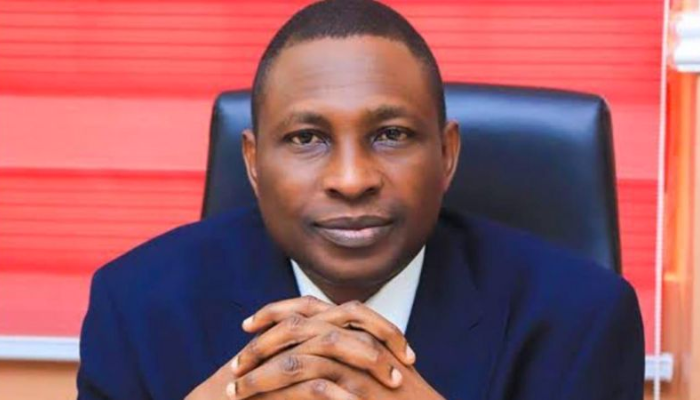
Controversies have trailed President Bola Tinubu’s appointment of Olanipekun Olukoyede as Chairman of the Economic and Financial Crimes Commission (EFCC).
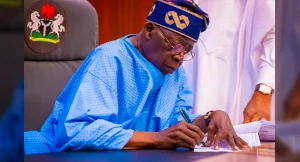
The president tapped Olukoyede to serve as the EFCC substantive chairman for a renewable term of four years in the first instance, pending Senate confirmation.
The appointment follows the resignation of the suspended chairman, Abdulrasheed Bawa, who was later replaced by Abdulkarim Chukkol, a one-time Director of Operation in the agency in June, this year.
Olukoyede is a lawyer with over 22 years of experience as a regulatory compliance consultant and specialist in fraud management and corporate intelligence. He has extensive experience in the operations of EFCC, having previously served as Chief of Staff to the Chairman (2016-2018) and Secretary to the Commission (2018-2023).
President Tinubu further approved the appointment of Muhammad Hassan Hammajoda to serve as Secretary of the Commission for a renewable term of five years in the first instance, pending Senate confirmation.
The President tasked the new EFCC leadership to justify the confidence reposed in them for the important national assignment to drive a newly invigorated war on corruption to be undertaken through a reformed institutional architecture in the anti-corruption sector as a central pillar of the President’s Renewed Hope agenda.
A statement by the Special Adviser on Media and Publicity, Ajuri Ngelale, explained that the development is in compliance with the powers vested in President Tinubu as established in section 2 (3) of the EFCC (Establishment) Act, 2004, that “the Chairman and members of the Commission, other than ex-officio members, shall be appointed by the President.”
Olukoyede was born in Ikere-Ekiti on October 14, 1969. The new anti-graft agency chair is an alumnus of Lagos State University; University of Lagos; Institute of Arbitration ICC – Paris, France and University of Harvard (Kennedy School of Executive Education). He is also an experienced lawyer, who is specialised in compliance management, corporate intelligence, and fraud management, and is a serving pastor of the Redeemed Christian Church of God (RCCG).
However, many in some quarters view his appointment as a violation of the law establishing the anti-corruption agency. Olukoyede, although a former EFCC secretary and ex-chief of staff to the chairman of the commission, did not meet the requirements of section 2(3) of the EFCC Act, to be qualified for the appointment.
The law stipulates that a chairman of the commission “must be a serving or retired member of any government security or law enforcement agency not below the rank of Assistant Commissioner of Police or equivalent; possess not less than 15 years experience.”
Olukoyede had no experience in any security or law enforcement agency until his first appointment at the EFCC in 2016, when he was appointed to serve as the Chief of Staff to then acting chairman, Ibrahim Magu. He was subsequently appointed as the secretary of the commission in 2018 and served in that capacity up till 2020, when he was suspended from office by then President Muhammadu Buhari. He was suspended alongside Magu and some other officials of the commission. He and Magu were never recalled.
Daniel Bwala, Abuja-based lawyer and member of the Peoples Democratic Party (PDP), in his reaction, described the appointment as “unlawful and illegal”, adding that “it runs foul of the provisions of Section 2 of the EFCC Act.”
Bwala said the Act provides that the person to be appointed as EFCC Chairman must among other things have been “a serving or retired member of any security or law enforcement agency, have 15 years cognate experience of law enforcement, and must not be below the rank of Assistant Commissioner of Police.”
He, however, noted that “Olukayode is a private legal practitioner and has never worked or belong to any security or law enforcement agency as a member, adding that his private legal practice years cannot be equated to the rank in law enforcement.
According to him, “attending seminar courses as a private legal practitioner cannot equate to 15 years cognate experience contemplated by section 2 of the Act.
He only has a stint as Chief of Staff to Magu, and later became a Secretary of the Commission, all of which lasted for less than 6 years.”
A frontline Northern group, Arewa Youth Forum (AYF) cautioned President Tinubu over his lopsided appointment in favour of the Yoruba, describing the trend as unacceptable. The group expressed its concern in a statement issued in Kaduna yesterday, by its president, Ahmed Mohammed Zagi.
He said: “We have watched with reservations the trend, which is becoming a norm of the President’s choice for replacements in federal appointments being made, with all the positions perceived to be juicy, being handed to his kinsmen.
“This is totally unacceptable in a diverse and multi- ethnic country like ours, as it may further lead to dividing the country along ethnic lines,” the statement said.
AYF pointed out Olukoyede’s appointment, a position that was hitherto held by a Northerner, Abdulrasheed Bawa. “Other examples of such one-sided appointment includes that of replacing the Federal Inland Revenue Service (FIRS) boss, Mohammed Nami, also a Northerner, with his kinsman, Mr Zacch Adedeji.
“Similarly, the Central Bank of Nigeria (CBN) embattled governor, Godwin Emefiele, was replaced with Yemi Cardoso, another Yoruba man. Same can be said of the Nigeria Customs Service, where Col. Hamid Ali (rtd) was replaced with Comptroller-General Bashir Adeniyi.”
The group tasked Tinubu to focus on ways to unite the country, rather than creating avenue for mutual suspicion, which such appointments could cause.
Also, Human Rights Writers Association of Nigeria (HURIWA) frowned at Olukoyede’s appointment, saying it was in clear violations of the federal character principles as enshrined in section 14(3) of the 1999 Constitution.
The group also condemned the arm-twisting tactics adopted by President Tinubu in arbitrarily detaining the EFCC chairman, Bawa, for over two months, thereby forcing him to resign to make way for the new appointment.
National coordinator of the group, Emmanuel Onwubiko, in a statement, said the recent actions taken by President Tinubu have raised serious concerns about the state of human rights and the rule of law.
According to HURIWA, it is inconceivable that Tinubu has now populated all key and juicy national offices with his Yoruba kinsmen. HURIWA lamented that President Tinubu is simply copying the nepotistic template practiced by his predecessor, Muhammadu Buhari, who for eight years populated same and much more strategic offices with his Fulani kinsmen.
Onwubiko said President Tinubu’s alleged abuse of power, particularly the detention of political prisoners and his disregard for due process, is a significant threat to the principles of democracy and justice.
He further stated that the President has used his office to target perceived political enemies, former government officials, and those who opposed him during the 2023 party primaries and campaigns.
“Another case that has raised eyebrows is the dismissal of the former CBN Governor, Emefiele, who was sacked by Tinubu in September for allegedly mismanaging the country’s foreign reserves, whereas it is politically motivated.”
But responding to the barrage of criticisms, the Presidency insisted that Olukoyede is qualified to occupy the office. Presidential spokesperson, Ajuri Ngelale, insisted on Olukoyede’s qualification for the job in a statement, following the controversy the appointment has triggered.
Since EFCC was the first law enforcement or security agency Olukorede served in, many said, he could not be said to have to have garnered the required cognate experience before then. But the presidency insisted that Olukoyede “satisfied every legal detail to be appointed as Chairman.
“He was a member of a law enforcement organisation as Secretary, in this case the EFCC, as stipulated in the EFCC Act, and as such satisfied every legal detail to be appointed as Chairman,” the presidency said in answer to those who argued that his administrative roles at the EFCC do not qualify as cognate experience required to become EFCC chair.
“Section 2(1)(p) of the EFCC Act plainly, ordinarily, and unambiguously established the Secretary to the Commission (i.e., EFCC) as its member and head of its administration. The Supreme Court determined in the case of Ejuetami v. Olaiya & Anor (2001) LPELR-1072 (SC) at Pg.23-24, that: The words used are to be given their ‘ordinary and natural sense’. Therefore the clear, explicit and unambiguous words used in sections 2(1)(a)(i)-(iii), (p), 2(2), 3(1)-(3) and 8(5) of the EFCC Act must be given their ordinary and natural sense in line with the guidelines set by the Supreme Court in its long line of undisturbed judicial precedents.
“The provision of Section 2(1) sub-paragraph (iii) of the EFCC Act did not state the nature of the experience which a person is required to possess its similar or alike for 15 years.”
This implies that such cognate experience is presumed to be that of the work or functions of the EFCC acquired anywhere since the EFCC Act did not state the specific place where it must be acquired. It is also unambiguous by the provisions of sub-paragraph (iii) that once a person possessed 15 years of such cognate (i.e., similar or alike) experience, then he has satisfied the provisions of sub-paragraph (iii) of section 2(1)(a) of the EFCC Act.
“It is clear from the unambiguous provisions of the EFCC Establishment Act, 2004, that any member of the Commission whether serving or retired who has 15 years’ cognate experience in their chosen career are eligible to be appointed as the Chairman of the Commission. Prior to this time, the convention and precedence is that to be qualified for appointment as the EFCC Chairman, the nominee must be a Police Officer or someone with law enforcement background, particularly in the area of investigation. This has not only exposed the Commission to all manner of vices but has brewed internal wrangling, discontent, and hatred among the members of staff.
“It is non-justiciable to elevate convention above statutory provision. It is time to move away from fiction to fact and from convention to strict adherence to the statutory provisions of the enabling Act of the Commission in our constitutional democracy. Olukoyede satisfied every legal requirement to be appointed as EFCC Chairman,” the statement argued.
EFCC
Also defending the appointment in an article titled ‘Setting the facts straight about Olukoyede and his eligibility for EFCC Chairmanship,’ Anthony Idoko, a Solicitor of the Supreme Court, said: “Let it be put on record that Olukoyede was not suspended because of any wrongdoing or crime he committed. Note also that he was not suspended on the recommendation of Justice Isa Ayo Salami’s Panel of Inquiry. Rather, he was among other staff of the EFCC who were suspended as administrative protocol demanded because the Panel claimed that it wanted unhindered access to documents in the offices of the affected officers. It is also very instructive to state that the Presidency lifted the suspension after he was cleared of any wrongdoing by the Panel. He was also further issued with a clearance letter to that effect.
“On his qualifications, Olukoyede is a trained lawyer, attorney and Regulatory Compliance Consultant, specialist in fraud management, compliance management and corporate intelligence, and offered more than 20 years of leadership expertise, a certified fraud examiner, led and managed as an attorney and consultant, investigation and civil litigation of fraud and financial crimes in international development projects, consultant on manpower development for law enforcement and anti-corruption agencies. He has also carried out system study review for a number of financial crime law enforcement agencies, government institutions and corporate organizations, both locally and Internationally.
“Being a former Chief of Staff to the Chairman of EFCC with fathom of experience in managing high and low level personnel to ensure high performance, his responsibilities included coordination and analysis of reports from all the directorates in EFCC, supervision of the conduct of investigations involving all suspects, politically exposed persons and other high profile cases also analysis of updates on prosecution of all cases handled by the Commission.
“Also, as the Secretary to the Commission, he had the statutory responsibilities of being the head of the secretariat of the commission in charge of developing, implementing and coordinating compliance with Strategic Policy documents for Operations, Legal and Administrative sections of EFCC. What else does he need to bring in terms of qualifications, experience and proficiency to prove he is duly qualified for the office?”







-

 News4 years ago
Insecurity: Buhari presides over National Security Council meeting (Photos)
-

 Privacy5 years ago
Self-imposed Oba vacates ‘palace’ after warnings by community
-

 News5 years ago
Nollywood Actress Nkechi Blessing speaks on plastic surgery, big butts
-
 Entertainment4 years ago
DJ Dimple Nipple dropped by longtime boyfriend after claiming D’Prince allegedly demanded sex for roles
-

 News5 years ago
Plus size rocks: Ghanaian plus size dancer who can’t travel by air because of her size
-
 Opinion5 years ago
Leave our community, Imobi orders self-imposed Oba
-

 News5 years ago
How CCTV ’caught’ Baba Ijesha molesting minor
-

 Sports4 years ago
Meet Ashleigh Plumptre, the ‘Oyinbo’ member of Nigeria Super Falcons [Video]