Connect with us

News

President Tinubu’s address at UN general assembly (Full Text)

Published

on


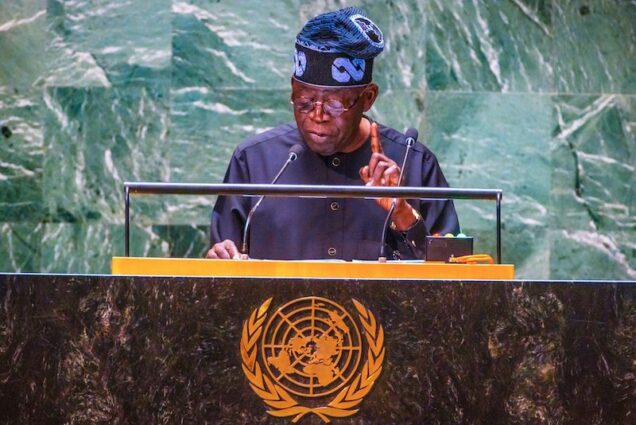
President Bola Tinubu delivered his first address at the 78th session of the United Nations General Assembly in the early hours of Wednesday (7:55 pm New York time).

His speech touched on the need for Africa to scale the limitations of foreign exploitation to reach its lofty potential while attaining the prosperity inherent in the region’s democratic ideals, the importance of the international community seeing African development as a priority for investments, and the need to tackle the effects of climate change.

See the full speech below:

STATEMENT DELIVERED BY HIS EXCELLENCY, BOLA AHMED TINUBU, GCFR PRESIDENT, FEDERAL REPUBLIC OF NIGERIA AT THE GENERAL DEBATE OF THE 78TH SESSION OF UNITED NATIONS GENERAL ASSEMBLY, 18TH SEPTEMBER 2023

Mr. President,

Heads of State and Government, Secretary-General,

Distinguished Delegates, Ladies and Gentlemen,


Mr. President,

On behalf of the people of Nigeria, I congratulate you on your well-deserved election as President of this Session of the United Nations General Assembly.

We commend your predecessor, His Excellency, Mr. Csaba Korosi for his able stewardship of the Assembly.

We also commend His Excellency, Antonio Guterres, Secretary General of the United Nations, for his work seeking to forge solutions to humanity’s common challenges.

This is my first address before the General Assembly. Permit me to say a few words on behalf of Nigeria, on behalf of Africa, regarding this year’s theme.

Many proclamations have been made, yet our troubles remain close at hand. Failures in good governance have hindered Africa. But broken promises, unfair treatment and outright exploitation from abroad have also exacted a heavy toll on our ability to progress.

Given this long history, if this year’s theme is to mean anything at all, it must mean something special and particular to Africa.

In the aftermath of the Second World War, nations gathered in an attempt to rebuild their war- torn societies. A new global system was born and this great body, the United Nations, was established as a symbol and protector of the aspirations and finest ideals of humankind.

Nations saw that it was in their own interests to help others exit the rubble and wasteland of war. Reliable and significant assistance allowed countries emaciated by war to grow into strong and productive societies.

The period was a highwater mark for trust in global institutions and the belief that humanity had learned the necessary lessons to move forward in global solidarity and harmony.

Today and for several decades, Africa has been asking for the same level of political commitment and devotion of resource that described the Marshall Plan.

See also  Release of Tinubu's academic records useless to Atiku: Tinubu's lawyer

We realize that underlying conditions and causes of the economic challenges facing today’s Africa are significantly different from those of post war Europe.

We are not asking for identical programs and actions. What we seek is an equally firm commitment to partnership. We seek enhanced international cooperation with African nations to achieve the 2030 agenda and Sustainable Development Goals.

There are five important points I want to highlight.

First, if this year’s theme is to have any impact at all, global institutions, other nations and their private sector actors must see African development as a priority, not just for Africa but in their interests as well.

Due to both longstanding internal and external factors, Nigeria’s and Africa’s economic structures have been skewed to impede development, industrial expansion, job creation, and the equitable distribution of wealth.

If Nigeria is to fulfil its duty to its people and the rest of Africa, we must create jobs and the belief in a better future for our people.

We must also lead by example.

To foster economic growth and investor confidence in Nigeria, I removed the costly and corrupt fuel subsidy while also discarding a noxious exchange rate system in my first days in office. Other growth and job oriented reforms are in the wings.

I am mindful of the transient hardship that reform can cause. However, it is necessary to go through this phase in order to establish a foundation for durable growth and investment to build the economy our people deserve.

We welcome partnerships with those who do not mind seeing Nigeria and Africa assume larger roles in the global community.

The question is not whether Nigeria is open for business. The question is how much of the world is truly open to doing business with Nigeria and Africa in an equal, mutually beneficial manner.

Direct investment in critical industries, opening their ports to a wider range and larger quantity of African exports and meaningful debt relief are important aspects of the cooperation we seek.

Second, we must affirm democratic governance as the best guarantor of the sovereign will and well-being of the people. Military coups are wrong, as is any tilted civilian political arrangement that perpetuates injustice.

The wave crossing parts of Africa does not demonstrate favour towards coups. It is a demand for solutions to perennial problems.

Regarding Niger, we are negotiating with the military leaders. As Chairman of ECOWAS, I seek to help re-establish democratic governance in a manner that addresses the political and economic challenges confronting that nation, including the violent extremists who seek to foment instability in our region. I extend a hand of friendship to all who genuinely support this mission.

See also  Tinubu mourns ‘unforgettable heroes' killed in Borno attack

This brings me to my third crucial point. Our entire region is locked in protracted battle against violent extremists. In the turmoil, a dark channel of inhumane commerce has formed. Along the route, everything is for sale. Men, women and children are seen as chattel.

Yet, thousands risk the Sahara’s hot sand and the Mediterranean’s cold depths in search of a better life. At the same time, mercenaries and extremists with their lethal weapons and vile ideologies invade our region from the north.

This harmful traffic undermines the peace and stability of an entire region. African nations will improve our economies so that our people do not risk their lives to sweep the floors and streets of other nations. We also shall devote ourselves to disbanding extremist groups on our turf.

Yet, to fully corral this threat, the international community must strengthen its commitment to arrest the flow of arms and violent people into West Africa.

The fourth important aspect of global trust and solidarity is to secure the continent’s mineral rich areas from pilfering and conflict. Many such areas have become catacombs of misery and exploitation. The Democratic Republic of the Congo has suffered this for decades, despite the strong UN presence there. The world economy owes the DRC much but gives her very little.

The mayhem visited on resource rich areas does not respect national boundaries. Sudan, Mali, Burkina Faso, CAR, the list grows.

The problems also knocks Nigeria’s door.

Foreign entities abetted by local criminals who aspire to be petty warlords have drafted thousands of people into servitude to illegally mine gold and other resources. Billions of dollars meant to improve the nation now fuel violent enterprises. If left unchecked, they will threaten peace and place national security at grave risk.

Given the extent of this injustice and the high stakes involved, many Africans are asking whether this phenomenon is by accident or by design.

Member nations must reply by working with us to deter their firms and nationals from this 21st century pillage of the continent’s riches.

Fifth, climate change severely impacts Nigeria and Africa. Northern Nigeria is hounded by desert encroachment on once arable land. Our south is pounded by the rising tide of coastal flooding and erosion. In the middle, the rainy season brings floods that kill and displace multitudes.

See also  Tinubu: Taiwo Akinkunmi left a generational legacy

As I lament deaths at home, I also lament the grave loss of life in Morocco and Libya. The Nigerian people are with you.

African nations will fight climate change but must do so on our own terms. To achieve the needed popular consensus, this campaign must accord with overall economic efforts.

In Nigeria, we shall build political consensus by highlighting remedial actions which also promote economic good. Projects such as a Green Wall to stop desert encroachment, halting the destruction of our forests by mass production and distribution of gas burning stoves, and providing employment in local water management and irrigation projects are examples of efforts that equally advance both economic and climate change objectives.

Continental efforts regarding climate change will register important victories if established economies were more forthcoming with public and private sector investment for Africa’s preferred initiatives.

Again, this would go far in demonstrating that global solidarity is real and working.

CONCLUSION

As I close, let me emphasize that Nigeria’s objectives accord with the guiding principles of this world body: peace, security, human rights and development.

In fundamental ways, nature has been kind to Africa, giving abundant land, resources and creative and industrious people. Yet, man has too often been unkind to his fellow man and this sad tendency has brought sustained hardship to Africa’s doorstep.

To keep faith with the tenets of this world body and the theme of this year’s Assembly, the poverty of nations must end. The pillage of one nation’s resources by the overreach of firms and people of stronger nations must end. The will of the people must be respected. This beauty, generous and forgiving planet must be protected.

As for Africa, we seek to be neither appendage nor patron. We do not wish to replace old shackles with new ones.

Instead, we hope to walk the rich African soil and live under the magnificent African sky free of the wrongs of the past and clear of their associated encumbrances. We desire a prosperous, vibrant democratic living space for our people.

To the rest of the world, I say walk with us as true friends and partners. Africa is not a problem to be avoided nor is it to be pitied. Africa is nothing less than the key to the world’s future.

Continue Reading
Click to comment

Leave a Reply

Your email address will not be published. Required fields are marked *

News

Two Oyo commissioner, special adviser resign

Published

on

By

Two senior officials in the Oyo State Ministry of Budget and Economic Planning have resigned their appointments from Governor Seyi Makinde’s administration.

The officials are Ayobami Ojo, the Commissioner for Budget and Economic Planning, and Simeon Oyeleke, the ministry’s Special Adviser on Budget and Economic Planning.

In separate letters dated November 2, and addressed to Mr Makinde, both officials said their resignations would take effect immediately, while thanking the governor for the opportunity to serve but did not give specific reasons for their decisions.

In his letter, Ojo referred to his appointment letter dated 22 June 2026 and formally announced his resignation as commissioner.

“With reference to your letter dated 22nd June, 2026 (SP.S.662/2/VOL.IV/192), I respectfully write to formally resign my appointment as Honourable Commissioner for Budget and Economic Planning, with effect from today, 2nd November, 2026,” he wrote.

He described his time in government as an honour and said he appreciated the opportunity to serve the state.

See also  Police arrest 46 for obstructing Peter Obi’s movement in Benue

Oyeleke also tendered his resignation with effect from 2 November.

In his letter, he thanked Mr Makinde for the confidence reposed in him and the opportunity to contribute to the administration’s policies and development programmes.

He also expressed appreciation for the governor’s leadership, support and encouragement during his time in office.

“I remain grateful for the opportunity to have been part of this administration and to have contributed to its laudable achievements. I also remain committed to the peace, progress and development of Oyo State,” he wrote.

The latest resignations come amid a series of exits of political appointees and other officials from the Makinde administration in recent months.

It would be recalled that Segun Ogunwuyi resigned as the governor’s chief of staff on 12 October, a position he had held since July 2021. His resignation took immediate effect, although he did not state a reason for his departure.

A few hours after Ogunwuyi’s departure, Makinde appointed Bashorun Akinwole, popularly known as Wolekanle, as his replacement.

See also  Tinubu, Shettima, Akande attend APC convention in Abuja

On the same day, Tara Adefope, the Director-General of the Oyo State Due Process Office, also resigned from her position, while in late October, Kabiru Salami, the governor’s Executive Assistant on Security Coordination, also tendered his resignation.

Other officials who have left the administration include Funmi Arulogun, a Senior Special Assistant on Diaspora Matters, who resigned in August, citing personal and political considerations.

Babatunde Oduyoye, a member of the Oyo State Advisory Council, also resigned in July, while Fatai Owoseni, a former Commissioner of Police who served as the governor’s Special Adviser on Security resigned in May.

Continue Reading

News

Good morning! Nigerian Newspapers Headlines: Campaigns: OK Movement insists on independence

Published

on

By

1. The OK (Obi/Kwankwaso) Movement has declared that it will maintain its independent identity while mobilising support for the Nigeria Democratic Congress (NDC) and its candidates ahead of the 2027 general election. 

Movement’s leader John Ughulu said the group remained committed to its original mission of securing the election of former Anambra State Governor Peter Obi and erstwhile Kano State Governor Rabiu Musa Kwankwaso.

Speaking in an interview, Ughulu dismissed suggestions that the movement’s decision to campaign independently would undermine its support for the NDC, insisting that the focus should be on achieving a common  political objective.

2. President Bola Ahmed Tinubu’s re-election bid got a big boost at the weekend with endorsements from across the country. His achievement, the need for consolidation, national cohesion, and other reasons were adduced for the show of solidarity. The presidential election is billed for January 16, 2027

3. The Federal Government has vowed to crack down on inflated public contracts and procurement violations, warning heads of government-owned agencies, corporations, councils, authorities and commissions that they risk sanctions for breaching procurement regulations. The government raised the alarm over contract awards that exceed approved price benchmarks.

See also  Tinubu to Qatari investors: Report officials who demand bribes to me

4. The African Democratic Congress has rescheduled its presidential campaign kick-off in Sokoto State to Wednesday, November 4, despite alleging threats, attacks on its members and attempts by the state government to frustrate the event. The party said its decision to proceed with the campaign was a demonstration of its determination to exercise its constitutional rights despite what it described as growing political intimidation ahead of the 2027 general elections.

5. Troops of Operation Hadin Kai have neutralised four leaders of the Islamic State West Africa Province, including two Arabs, a commander and several of their foot soldiers in Kukawa Local Government Area of Borno State. The Army said they were neutralised on October 31, 2026, by combined troops of the Joint Task Force deployed to Kukawa following a massive ISWAP terrorists attack on their locations.

6. United States President, Donald Trump, has agreed to grant an immediate visa to the mother of a 15-year-old Ghanaian boy shot dead in New York, following a request by the city’s mayor, Zohran Mamdani.
Mamdani announced the development on Saturday after speaking with Trump, saying the visa would allow the teenager’s mother to travel to the United States and attend her son’s funeral.

See also  Tinubu: Taiwo Akinkunmi left a generational legacy

7. The National Drug Law Enforcement Agency has arrested two Nigerians based in Europe after they allegedly ingested 200 wraps of cocaine weighing 3.46kg while attempting to travel from Abuja to Paris, France. The suspects, identified as Aliocus Odife and Sam Blackborn, were arrested on Wednesday during the outward clearance of an Air France flight, AF 832, at the Nnamdi Azikiwe International Airport, Abuja.

8. Gunmen suspected to be kidnappers have abducted a 100-level female student of Plateau State University, Bokkos, while another person sustained injuries during an attack on off-campus student residential areas in Bokkos Local Government Area of Plateau State. It was learnt that the incidents, which occurred on Saturday evening at about 8:40pm, had heightened concerns over the safety of students residing outside the university campus.

9. An early-morning fire outbreak at the weekend destroyed no fewer than 110 buildings and structures at Kofar Ruwa Timber Market in the Kano metropolis. The Kano State Fire Service, while confirming the incident in a statement on Sunday, said the inferno razed 75 permanent buildings and 35 temporary structures across different sections of the market.

See also  JAMB sets 140 as cut-off mark for varsity admission

10. The immediate past National Chairman of the Labour Party, Julius Abure, has declared his readiness to align with President Bola Tinubu or former Vice-President Atiku Abubakar ahead of the 2027 presidential election, while ruling out support for the presidential candidate of the Nigeria Democratic Congress, Peter Obi.

Continue Reading

News

Relief as suspected Ebola cases in Adamawa tested negative

Published

on

By

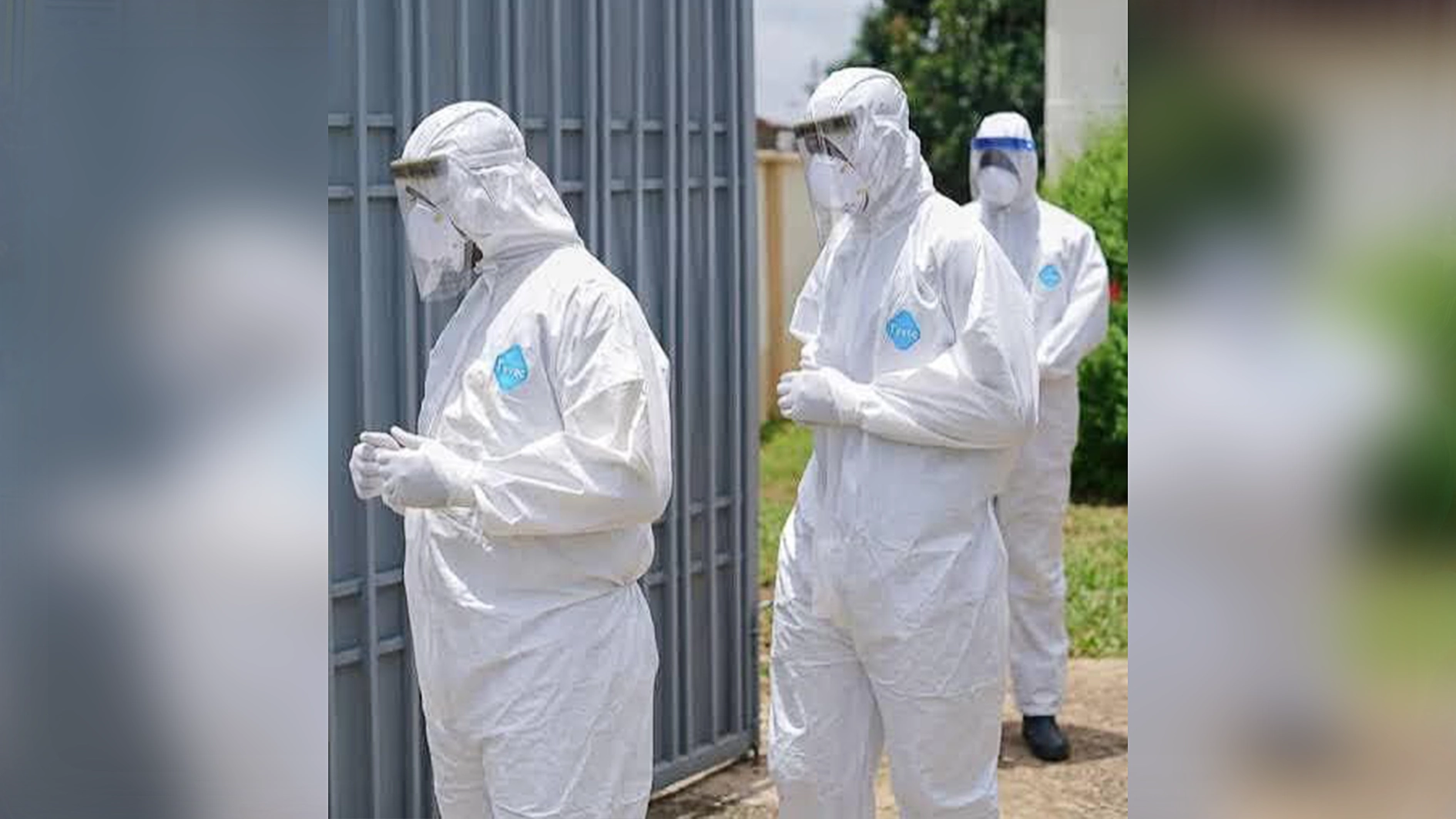
The Nigeria Centre for Disease Control and Prevention (NCDC) has said that there are currently no laboratory-confirmed cases of Ebola  in Adamawa.

The NCDC had on Saturday said that there were two suspected cases of Ebola in the north-east state, adding that the individuals had been isolated while contact identification was ongoing.

But in a statement on Sunday, the director-general of NCDC, Jide Idris,
said samples collected from the two individuals, who had symptoms suggestive of Ebola, tested negative after two rounds of testing.

“The report was received by the Adamawa State Public Health Emergency Operations Centre (PHEOC) in the early hours of 30 October 2026, following the identification of two individuals presenting with symptoms suggestive of Ebola, requiring further investigation,” the statement reads.

“Hence the alert that was released early this evening. The individuals have been isolated, and appropriate public health measures have been initiated.

“Samples were collected for laboratory testing to establish the cause of the illness. Fortunately, the samples turned out negative for EBV after two rounds of testing.”

See also  ‘I’ve never sexually harassed any woman’ — Akpabio breaks silence on Natasha Akpoti’s allegation

Idris commended the Adamawa health commissioner and his team for their “proactive approach”, adding that the NCDC was working closely with the state government to investigate the report of suspected Ebola cases.

“Currently, there is no laboratory-confirmed Ebola case in Adamawa state,” he said.

“The index case previously confirmed in the Federal Capital Territory remains the only confirmed case reported in Nigeria to date.”

He urged the public to remain calm and avoid sharing unverified information or speculating about the situation.

“The public is encouraged to obtain information from official government and public health communication channels,” he said.

Idris described Ebola as a serious infectious disease that requires prompt identification, appropriate clinical management and effective infection prevention and control measures.

“Anyone experiencing symptoms such as fever, severe weakness, headache, muscle pain, vomiting, diarrhoea or unexplained bleeding, particularly following relevant exposure, should seek immediate medical attention and inform healthcare workers of any relevant travel or contact history,” he said.

See also  Tinubu may suspend import duties on food, drugs

“Individuals should avoid self-medication and follow the advice of healthcare professionals.”

Nigeriaconfirmed its first Ebola case in more than a decade on October 20, after a 42-year-old Swiss woman tested positive for the Bundibugyo strain in Abuja.

The patient, who had travelled from Uganda to Nigeria, was subsequently isolated and treated by Nigerian health workers.

On Monday, the federal governmentevacuated the patient to Switzerland aboard a medical plane.

Her husband, who was identified as a close contact, was also evacuated to Switzerland.

Ali Pate, coordinating minister of health and social welfare, said the patient was clinically much improved, stable, conscious and communicating, with her laboratory test results approaching baseline levels.

Continue Reading

Trending News