Politics
Ministerial list: Five ex-govs, technocrats lead Tinubu’s 42-man cabinet
Published
3 years agoon
By
admin
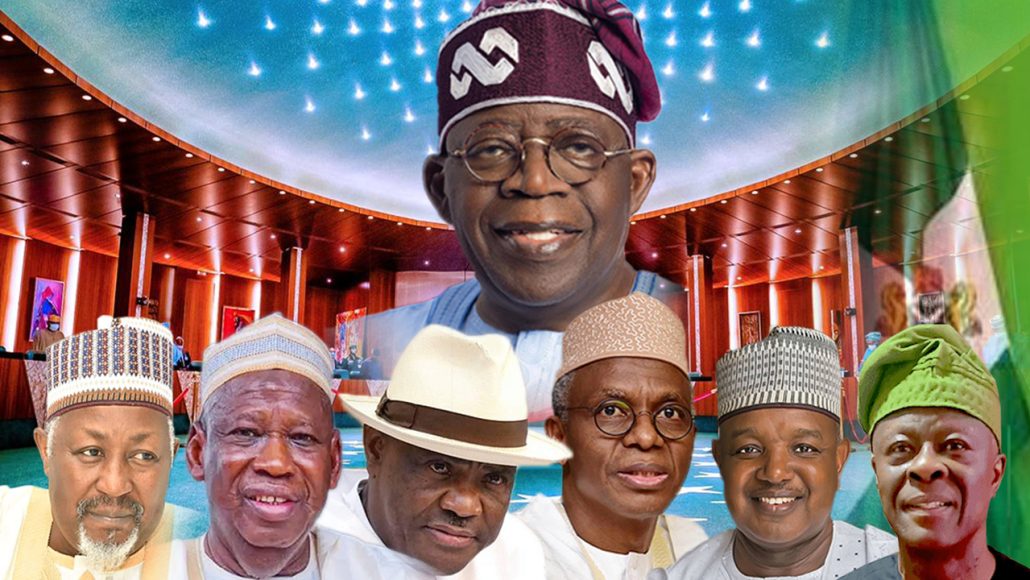
The jostle for ministerial slots is at the moment nearing conclusion. Reports have it that there are strong indications that no fewer than five former governors will feature in the president’s list of nominees that is heading to the Senate for approval between now and next week.
The unusual list, already dubbed the ‘cabinet of (political) unity’, will have nominees drawn from the ruling All Progressives Congress (APC), Peoples Democratic Party (PDP) and many technocrats.
President Bola Tinubu’s handshake across party lines has already elicited contests and intrigues in political camps over choice of suitable representatives in some of the key states.
But there may be enough slots to go round sought-after persons. The Guardian learnt that barring last minute change, the cabinet will be as bloated as what former President Muhammadu Buhari had, but with major realignments in portfolios.
The President has less than 20 days left out of the 60 allowed by the Constitution for him to send his list of Ministers to the Senate for screening.
Yesterday, it was learnt that a 42-member cabinet is being expected because “each state is constitutionally mandated to have a representative at the cabinet and as it was done by the last administration, each of the six geological zones will also have members in the unity government.”
The new cabinet, as gathered, will consist of 42 Ministers and 20 Special Advisers. Some of the remarkable difference from the last administration would be the likely abrogation of Ministers of State. Also, SAs will contribute to discussions at the weekly Federal Executive Council (FEC) meetings.
Also being anticipated is the unbundling of some large ministries into two or three to create enough portfolios for cabinet members. Some of the ministries to be touched include Works and Housing, Agriculture and Rural Development, Humanitarian Affairs, Disaster Management and Social Development, and Youths and Sports.
Those who made the proposed list of 20 expected to serve as Senior Special Assistants (SSAs), Special Assistants (SAs) and Personal Assistants (PAs) are: Dr Adekunle Tinubu – Personal Physician; Tunde Rahman – SSAP (Media); Damilotun Aderemi – SSAP (Private Secretary); Ibrahim Masari – SSAP (Political Matters); Toyin Subair – SSAP (Domestic); Abdulaziz Abdulaziz – SSAP (Print Media); Otega Ogara – SSAP (Digital/New); Demola Oshodi – SSAP (Protocol); Tope Ajayi – SSAP (Media & Public) and Yetunde Sekoni – SSAP.
Others are Motunrayo Jinadu – SSAP; Segun Dada – SAP (Social Media); Paul Adekanye – SAP (Logistics); Friday Soton – SAP (Housekeeping); Mrs Shitta-Bey Akande – SAP (Catering); Nosa Asemota – SAP (Visual Communication) Personal Photographer; Kamal Yusuf – PA (Special Duties); Wale Fadairo – PA (General Duties); Sunday Moses – PA (Videography); and Taiwo Okonlawon – PA (State Photographer).
The proposed nominees, according to a document seen at the weekend, await President Tinubu’s formal approval before it is officially announced. Some of the nominees have actually started working in the assigned roles.
However, state chapters and national secretariat of the APC have been sidelined in the process of recommending the ministerial nominees as “the governors are in charge and states where opposition parties occupy the seat of government, party leaders make recommendations, that is why some states have multiple nominees.”
Some of the governors that might have been penciled down to be part of the final list to be submitted to the senate included former governor of Kaduna State, Mallam Nasir el-Rufai, especially for his role in the emergence of Hon. Tajudeen Abbas as the Speaker House of Representative. Besides, the report of the committee set up by the APC in 2018 on true federalism, which he headed, is said to be one of the major reasons he is being rooted for by Tinubu’s camp.
Others are former governors Abdulahi Ganduje (Kano), Abubakar Atiku Bagudu (Kebbi), Muhammad Badaru Abubakar (Jigawa) and Nyesom Wike (Rivers).
It was also gathered that former Ogun State governor, Senator Gbenga Daniel is being favoured ahead of Senator Ibikunle Amosun for the ministerial list.
Former governor of Ekiti State, Kayode Fayemi, is also being considered for a Foreign Affairs Minister role. He had served in the last administration as Minister of Mines and Steel.
In Lagos, which is the President’s forte, Senator Tokunbo Abiru, a banker, is being primed to emerge as the new Finance Minister. His switch over from the Senate, where he currently represents Lagos East senatorial district, is to pave way for the return of former Lagos governor, Akinwunmi Ambode, into the President’s political family. After his recent reconciliation with his godfather, Ambode is being positioned to replace Abiru in the Senate.
In Delta State, the APC is uncertain who will be appointed minister following scheming by the different interest groups and camps within the party.
The Guardian gathered that even the leadership of the party was not pushing anyone for the ministerial position, as the floor remained open for anyone interested.
A party source said the party has been polarised into two camps – one led by former deputy senate president, Ovie Omo-Agege, and another spearheaded by Lauretta Onochie and Dr Cairo Ojougboh, who was reportedly expelled from the party.
According to a reliable source: “From the top, the party may decide to pick Festus Keyamo, because he was presidential campaign spokesman and has been assisting the President to defend his case at the tribunal.”
But it was also gathered that another bloc is rooting for Otega Emerhor, with the support of Omo-Agege, since he (Omo-Agege) is still fighting to ‘reclaim’ his governorship mandate at the election tribunal.
In Cross Rivers State, there were speculations that some party bigwigs have been lobbying Aso Rock for ministerial positions.
Sources in Calabar hinted that interested persons, including the immediate past governor, Prof. Ben Ayade; former senate leader, Victor Ndoma-Egba; APC National Women Leader, who was a former commissioner for Health in the state, Dr Betta Edu; a governorship aspirant in this year’s elections, Senator John Owan Enoh; former party chairman and ambassador, Soni Abang; immediate past Board chairman of Nigeria Ports Authority (NPA) and one-time commissioner for Information, Akin Rocket, and renowned businessman and also a governorship aspirant, Ben Akak, might be angling to be made minister.
While Edu is relying on some party heavyweights, female-folks and ‘office of the First Lady’ to push her cause, Ayade is banking on his influence and connection with some former governors. Ndoma-Egba is counting on his experience and exploring his contacts with his colleagues in the National Assembly to pull through.
However, a group called the All Progressives Congress (APC) Legacy Group, Cross River State, has sounded a note of caution to Tinubu in appointing ministerial nominees from the state.
In a statement issued in Calabar, their leader, Sampson Egom, said: “It is important for the APC and Tinubu to be properly guided before he makes the choice of his minister from Cross River.
“Let the party reward and promote this silent majority, who do not have political godfathers and godmothers,” the statement reads in part.
According to a new amendment to the 1999 Constitution, the President and governors must submit the names of persons nominated as ministers or commissioners within 60 days of taking the oath of office for confirmation by the Senate or state House of Assembly.
President Tinubu was sworn-in on May 29, and already 42 days since coming onboard. The presidential spokesman, Dele Alake, earlier told Nigerians to expect Tinubu’s ministerial roll call within the first 30 days in office, as a departure for his predecessor that took six months to inaugurate one.
In May, Alake said: “A month maximum is enough for any serious government to form its cabinet and put a structure of government in place after the swearing-in”.
But last Thursday, Alake reclined on that timeline, saying it was the President’s sole prerogative to appoint persons into the new cabinet “when he is good and ready”.
Fielding questions from State House Correspondents in Abuja, Alake noted that Nigeria runs a presidential system, which only confers on the President the prerogative power to appoint ministers.
He said, “you know, this is an executive presidency, we’re not running a parliamentary system. So, the bucks stop on his table, and he decides who is fit and proper to make his cabinet list.”
Alake, a Special Adviser on Special Duties, Communications and Strategy noted the avalanche of what he described as ‘speculations’ in the public domain, adding that such reports were mere fabrications.
“I can tell you all those things you’ve been reading in the media are mere fabrications. There is no iota of truth in all those things. When the President is good and ready, you will be the first to know about his intentions,” he said.
Expectations are high that when the list of ministerial nominees is unveiled, notable persons that may not have been prominent in the South-east region or in the APC may form part of it.
The Guardian investigation revealed that Tinubu, to assuage discontents arising from his election, is ready to accommodate politicians and eggheads that could enable his administration achieve a national cohesion. It was gathered that in doing so, he may not rely solely on members of the party that worked for his success in the region.
Towards the end, it was revealed that the list might contain a mix of members, especially of the PDP and APC, adding that the effort was also to strengthen the party in the region.
So far, Tinubu has received ex-governors of Enugu and Abia states, Ifeanyi Ugwuanyi and Okezie Ikpeazu, in that order. They were among the G-5 governors of the PDP. While it is not clear whether Ikpeazu could make the list, that of Ugwuanyi is said to be a done deal based on his closeness with Tinubu and his efforts to unite segments of the country as governor.
In Abia, however, there is a rift between former Minister, Uche Ogar, and the governorship candidate of the party in the 2023 elections, Ikechi Emenike, over control of the party.
The rift has divided members of the party. A source stated that the party might have submitted two lists of potential ministers to the president.
It was learnt that though Ugwuanyi is not of the APC, his mien that has endeared him to all manner of people has become a factor that may earn him a place in the administration of Tinubu.
The other factor is the crisis in the state APC, which has divided the party and limited its chances at the last elections. It was speculated that allowing any of the factions led by Ugochukwu Agballah or Adolphus Ude, among others, to nominate candidates would fester the crisis.
In Ebonyi, there are rumours that former Senate President, Anyim Pius Anyim, may also make the list. Anyim’s closeness with the immediate past governor of the state, Dave Umahi, who will eventually have a say in who should be appointed from the state is said to be a factor.
Anyim had before the election openly endorsed the governorship candidate of the APC; a position that many felt impacted on the performance of Tinubu in the state. Anyim has been received by President Tinubu at the State House.
For Imo state, it will be unlikely for Governor Uzodimma not to have a say in the choice of minister to represent the state.
The crisis in Anambra APC might also make the president look elsewhere for his minister. Only last week, he held talks with the former National Publicity of the PDP, Olisa Metuh.
In a related development, the APC in Rivers State has denied ceding any ministerial nomination slot to Wike.
The state party spokesperson, Darlington Nwauju, made the denial at a press briefing on Wednesday, describing the claim as “the most fantastically audacious of lies”.
Nwauju, while reacting to a publication authored by the former Chief of Staff to the Rivers State Government, and state leader of the Amalgamated Bola Tinubu Campaign Council, Chief Tony Okocha, said, “the state chapter of the party has never interacted with the Amalgamated Bola Tinubu Campaign Council emphasising that there are more than a hundred NGOs and support groups, who worked for the APC in Rivers State.”

You may like
-
Good morning! Nigerian Newspapers Headlines: Automatic ticket: Tinubu leaves lawmakers’ fate in govs’ hands
-
Why Tinubu addressed families of Plateau attacks victims at Jos Airport — Presidency
-
Tinubu condemns Plateau, Kaduna killings, orders security agencies to rescue all abductees
-
Ẹ káàbọ̀ şé dáadáa’ — King Charles greets Tinubu, Nigerian delegation
-
Full List: Tinubu approves 65 ambassadorial postings… Reno Omokri to Mexico, Fani-Kayode to Germany
-
Masterclass: Tinubu oversees historic resolution of OPL 245 dispute
Politics
What supreme court judgement means for David Mark, ADC
Published
1 month agoon
May 2, 2026By
admin
By Bolanle Olabimtan
The supreme court judgement on the leadership crisis in the African Democratic Congress (ADC) has generated mixed interpretations and confusion about who is in charge of the party.
However, rather than settle the dispute, the apex court’s decision focused on a procedural misstep and sent the case back to where it began.
To understand the case in its entirety and what the supreme court judgement means, it is important to start from the beginning.
FEDERAL HIGH COURT
On September 2, 2025, Nafiu Bala, former vice chairman of the ADC, approached a federal high court in Abuja (Suit No. FHC/ABJ/CS/1819/2025), seeking to stop David Mark, former senate president, and his faction from parading themselves as leaders of the party.
Bala listed the ADC, Mark, Rauf Aregbesola (national secretary), the Independent National Electoral Commission (INEC), and Ralph Nwosu, the party’s founder and former national chairman, as defendants.
He also sought an order to restrain INEC from recognising them and to compel recognition of himself as acting national chairman.
He further filed motions seeking to stop the party from holding meetings, congresses, or conventions pending the determination of the suit.
The motion ex parte was heard on September 4, 2025, and Emeka Nwite, the trial judge, directed that the respondents, including INEC, be put on notice to show cause why the motion ex parte should not be granted.
This means the motion ex parte was neither granted nor refused.
COURT OF APPEAL
Dissatisfied with the interim ruling, Mark filed an appeal challenging the jurisdiction of the federal high court to continue to hear Bala’s suit.
However, on March 12, 2026, the court of appeal dismissed Mark’s case in its entirety, holding that it was incompetent and unmeritorious.
A three-member panel of the appellate court, led by Uchechukwu Onyemenam, found that there was no substantive ruling by the federal high court on the ex parte application, as the trial judge merely ordered that parties be put on notice.
As such, there was no valid decision upon which an appeal could properly be anchored.
The court further faulted Mark for relying on an enrolled order rather than the actual proceedings and ruling of the trial court, noting that only the judge’s pronouncement constitutes the authentic record of the court.
The court also held that the appeal arose from an interlocutory ruling, for which Mark failed to obtain the required leave before approaching the appellate court.
On the issue of jurisdiction, the court of appeal noted that the question was still pending before the federal high court and could not be determined at the appellate level at that stage, describing the appeal as premature.
Having dismissed the appeal, the court issued preservatory orders to safeguard the subject matter of the dispute.
The court directed the parties to maintain the status quo ante bellum and to refrain from any action that could undermine the proceedings before the trial court.
On April 1, INEC announced that it would no longer recognise the factions of the ADC led by Mark or Bala, following its review of the court of appeal judgement.
SUPREME COURT
On further appeal to the apex court, Mark, among other things, argued that he had a lawful right to proceed with the appeal without seeking leave of the trial court.
He also raised the issue of jurisdiction, arguing that the trial court lacks the jurisdiction to entertain Bala’s suit.
In a unanimous judgement delivered on Thursday, a five-member panel of the supreme court held that the appeal fails in part and succeeds in part.
In the first part, the apex court agreed with the court of appeal’s verdict that the appellant (Mark) ought to have sought leave of the trial court before filing an appeal, since the substantive issues before the trial court had not yet been heard and determined.
“I find the court below to be right that the appellant, in whose favour the order of the federal high court was made, ought to have sought the leave of the court before appeal…” the supreme court held.
Mohammed Garba, who read the lead judgment, held that since the appellant failed to meet the condition precedent for filing the appeal, it robbed the appellate court and, by extension, the supreme court of jurisdiction to entertain the suit.
The lead justice also held that the issue opposing jurisdiction of the trial court cannot be determined by the supreme court since it is already the subject of a pending preliminary objection, which has not yet been determined at the high court.
“I therefore endorse the decision by the court below upholding the first respondent’s preliminary objection to the competence of the appellant’s appeal and an order striking it out on that ground,” Garba said.
Consequently, the court ordered the parties to go back and continue with the suit pending at the federal high court.
On the second issue, which succeeded, the supreme court said the court of appeal overstepped its boundaries by asking parties to maintain the status quo.
“Status quo ante bellum”, in legal terms, refers to restoring the condition of the position of things as they were before the dispute arose.
The court reasoned that once the appeal was dismissed, the court of appeal had become functus officio — meaning it had exhausted its authority in the case and could not make further substantive orders.
The supreme court consequently set aside the status quo order, describing it as “unnecessary, unwarranted and improper”.
“The court was wrong to have made a purported preservatory order suo moto in respect of a proceeding pending before the lower court, as that power belongs to that trial court, which shall be in control of proceedings in the matter when it is returned to it by the appellate court either for continuation, hearing or retrial as the case may be,” the court ruled.
DOES THIS MEAN DAVID MARK’S FACTION HAS WON?
The verdict of the supreme court does not mean victory for the Mark-led faction or even any faction.
While the removal of the status quo order may give the Mark-led faction some breathing room, the supreme court did not affirm any leadership.
The most important question of who legitimately controls the ADC remains unresolved.
The outcome will now depend on the decision of the trial court after full proceedings.
After the matter is resolved at the trial court, the losing faction would likely appeal the verdict back up to the supreme court.
Meanwhile, INEC has updated its website, listing Mark as the national chairman of the ADC and Aregbesola as national secretary
Culled from TheCable
Politics
2027: APC postpones presidential, governorship primaries
Published
1 month agoon
April 23, 2026By
admin
The All Progressives Congress has postponed its presidential primary election, earlier slated for May 15 and 16, to May 23, 2026, while the governorship primaries will now hold on May 21, 2026, in line with a revised timetable for its 2027 general election activities.
The APC Deputy National Publicity Secretary, Duro Meseko, disclosed this at the end of the 186th National Working Committee meeting in Abuja on Thursday, announcing adjustments to the earlier schedule, including the postponement of key processes such as the screening of aspirants and the consideration of appeals.
Meseko also disclosed that the screening of aspirants, initially scheduled for May 6 to May 8, including the presidential screening set for May 9, has now been rescheduled.
Announcing the adjustment to the APC 2027 schedule of activities, the Deputy National Publicity Secretary stated, “We now have a new revised timetable in accordance with the Constitution of the Federal Republic of Nigeria, 1999, as amended, the Electoral Act 2026, and the Independent National Electoral Commission revised timetable and schedule of activities for the 2027 general elections.
“We hereby present the new revised timetable and schedule of activities for the conduct of the 2027 general elections to the press.
“Notice had already been given to state chapters on Monday, 20th April. Sales of forms will commence this Saturday, 25th April, to Saturday, 2nd May, 2026. The last day for submission of completed forms and accompanying documents is now Monday, 4th May, 2026. Screening of aspirants – House of Assembly, House of Representatives, Senate, Governorship, and Presidential—will hold as follows: Wednesday, 6th May to Friday, 8th May, 2026, for House of Assembly, House of Representatives, Senate, and Governorship screening respectively. Saturday, 9th May, 2026, is the screening for Presidential aspirants.
“Publication of screening results for State House of Assembly, House of Representatives, Senate, Governorship, and Presidential will hold on Monday, 11th May, 2026. Screening appeals will be handled by the appeal committees from Tuesday, 12th May to Wednesday, 13th May, 2026, for the State House of Assembly, House of Representatives, Senate, Governorship, and Presidential.
“Primary elections of the All Progressives Congress commence as follows: Friday, 15th May, 2026: House of Representatives primary elections. Monday, 18th May, 2026: Senate primary elections. Wednesday, 20th May, 2026: State House of Assembly primary elections. Thursday, 21st May, 2026: Governorship primary elections.
Saturday, 23rd May, 2026: Presidential primary elections.”
He announced that the post-primary appeal committees will sit on Monday, 18th May, 2026, for the House of Representatives; Wednesday, 20th May, 2026, for the Senate; Thursday, 21st May, 2026, for the State House of Assembly; Saturday, 23rd May, 2026, for the governorship; and Monday, 25th May, 2026, for the presidential.
He continued, “That is one of the resolutions today. The second is the schedule of activities and timetable for the 2026 ward, LGA, and state congresses in Zamfara State, beginning Tuesday, 28th April, 2026. The ward congresses, LGA congresses, and state congresses will commence on that date.
“Screening of aspirants for ward executive positions will follow on Wednesday, 29th April, 2026. Ward congresses will be held on Thursday, 30th April, 2026. Appeals from ward screening and ward congresses will be held on Friday, 1st May, 2026. Appeals arising from LGA congresses and screening of state executive members will also be held on the same day. Appeals arising from state congresses will be held on Sunday, 3rd May, 2026.
That is the timetable for the congresses in Zamfara State.”
He explained that the party has adopted the two modes of primary elections provided in the 2026 Electoral Act, direct primary and consensus, for selecting candidates for elective positions.
Meseko added, “In this 186th meeting of the National Working Committee of the All Progressives Congress, we adopted the mode of primaries as provided in the Electoral Act: direct and consensus mode, with a caveat that members are at liberty to pick.
“That is, aspirants are free to decide their preference in accordance with the Electoral Act. Where consensus works, it stands, and where an aspirant does not agree to consensus, it automatically reverts to direct primaries.
“There was also a rumour that forms would be restricted or limited to certain individuals. I am here to inform all party faithful and aspirants that nomination forms for all aspirants seeking offices under the All Progressives Congress are available for all, not exclusively reserved for any individual.”
The Independent National Electoral Commission has fixed the Presidential and National Assembly elections for Saturday, January 16, 2027, while the Governorship and State Houses of Assembly elections will hold on Saturday, February 6, 2027.
The commission also stated that party primaries, including the resolution of disputes arising from them, are scheduled to take place between April 23, 2026 and May 30, 2026.
According to INEC, campaigns for the Presidential and National Assembly elections will commence on August 19, 2026, while campaigns for the Governorship and State Houses of Assembly elections will begin on September 9, 2026.
Politics
ADC crisis: Presidential ticket tears Atiku, Obi, Kwankwaso apart
Published
2 months agoon
April 16, 2026By
admin
The crisis threatening to tear apart the African Democratic Congress (ADC) may get worse as the party’s presidential ticket is tearing supporters of major aspirants apart ahead of the primary.
It would be recalled that the Independent National Electoral Commission (INEC) has refused to recognise any of the three camps laying claim to the party’s leadership.
This followed a Court of Appeal order in a suit challenging the recognition of David Mark, Rauf Aregbesola and others as officials of the National Working Committee (NWC).
Many state chapters remain polarised and unable to hold congresses. Yet, the party on Tuesday held its convention in Abuja without INEC monitoring, a move widely considered risky.
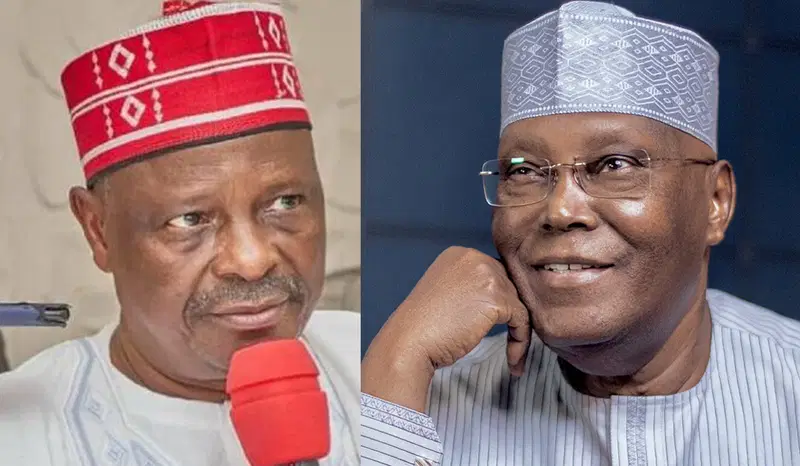
Ahead of the primary to pick the ticket for the presidential candidate, there is a widening gulf among the camps of former Vice President Atiku Abubakar, former Anambra State Governor Peter Obi and Kwankwasiyya Movement leader, Senator Rabiu Kwankwaso, all believed to be eyeing the ticket.
The trio are defectors from other parties who have converged on the ADC amid ongoing political realignments ahead of the 2027 general election.
While Atiku left the Peoples Democratic Party (PDP) last year to become the ADC arrowhead, Obi also quit the Labour Party (LP), on whose platform he contested the 2023 presidential election.
Kwankwaso, a former governor of Kano State and ex-Defence Minister, left the New Nigeria Peoples Party (NNPP) for the ADC last month.
Despite their stated commitment to building a formidable opposition platform to challenge the ruling All Progressives Congress (APC), the cracks became evident shortly after the convention.
Atiku’s ally, Dele Momodu, said the former vice president’s camp favours an Atiku/Obi ticket.
However, Obi’s camp rejected the proposal, insisting that the ticket should be zoned to the South.
Momodu argued that pairing Obi with Atiku would give the ADC a significant electoral advantage, citing their previous collaboration in 2019.
The duo, however, lost the election to the late President Muhammadu Buhari.
Speaking on television on Tuesday night, Momodu said: “I’d pair him (Atiku) with Peter Obi because they worked together in 2019. So, they already share a similar temperament.
“Peter Obi came third in the last election. You don’t have to work too hard to maintain and attract the same group of people who love him.”
He maintained that the proposed Atiku/Obi alliance, if consummated, would strengthen the opposition’s chances of capturing federal power, especially amid ongoing political realignments.
But the Coordinator of the Obedient Movement – Obi’s caucus within the ADC – Tanko Yunusa, insisted that zoning the ticket to the South remains the only acceptable option.
He added that once zoned to the South, Obi should emerge as the sole beneficiary and be paired with Kwankwaso.
Yunusa, who also spoke on television, said Obi enjoys broad acceptability within the ADC.
According to him, the reception accorded Obi and Kwankwaso by delegates at Tuesday’s national convention reflected the preference of party members.
He warned that the ADC risks losing the election if its candidate does not emerge from the South.
Yunusa described the former Anambra State governor as the best choice for the ticket, citing what he called his integrity and lack of political baggage.
He said: “You’ve never seen him (Obi) owning a debt. Neither have you seen him segregating. In all of that, he still mingles with his colleagues to fight for the soul of the country.”
He added that Obi has recognised the need to build alliances with the North, noting his increasing engagement with northern leaders across religious lines.
Yunusa said: “When he came to my state in Kano, you could see the synergy between him and Rabiu Musa Kwankwaso. The reception was overwhelming; we barely managed the mammoth crowd.
“It was shouts of Obi/Kwankwaso! Obi/Kwankwaso! The signage and the chorus showed a major shift from what it was in 2023 and 2026 towards 2027. I was elated.”
He dismissed the suggestion of an Atiku/Obi ticket as unworkable.
Yunusa said: “It’s a Southern presidency. To make it easier for the party to win, zone it to the South and give the candidacy to the region, and you are assured of victory.
“Anything short of that will only lead to defeat. Nigerians should conduct independent assessments.
“The level of enthusiasm and support shown for Peter Obi and Kwankwaso indicates that the people have spoken.
“If those two are paired – Peter Obi as presidential candidate and Kwankwaso as running mate – the election would effectively be decided early.
“The momentum has grown, especially among young Nigerians seeking credible leadership and good governance.”
There is also a widespread belief that Atiku, 79, may have an edge over Obi in a competitive primary, given his long-standing experience in party contests dating back to 1991/1992.
This perception has fuelled calls by Obi’s supporters for the ticket to be zoned to the South, effectively limiting Atiku’s chances of contesting.
However, the ADC spokesman, Bolaji Abdullahi, has repeatedly assured that the party will provide a level playing field for all aspirants.
Last week, Obi reiterated that the process for selecting the party’s candidate must not be “transactional.”
He said in an interview: “In the PDP, I left for the LP because people were not playing by the rules.
“The presidential primary was transactional. I cannot be part of transactional primaries. I cannot pay people to serve them.
“I may not have spent a long time in politics, but even if I had to repeat the process 20 times, I would take the same decision – to leave. I cannot advocate change while participating in a flawed process.
“I am now in the ADC with some of the same people I left in the PDP and other parties.
“But if the same process is compromised again, I will speak out.
“I have never been involved in any form of election rigging – at the primary level, during the election, or afterwards.”
Trending News
-
News4 years agoInsecurity: Buhari presides over National Security Council meeting (Photos)
-
Privacy5 years agoSelf-imposed Oba vacates ‘palace’ after warnings by community
-
News5 years agoNollywood Actress Nkechi Blessing speaks on plastic surgery, big butts
-
Entertainment4 years agoDJ Dimple Nipple dropped by longtime boyfriend after claiming D’Prince allegedly demanded sex for roles
-
News5 years agoPlus size rocks: Ghanaian plus size dancer who can’t travel by air because of her size
-
Opinion5 years agoLeave our community, Imobi orders self-imposed Oba
-
News5 years agoHow CCTV ’caught’ Baba Ijesha molesting minor
-
Sports4 years agoMeet Ashleigh Plumptre, the ‘Oyinbo’ member of Nigeria Super Falcons [Video]