Connect with us

News

Renewed hope as Lagos boy marches into Aso Villa

Published

on


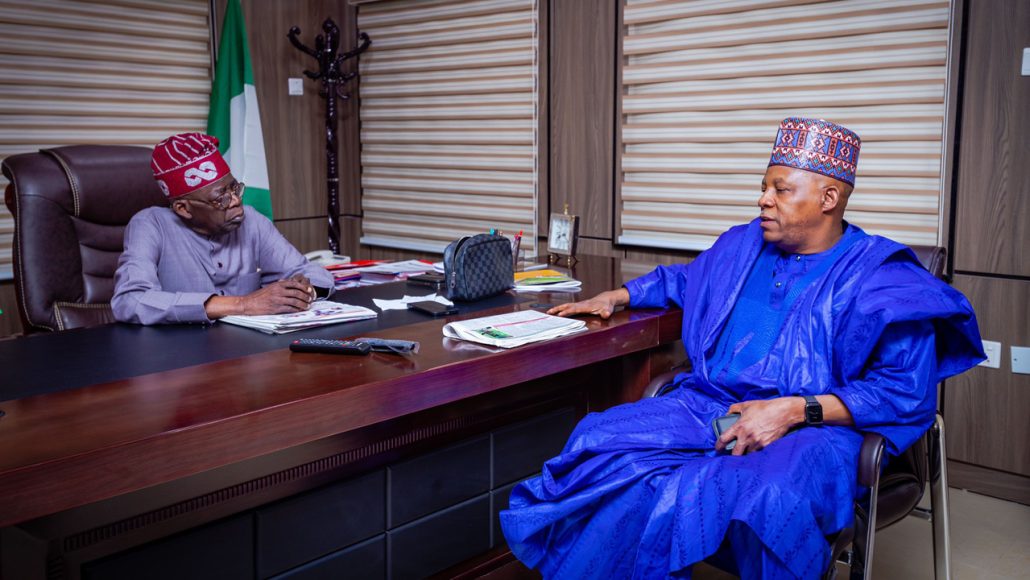
In a few hours from now, former governor of Lagos State and the national leader of the All Progressives Congress (APC), Asiwaju Bola Ahmed Tinubu, will be sworn-in as Nigeria’s 16th president. As the man fondly called by his followers as JAGABAN takes over the baton of leadership from President Muhammadu Buhari, several questions are being asked about him.

The questions include: At what point did Tinubu begin his journey to the Presidency? To what extent did his stint at the Senate in 1991/92 and eventual tenure as governor of Lagos State help to shape his political views and perspectives?

Much of what is known about Tinubu and his politics spans his exploits during the short-lived General Ibrahim Babangida transition to civil rule in 1991, the annulment of the 1993 presidential election, which was believed to have been won by Chief Moshood Kashimawo Olawale Abiola.

That Tinubu returned from exile, which was necessitated by his role in the agitation for reclaiming Abiola’s mandate from the military, to become the governor of Lagos State spoke about his staying power on democratic ideals. He was a notable member of the National Democratic Coalition (NADECO), which served as the rallying point for the restoration of democracy after the military junta demolished the remaining civil political structures in the country.

No doubt, his membership of NADECO and efforts to throw up a civilian governor for the state in 1991 coalesced to catapult him to the top row of Alliance for Democracy (AD) in the lead-up to the 1999 governorship race of Lagos State.

As a prime mover of the PRIMROSE Group within the Social Democratic Party (SDP), Tinubu expanded his political capital, not only in Lagos, but also across the federation. SDP, which was one of the two political parties decreed into existence by the Babangida regime, paraded heavyweight progressive politicians, notably the leader of the Peoples Front (PF), General Shehu Musa Yar’Adua.

The other party – the National Republican Convention (NRC), being populated by the contractor class – was seen as part of the military establishment. As such, SDP captured the imagination and appeal of the masses of Nigerians desiring a positive change.

It was therefore a combination of the experience and exposure from the SDP and AD days that established what could be described as the Tinubu political brand. The constant mutation within the AD, which led to the formation of Action Congress (AC), Action Congress of Nigeria (ACN) and cumulated in the merger of otherwise fringe national political parties to form the All Progressives Congress (APC) had the imprint of Tinubu’s political strategy of widening the sphere of progressive influence.

See also  Lagos guber poll: Ohanaeze declares support for Sanwo-Olu, says Igbo not at war with Yoruba

Consequently, on June 8, 2022, when he won the APC presidential primary election to clinch the party’s ticket, the challenge was how to make his rich fund of political goodwill redound to his victory. As an experienced politician, Tinubu discovered that the battle for the 2023 presidency would be fought majorly around media as the turf for campaign messaging.

How did he communicate his ideas to capture voter preference? Simple, he went for experienced hands in the media, said Bayo Onanuga, who served as the Head of the Media Directorate of the Tinubu Presidential Campaign Council.

In an exclusive interview with The Guardian, Onanuga explained that the kernel of the Tinubu campaign was to present him to Nigerians as “a man who has a lot of ideas, who has been governor of Lagos State and who did very wonderfully well in Lagos State.”

Onanuga said of Tinubu: “He is a man of deep knowledge, a man of very great ideas. He has profound ideas about a lot of things. When you talk to him, what people will call the native intelligence, he has it..”

He maintained that the way the president-elect can solve problems, makes people wonder where the man is coming from.

According to Onanuga, some of the innovative solutions that Tinubu brought to the table as the chief executive of Lagos State, include the development of road networks in the expansive Lekki peninsula, reclamation of the lagoon, and the establishment of a development masterplan for the mega city.

Having known the former Lagos State governor for a long time, Onanugua, who also served as publicity secretary when Tinubu contested the governorship in 1999, disclosed: “I think I was asked to lead the Media and Publicity Directorate because Asiwaju wanted me to be there. We’ve come a long way since 1992 or so. So, I knew him and he also knows me very well.

“For me, it was not difficult to sell him as a man who has a lot of ideas, as a man who can help this country to attain our dreams of a prosperous country. That was why I said, his campaign was easy for me. I knew who he was, I knew where he was coming from and I knew he could do a lot to help this country.”

Further, Onanuga described Tinubu as a courageous politician that is not afraid to take risks. For instance, on the issue of deficit budgeting, he said Tinubu has a different idea.

He stated; “There is a book he co-wrote, called Financialism: Water from an Empty Well. Anyone who wants to understand Bola Tinubu, will need to read it to know his worldview. He told them at the Nigerian Economic Summit Group (NESG) early this year that he doesn’t subscribe to the idea that deficit budget is bad. He said it can be good if it is used for productive things. If you are using it to consume then it is a compound negative, he said.”

See also  BREAKING: FG declares Monday, Tuesday public holidays for Christmas

Tinubu fell back on his peoples-politics to carve a pathway into the North, where he deployed old allies to capture the winning ballots. Another member of the Media and Publicity Directorate and famous broadcast journalist, Danladi Bako, said that the president-elect was able to build a formidable team of committed leaders.

Bako stated: “He located in every state people who could deliver the state. In Jigawa, you had all the big shots, but Alhaji Abubakar Badaru, the governor delivered. In Sokoto, (Senator Maigatakarda) Wamakko delivered. In Niger, 313 (Senator Sani) Musa, delivered, and in Kogi, Governor Yahaya Bello delivered.

“In Benue, George Akume turned the apple-cart, because he was a mentor to (Senator Gabriel) Suswam, and to (Governor Samuel) Ortom, so the godfather influence came to the fore in Benue. The vice presidential candidate was coming from the North East, he tidied up his home, he knew that Borno was done…”

“Considering that North West remained the battleground,” Bako remarked, “Asiwaju was kind enough to draft strong North West people, my humble self inclusive, and I know the work we did in the media, within the youth group, and within the women group.

“As far back as 1973, I was a kid celebrity on the radio as a young boy. So, everybody grew up to know me as their own. So, I was a marketing tool for Asiwaju in the North West, whether it was Kaduna or it was Sokoto.”

He said the Tinubu train dragged along other notable persons to ensure total victory, including, Zamfara State governor, Dr. Bello Matawalle; Governor of Kebbi, Senator Atiku Bagudu.

“All of us worked intensely along with Badaru, and to a large extent, along with (Mallam Nasir) El-Rufai, to make sure that the seven states in the North West were delivered to Asiwaju and the APC. And, the moment you pick up, a sizeable amount of those 22 million votes in the North West, you were home and dry. That was the strategy and of course, we did not leave any stone unturned.”

He noted that the mere indication of the quality of the Presidential Campaign Council, the admixture of reliable, comfortable political heavyeights, Simon Lalong and Abdullahi Adamu in the Middle Belt, 313 (Senator Musa); guaranteed that the Middle Belt was going to deliver.

See also  'Seven killed, 16 injured’ as suicide bombers attack wedding guests in Borno

“At least, five out of six states, and that was what happened,” he added, stressing that it was the same for the Presidential Campaign Council Media Directorate.

“When a man will look out to bring a Senior Advocate of Nigeria (SAN), Festus Keyamu; former mnister, Fani Kayode; former Editor/Publisher of TheNews and Tempo, and former MD of the News Agency of Nigeria (NAN), Bayo Onanuga; then the former Director General (DG) of NBC, 20 years ago, Danladi Bako, in the midst, then he now tops it with Dele Alake, who was Commissioner for Information in Lagos State for eight years, no other party, apart from APC, has that arsenal, that armada of people.

“Then look at the second level, Ali M. Ali, Hanatu Musa, and so many other people. So, in terms of grading, there was a lot that the Media and Publicity could do and did deliver and it showed the difference because you had people who were in other parties just beating around the bush.”

Bako said of Tinubu: “He is humble, he understands how to make compromises. He understands how to wait for his time. He understands what to do when at crossroads. He understands that he cannot win all the time.

“For somebody who was a Senator in 1991 and waited till 1999 to become governor, even after his eight years, he followed up by allowing Nuhu Ribadu to be the presidential candidate of ACN, followed up by allowing Atiku Abubakar to be candidate, followed up by allowing Buhari to be a candidate in 2014. If he was a greedy, over-ambitious person, he would have taken it for himself all this period, but he waited strategically, and made quality northerners the candidate in 2007, 2011, and 2015. He made sure that he allowed them the space, so it was easy for him to come back and say, I have tried my best, for you.

“And if they didn’t win, that wasn’t his fault, but he had allowed and remembered that for a long time, the kind of strategy in politics in Nigeria was a synergy between the North and East, or North and Rivers.”

As Renewed Hope berths, all eyes would be on both the ship and the horizon to see how and whether the pilot, Tinubu and Shettima, could paddle the ship stably through the rough seas of political uncertainty and inclement economic weather to a safe harbour of peace and prosperity.

CULLED FROM THE GUARDIAN

News

Oyo school abductions: Makinde signs executive order, restricts Okada 

Published

on

By

Governor Seyi Makinde of Oyo state
has signed Executive Order No. 002 of 2026, aimed at strengthening security, enforcing vehicle registration regulations and improving traffic management across the state.

The governor also announced restrictions on the operations of commercial motorcycle operators, popularly known as “Okada” riders.

The development follows growing concerns over security challenges in parts of the state, particularly the continued captivity of teachers and pupils abducted in Oriire Local Government Area more than 20 days ago.

Speaking during the signing ceremony in his Office on Friday, Makinde said the executive order was designed to ensure strict compliance with existing laws governing vehicle registration and traffic regulations.

He noted that unregistered vehicles, motorcycles, and tricycles have increasingly been used to perpetrate criminal activities within the state.

According to the governor, security agencies often encounter difficulties tracking and investigating crimes involving unregistered vehicles because of the absence of identifiable registration details.

Governor Makinde explained that the executive order would provide a legal framework for the strict enforcement of vehicle registration requirements and other traffic regulations, including measures against driving against traffic and related offences.

According to him, designated enforcement authorities have been empowered to arrest offenders and impound vehicles, motorcycles, or tricycles found violating the provisions of the order.

See also  Nigerian troops kill 30 terrorists

The governor said offenders apprehended under the executive order would be prosecuted in accordance with the law, while seized assets and properties would be handled through established legal procedures.

The governor linked the latest security measures to lessons learnt from recent security breaches, especially the abduction of schoolchildren and teachers in Oriire Local Government Area.

“We are living through very trying times; for over 20 days, our teachers and pupils have remained in captivity in the hands of terrorists. Our thoughts and prayers remain with them and with their families who continue to endure unimaginable pain and uncertainty,” He said. 

He assured residents that his administration remained fully committed to securing the safe return of all abducted victims and was working relentlessly with relevant security agencies to achieve that objective.

“As a government, we share in their anxiety and their hope, and we remain committed to doing everything within our power to secure the safe return of every one of them,” Makinde said.

The governor acknowledged the pain being experienced by the affected families and communities, stressing that the abducted teachers and pupils had neither been forgotten nor abandoned.

See also  COVID-19: UK donates 699,760 doses of AstraZeneca vaccines to Nigeria

While declining to disclose operational details for security reasons, Makinde maintained that extensive efforts were ongoing behind the scenes and urged residents not to mistake the government’s silence for inaction.

One of the major highlights of the executive order is the restriction placed on commercial motorcycle operations across Oyo State.

Makinde announced that commercial motorcycle operators would no longer be permitted to operate between 10:30 p.m. and 5:30 a.m. statewide, describing the measure as part of additional efforts to improve security and public safety.

The governor said the restriction became necessary as part of broader strategies to curb criminal activities and strengthen surveillance across communities.

He appealed to residents to actively support security agencies by providing timely information on suspicious movements and activities.

According to him, security remains a collective responsibility that requires the cooperation of all citizens.

“If you see something, say something, and authorities will do something,” he said, while reminding residents of the state’s toll-free emergency number, 615, for reporting security threats and emergencies.

Makinde also urged residents to remain vigilant, united and resilient despite the current security challenges, warning against allowing fear to undermine communal harmony and confidence.

See also  JUST IN: APC shifts congresses, national convention timeline

He commended security agencies and members of the state’s security outfit, Amotekun Corps, for their dedication, sacrifices and professionalism in responding to security threats across Oyo State.

The governor expressed optimism that with sustained collaboration among security agencies, community stakeholders, and residents, the abducted teachers and pupils would be rescued safely and security across the state would be further strengthened.

In his address at the event, the Attorney General of the state and Commissioner for Justice, Abiodun Aikomo, stated that the implementation of the order would be carried out by relevant agencies, including the Oyo State Road Traffic Management Authority (OYRTMA), the Nigeria Police Force and other law enforcement bodies, which would be required to submit periodic reports on enforcement activities to the state government.

To ensure transparency and accountability, Aikomo stated that the Office of the Director of Public Prosecutions would provide oversight on prosecutions arising from the enforcement exercise, while members of the public would be encouraged to report any misconduct by officials involved in implementing the order.

Continue Reading

News

Nigeria set to repatriate over 1,000 nationals from South Africa as violence continues

Published

on

By

The Federal government has kick-started plans to bring back home more than 1,000 Nigerians from South Africa as concerns grow over rising anti-immigrant sentiments and renewed xenophobic tensions in the southern African nation.

According to reports, Nigeria’s Ministry of Foreign Affairs confirmed on Friday that screening for a voluntary repatriation programme began on Thursday, with authorities expecting over 1,000 Nigerians to participate.

Foreign ministry spokesperson Kimiebi Ebienfa told AFP that the final number of those seeking to return home had not yet been determined but noted that the figure was expected to exceed 1,000.

“Total figure not out yet,” he said. “We are expecting over 1,000 persons.”

The move follows a similar action by Ghana, which recently repatriated hundreds of its nationals from South Africa amid increasing fears over protests and violence directed at foreign nationals.

In a statement dated Tuesday, Nigeria’s High Commission in Pretoria said it had “negotiated waivers with host authorities” so that those with “immigration-related offences” would be allowed to leave on the eventual repatriation flights rather than be detained.

See also  'Seven killed, 16 injured’ as suicide bombers attack wedding guests in Borno

South Africa, until recently the continent’s most industrialised economy, has long attracted workers from across the region.

But saddled with an unemployment rate of over 30 per cent, it has seen repeated spurts of xenophobic protests — including renewed violence in recent weeks.

The latest tensions have revived uncomfortable debates across Africa about xenophobia, migration and the gap between pan-African rhetoric and realities facing migration on the continent.

An ultimatum by one citizen-led group for illegal migrants to be expelled by June 30 has raised fears of violence after bouts of anti-immigrant unrest in the past that claimed dozens of lives.

Last month, Ghana repatriated some 300 people, the first batch of what authorities said was expected to be a total of about 800 Ghanaian nationals.

The South African government has said it is stepping up enforcement against undocumented immigrants but urged citizens not to take matters into their own hands.

See also  COVID-19: UK donates 699,760 doses of AstraZeneca vaccines to Nigeria

There are more than three million foreigners living in South Africa, or 5.1 per cent of the population, according to the statistics agency.

More than 63 per cent come from countries in the 16-member Southern African Development Community (SADC) bloc.

Continue Reading

News

Again, WAEC candidates write exams with Torchlight

Published

on

By

The 2026 West African Senior School Certificate Examination (WASSCE) got off to a dark start on Thursday across several centres in Oyo, Lagos, Ogun and Osun states.

Due to the late arrival of examination materials, several candidates were forced to sit for papers late into the evening.

On Monday, candidates reportedly waited several hours before writing the Physics Essay and Objective papers, which were scheduled for 2pm and 3:30pm respectively.

The delays persisted on Wednesday, with the General Mathematics Objective paper starting at 6:30pm in some centres and as late as 8:30pm in others, leaving candidates to finish the examination after 10pm.

The situation was said to be particularly severe in some centres in Ibadan, the Oyo state capital.

The first batch of the Agricultural Science practical examination was slated for 2pm, while the second batch was scheduled for 3:30pm.

However, as of 8pm, some centres in the state had yet to commence the examination.

See also  JUST IN: APC shifts congresses, national convention timeline

Due to the delay, candidates reportedly sat the examination under poor lighting conditions.

In a viral video, several students could be seen writing the examination with torchlights, mobile phone flashlights and solar-powered lamps.

The incident has since triggered widespread outrage on social media.

Mariam Kehinde, an X user, said that as of past 8pm on Thursday, her sister was yet to return home from the examination centre.

“What exactly is happening in this country sef? My sister left for her WAEC exam since morning and still hadn’t returned home,” she wrote.

“She called around 6pm saying their exam paper had just arrived at that time nitori olorun. She was still at the exam centre, and my mum even had to wait.”

Adedeji Adeyinka, another user, described Thursday’s conduct of the examination as “particularly disturbing”.

“Candidates writing Government completed the Theory paper and were instructed to wait for the Objective paper, only for the question paper to arrive more than FOUR HOURS later,” he posted.

See also  Again, Buhari, APC presidential aspirants’ meeting fails to produce consensus candidate

“How is this acceptable in a national examination? Even more shocking was the situation faced by students writing Agricultural Science Practical. An examination scheduled for 2:00 p.m. did not commence until about 9:00 p.m. in many parts of Oyo State.

“A seven-hour delay is not a minor inconvenience. It is a systemic failure.”

Another X user identified as Mum Ire also lamented the shortage of question papers during Wednesday’s Mathematics examination.

“Out of 75 candidates, only 35 Mathematics question papers were brought to the examination centre for the entire exam yesterday,” she wrote on Thursday.

“When did WAEC start operating like this?

“Now we are being told that the Agriculture Science practical questions are on the way at 8:10 pm.”

Joel Abodunrin also decried the shortage of question papers.

“WAEC’s been doing well until today,” he wrote on Wednesday.

“An examination hall of about 250 candidates and having Mathematics question papers for only 120.

See also  Lagos guber poll: Ohanaeze declares support for Sanwo-Olu, says Igbo not at war with Yoruba

“Getting to tear the questions into pieces so that all could have something to do.”

Hakeem Olaoye, another user, said candidates were being made to write examinations at unreasonable hours.

“WAEC exam being conducted late in the evening.

“The Agric practical exam that was supposed to be held by 2pm just commenced some minutes after 7pm,” he wrote.

“Very disheartening indeed. Likewise for Mathematics. A school with 130 students was given 16 question booklets to share among.”

The development has raised concerns about the safety of candidates amid the country’s growing security challenges.

Continue Reading

Trending News