The Federal High Court sitting in Asaba, Delta State, has sentenced nine drug traffickers, including four internationally-wanted Mexicans, to 10 years imprisonment each.
The judge, Okon Abang, gave the judgement on Tuesday and scathingly rebuked the NDLEA for blocking stiffer punishment for the offenders.
The National Drugs Law Enforcement Agency (NDLEA) recently entered into a plea agreement with the defendants to secure less jail time for them, after six years of trial and 21 witnesses paraded in the case.
The defendants were caught in 2016 at a “clandestine” laboratory in Asaba where they were producing a cocaine-like substance – methamphetamine, with evidence also showing they were running a drug trafficking organisation.
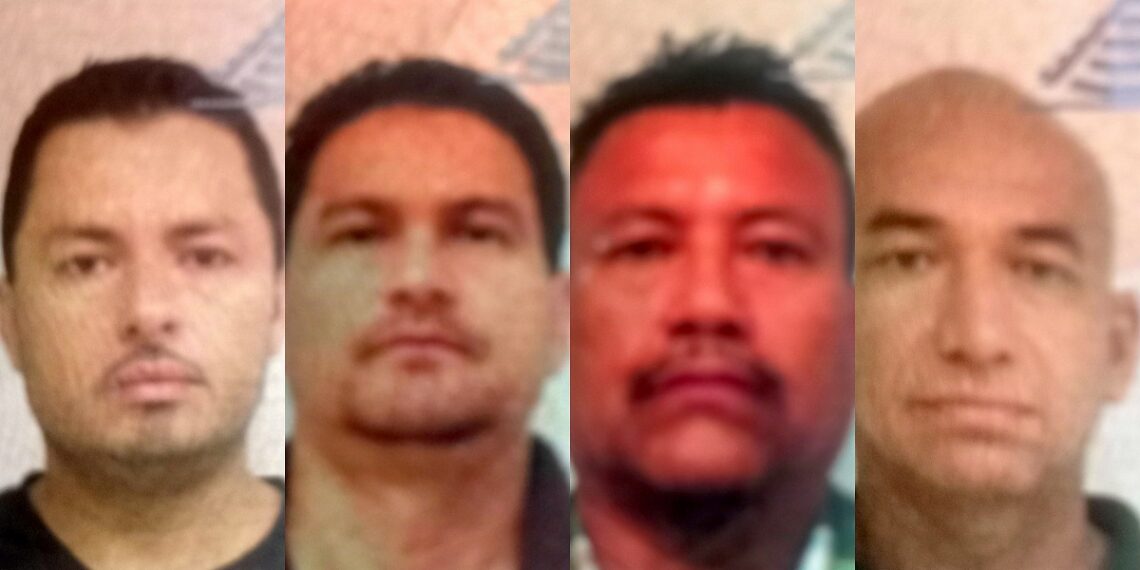
They include five Nigerians – Anthony Umolu, Chibi Aruh, Izuchukwu Anieto, Williams Agusi and Augustine Koisochukwu Umolu with four Mexican conspirators who are said to be on international watchlists.
The Mexicans known to be part of a large cartel of drug traffickers with extensive reach around the world are Cervantos Bruno, Rivas Pstiano, Castillo Ctistobal and Patida Pedro.
Shortly after their arrest in 2016, the NDLEA charged them with five counts that attract between 15 to 25 years in jail under the NDLEA Act.
They all maintained their innocence from the inception of the case in 2016 until recently when they changed their plea to “guilty” in a deal they struck with the NDLEA.
Nearing the end of the prosecution’s case with 13 witnesses already called, the NDLEA entered into a plea agreement with the drug barons, proposing 10 years’ sentence that would be backdated to 2016.
The deal, aimed at reducing the convicts’ jail time by the six years period they had spent in detention while facing trial, was to leave them with less than four years to spend in prison.
‘Compromise’
Incensed by what he described as an “unreasonable”, “perverse” and “ill-motivated” plea bargain agreement, Mr Abang adopted the 10 years jail time proposed in the plea agreement but refused to backdate it.
He ordered the 10 years sentence to start counting from the day of his judgement on Tuesday.
“I cannot in good conscience backdate the sentence,” the judge said.
He said the plea agreement was insensitive to the gravity of the convicts’ offences and the quantum of scarce resources the government had deployed in prosecuting the offenders over the years.
He also described it as an afterthought, coming too late when the prosecution had already established the defendants’ guilt.
“The defendants made confessional statements that would even secure conviction on their own,” Mr Abang said and maintained that the plea bargain agreement was unjustifiable.
He said the defendants were “caught in the act”, with their confessional statements and the illicit substances seized from them tendered and admitted in evidence.
Citing section 270(2) of the Administration of Criminal Justice Act, Mr Abang said NDLEA could only have entered into a plea agreement with the defendants “where there is no sufficient evidence on record to secure a conviction.”
“Whereas, there is sufficient evidence to secure a conviction,” Mr Abang said, adding that the NDLEA failed to provide any reasonable excuse for “settling with drug barons”.
He expressed regrets that, with the filing of the plea agreement, the law hindered him from ordering NDLEA to proceed with the trial.
In another devastating blow to NDLEA’s growing profile of integrity and toughness on illicit drug trafficking, the judge identified many landed assets seized from the defendants but unaccounted for in the plea bargain agreement.
He noted that the NDLEA “compromised” the case to help the convicts to leave prison early enough to enjoy their illicitly acquired wealth.
“This is a case where the NDLEA compromised, waved the law, agreed on terms of conviction, backdated the terms of imprisonment assuming judicial powers where none exists, to enable the drug barons to come out of jail to enjoy their illegitimate wealth,” Mr Abang said.
Drug barons and their ‘clandestine lab’
The defendants were arrested at a “clandestine” laboratory in Asaba, Delta State, on 3 March 2016.
They were producing cocaine-like drug – methamphetamine – and extracting ephedrine, another illicit substance, at the laboratory located in a warehouse along Ibusu-Asaba Expressway, Delta State.
The five Nigerians had engaged the four Mexicans to help them to build, equip, and operate the laboratory.
Before their arrest, the Mexicans led drug trafficking from the West coast of Africa, Nigeria in particular, to eastern and southern Africa, Europe and South America.
Their notoriety in illicit drug trafficking had put them on the watchlist of world illicit drug tracking organisations, the NDLEA had told the judge during the trial.
They are also known to be well-versed in the different aspects of the value chain of the illicit drug business.
The well-equipped modern laboratory they helped to set up in Asaba was with an installed capacity to produce four tons of cocaine-like methamphetamine per production cycle of seven to eight hours.
NDLEA arrested them and their Nigerian conspirators with 1.5 kilogrammes of methamphetamine, and 63 grammes of another cocaine-like brownish substance during the raid on the facility in March 2016.
Charges
The agency, in March 2016, charged them with five offences, including unlawful extraction of ephedrine and preparation of methamphetamine, “a drug similar to heroin, and LSD.”
It also charged them with the operation of an illicit drug trafficking organisation through which they processed and exported methamphetamine.
In other counts, the agency accused them of running, managing and financing a drug trafficking organisation, as well as being in unlawful possession of illicit drugs that they were arrested with in 2016.
The offences charged under sections 11(d), 14(b), 20(1)(g) of the NDLEA Act attract punishment ranging from 15 to 25 years and forfeiture of the proceeds of crimes.
As of 3 July, when the agency and the defendants signed their plea agreement to enable the convicts to spend less than four more years in jail, the trial had gone on for six years and a total of 21 witnesses had testified.
Of the 21 witnesses, 13 of them were prosecution witnesses who testified during the trial, bringing the prosecution near to closing its case.
The rest eight witnesses testified during a trial-within-trial called for by the defendants to challenge the admissibility of their confessional statements.
Four of the eight witnesses who testified during the trial-within-trial were called by the defendants while the other four gave evidence for the prosecution.
The judge, at the end of the trial-within-trial, dismissed the defendants’ objection to the admissibility of their confessional statements and confirmed that they were made voluntarily.
In the case hardly fought for six years, the NDLEA went up to the Supreme Court expending time and scarce resources to ensure that the defendants were not granted bail.
Four ways NDLEA’s plea agreement violated the law
In his judgement on Tuesday, Mr Abang pointed out that the plea agreement failed to meet any of the four pre-conditions enumerated in section 270(2) of the Administration of Criminal Justice Act (ACJA).
Firstly, the judge said NDLEA could only have entered a plea agreement in a criminal case after obtaining the consent of the victims of the alleged crime.
In this case, Mr Abang said the NDLEA was not the victim, but the Nigerian society that had been traumatised by banditry, terrorism and other violent crimes perpetrated by the consumers of hard drugs.
He, therefore, said drug-related cases were not ones in which the NDLEA could enter into a plea agreement due to the impossibility of obtaining the consent of the victims for that purpose.
He added that by virtue of the ACJA provision, the NDLEA could only have entered into a plea agreement with the offenders where there was no sufficient evidence to secure the conviction of the offenders.
In violation of the provision, Mr Abang said, NDLEA struck a deal with the drug barons after successfully establishing the guilt of the defendants.
He also noted that the defendants refused to cooperate with investigators, contested every piece of evidence tendered by the prosecution during the trial, appealed the ruling denying them bail up to the Supreme Court, and also wrote a petition against him to frustrate the case.
Mr Abang also said the other condition that the offenders must have conceded to forfeit the proceeds of crimes before a plea agreement could be entered with them was also not fulfilled.
He noted that the landed assets seized from the defendants in Abuja as well as Lagos, Ogun and Anambra States were not presented for forfeiture in the plea agreement.
He added: “The NDLEA has not disclosed the entire property recovered from the convicts admitted in evidence in the purported plea bargain dated 30 June 2022 that ought to have been forfeited to the federal government of Nigeria.”
Scanty assets forfeited
The judge, after sentencing the convicts to 10 years imprisonment with effect from Tuesday, ordered the forfeiture of the few of their assets agreed on in the plea agreement.
The assets ordered to be forfeited to the federal government are a Mercedes Benz ML4 350 car, a Toyota Tundra Hilux van, as well as the sums of N20 million and N894,463.43 recovered from the convicts.
Mr Abang ordered the sums of money to be paid into the federation account with the Central Bank of Nigeria (CBN) within 30 days.
He also ordered NDLEA to file evidence of compliance with the order of payment within 60 days.
He ordered that the Mexicans “shall be deported from Nigeria upon completion of their jail terms and their passports released to them by the Chief Registrar of the court.”
Court drama
The defendants were produced in court on Tuesday guarded by armed personnel of prison officials. The court itself had a heavy presence of armed personnel of the police and the State Security Service (SSS).
They were led to the courtroom on the first floor of the court complex.
Their countenance remained calm until towards the end of the three hours-long judgement when it became clear the judge was not going to accept the terms of their plea agreement hook, line and sinker.
At that point when the reality dawned on them, the defendants standing around the dock not far from the left side of the judge’s bench were seen conferring among themselves.
They could be seen muttering while they put their heads together. The judge, not interested in the conference they were having, continued reading his judgement.
But as their conversation ended, they adjusted their posturing to continue listening to the judgement, and in the next moment, they all went down on their knees. Facing the judge, they held their palms together towards him appealing for leniency.
The judge, angry at the disruption of his reading, shouted at them to get up.
“Get up, please, I don’t have time for this drama,” the judge growled.
Reluctantly, they got up to their feet and the judge proceeded to pronounce their guilt and sentence.
The judge had devoted the first thirty minutes of the proceedings to listening to the prosecuting lawyer from the NDLEA, Umar Husseini, and the defence lawyers.
The defence lawyers – Kalu Onwuchekwu, I.U Uchechukwu, Victor Igbuche who represented the four Mexicans, and G.O Onyeka – with the prosecuting lawyer, had all defended the plea bargain agreement.
They said it was in the public interest, and in line with section 270(2) of ACJA which they argued allowed the parties to enter into a such a plea agreement at any stage before the prosecution closed its case.
They also said their clients were remorseful and the money recovered from them could be ploughed into NDLEA’s sensitisation programmes and fight against illicit drugs.













 News4 years ago

 Privacy5 years ago

 News5 years ago


 News5 years ago

 Opinion5 years ago

 News6 years ago

 Sports5 years ago