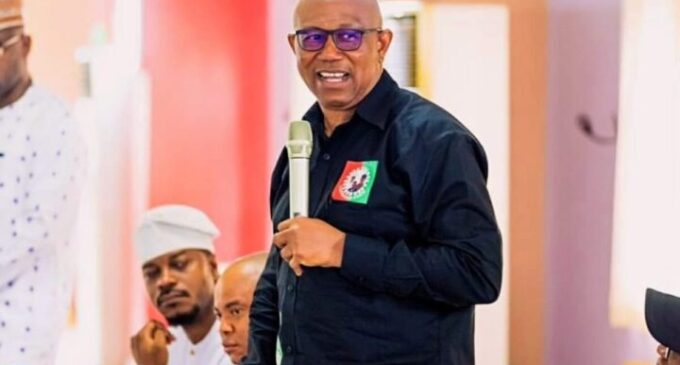
The campaign team of the presidential candidate of the Labour Party (LP), Peter Obi, is currently making moves to raise funds from Nigerians in the diaspora in order to execute the February 25, 2023, presidential election.
Last Monday, Julius Abure, LP national chairman, inaugurated an 11-member committee to organise the party’s diaspora activities in a bid to ensure the inclusiveness of Nigerians in the diaspora in the presidential campaign of Obi.
Speaking during the inauguration in Abuja, Abure said one of the committee’s terms of reference is to organise fundraising activities for the party.
“Their terms of reference, one, recommend to the national chairman the creation of diaspora chapters. Two, monitor the activities of diaspora chapters and report to the national chairman,” Abure said.
He added that the functions include organising “fundraising activities and donations to the party after liaising with the party”, and facilitating “travel arrangements for party officials and to perform any other functions connected thereto”.
The inauguration of the diaspora committee coincides with the foreign tour of the former Anambra state governor.
In the past few weeks, Obi has been to the United States of America, Canada, London, Rome and Germany to engage with Nigerians and seek their support for the 2023 presidential elections.
In one of his engagements with Nigerians in the diaspora, Obi said if elected president, he would turn Nigeria’s brain drain to gain, adding that the country is yet to fully harness the huge benefits of its citizens living abroad.
As Obi intensifies his international engagements, there have been a series of reactions from Nigerians, particularly in relation to the fundraising efforts of his supporters.
A report by THISDAY indicated that Nigerians in the diaspora have formed committees to create a crowdfunding portal to raise $150 million from Obi’s supporters in the diaspora and N100 billion from those in Nigeria.
APC SUPPORT GROUPS KICK AGAINST DIASPORA CROWDFUNDING
The decision of Obi’s supporters to crowdfund his campaign has generated some controversy, particularly on the legality of the initiative.
Tinubu-Shettima Connect, an All Progressives Congress (APC) support group, has asked the Independent National Electoral Commission (INEC) to disqualify Obi from what it described as a “violation of the electoral act”.
The group insinuated that it will file a legal suit against Obi over the development.
Another group, The Progressive Clan, in a statement, kicked against the decision to raise funds from Nigerians in the diaspora, while asking INEC to intervene in the matter.
“To be clear, these acts are an affront to the sacred provisions of the Constitution of the Federal Republic of Nigeria and the Electoral Act,” the group said.
“They are unlawful and the Independent Electoral Commission (INEC) must arrest illegalities immediately to assure Nigerians that the 2023 elections would not be influenced from outside in any form.”
THE LAW ON DIASPORA FUNDS
The 1999 constitution (as amended) and the Electoral Act of 2022 have provisions for the role of INEC in the collection of annual statements of political parties, analysis of sources of funds and restrictions on campaign funds.
Section 225 (3)(a) of the 1999 constitution prohibits political parties from having assets or funds in foreign countries.
Section 225 (3) states that: “No political party shall — hold or possess any funds or other assets outside Nigeria; or be entitled to retain any funds or assets remitted or sent to it from outside Nigeria.
“Any funds or other assets remitted or sent to a political party from outside Nigeria shall be paid over or transferred to the commission within twenty-one days of its receipt with such information as the omission may require.”
Section 85 of the Electoral Act 2022 reechoes the provisions of section 225 of the 1999 constitution.
Section 85 states: “Any political party that – (a) holds or possesses any fund outside Nigeria in contravention of section 225 (3) (a) of the Constitution, commits an offence and shall on conviction forfeit the funds or assets purchased with such funds to the Commission and in addition may be liable to a fine of at least 5,000,000; or (b) retains any fund or other asset remitted to it from outside Nigeria in contravention of section 225 (3) (a) of the Constitution commits an offence and shall on conviction forfeit the funds or assets to the Commission and in addition may be liable to a fine of at least N5,000,000.”
‘OBI — NOT LP — CAN RAISE FUNDS’
Timi Olagunju, a lawyer and policy analyst, said the electoral act does not forbid “receiving” funds from Nigerians in the diaspora, adding that the law specifically used the words “hold” and “possess” instead.
“Nigerians in the diaspora can send funds to individuals (in this case Mr. Obi or anyone who receives it as a gift on his behalf) through any means, for example, Western Union.
“A non-governmental organization, can also receive such and promote activities on behalf of a candidate or party, as there is no statutory provision that prevents Nigerian NGOs from engaging in advocacy or from endorsing candidates for public office,” he said
However, he further clarified that political parties cannot directly receive foreign funds into their domiciliary or any other account, in its name for the purpose of an election, adding that this is a clear breach of the law.
Another legal practitioner, Festus Ogun, in a legal opinion sent to TheCable, said Obi and his presidential campaign team did not violate any extant law in Nigeria.
According to Ogun, it is only political parties that are covered by the provisions of section 225(3)(a)(b) of the 1999 constitution, not political candidates or their campaign organisations.
“In our considered view, 225(3)(a)(b) of the 1999 Constitution is only applicable to political parties and it is not applicable to political candidates or their campaign organizations,” the legal practitioner said.
“It is not a subject of debate that the diaspora donations are said to be made to either Peter Obi and or his campaign organization. The question that follows is whether Peter Obi or his Campaign Organization(s) is a political party envisaged under 225(3)(a)(b) of the 1999 Constitution.
“Section 318 of the 1999 Constitution gives no definition for a “political party”. Thankfully, Section 152 of the Electoral Act, 2022 defines a “political party” to include “any association of persons whose activities include canvassing for votes in support of a candidate for election under this Act and registered by the commission”.
“We respectfully submit, therefore, that a candidate or his campaign organization(s) cannot be regarded as a political party under our extant electoral jurisprudence.
“Having cleared that, it is safe to say that donations made to Mr. Peter Obi or his campaign organization in furtherance of his presidential campaign cannot be said to be made to a political party as envisaged under 225(3)(a)(b) of the 1999 constitution.
“Neither Mr. Peter Obi nor his campaign organisation is a “political party” and must not be mistaken or confused for Labour Party, a duly registered political party under the law.
“It would have been a different ball game entirely if the donations were made to Labour Party, as a political party. Donations made to political candidates or their campaign teams are not caught under 225(3)(a)(b) of the 1999 constitution and Section 85 of the Electoral Act and are therefore not illegal and unconstitutional.”
Meanwhile, in an Arise Television interview aired on Monday, Paul Ananaba, a senior advocate of Nigeria (SAN), said a political candidate “is not barred from raising funds from the diaspora”.
“If Obi is raising funds from the diaspora as an individual that is correct, but as a political party it is entirely wrong. The law does not define a political party to include the candidate and neither does the definition of the candidate include the political party.
“The Electoral Act limits the amount a presidential candidate can spend on an election campaign to N5 billion.”










 News4 years ago
 Privacy5 years ago
 News5 years ago

 News5 years ago
 Opinion5 years ago
 News5 years ago
 Sports5 years ago