Connect with us

Metro News

I was wrongly jailed, Nigerian in US prison, Abegunde, cries for help

Published

on


In 2014, Mr. Olufolajimi Abegunde, relocated to the U.S. He aimed to pursue a Master of Business Administration (MBA) degree at Texas A & M University in College Station, Texas.

Upon graduation in 2016, and recognizing opportunities in the remittances industry, he incorporated FJ Williams Inc. doing business as (DBA) TranzAlert, a financial technology start-up. He is currently serving a jail term in the US.
In this interview, Abegunde speaks on his ordeal.

MY STORY

‘I have been incarcerated for over 50 months in the U.S prison. Things are tough and hard here. My travails began in August 2016 when a long-time friend, Ayodeji Ojo, visited me in the US from Nigeria along with his pregnant wife and infant daughter.

Ojo and his family were accommodated at my home in Atlanta, Georgia. At the time of the visit, Ojo had a wholly legitimate cheque of $26,900 that was issued to him by Bank of America. He intended to cash the cheque and utilise the funds for expenses associated with his family’s trip, including medical expenses related to his pregnant wife.

After being unsuccessful in his attempts to cash the cheque at multiple Bank of America branches, due to the relatively large size of the cheque, Ojo was advised by a Bank of America banker to open a new bank account at another bank, to let the cheque go through the clearing process before the funds would become available to him.

Ojo chose Wells Fargo Bank, and at Wells Fargo, he was told that he was required to provide a valid identification document, and contact information for correspondence in the form of a US mailing address and a US mobile phone number. Ojo informed the Wells Fargo banker that he was a visitor in the US and did not have a US mailing address and a US mobile phone number.

After Ojo asked me, I permitted him to utilize my address and mobile phone number to open the account. And so the bank account was opened on August 29, 2016, and Ojo was able to access the funds two days after without any challenges. From 2014 to 2016, there was a financial crisis in Nigeria around that time, and the government had stopped providing U.S. Dollars through official channels.

So people and businesses that needed U.S. Dollars had no choice but to access it through informal channels; which is a fancy way of saying the black market in Nigeria. In other words, informal currency exchange services became a de facto part of the marketplace for exchanging currencies, such that there is no legal requirement for buyers to know the sources of the funds the seller is exchanging.

So after about three months that my friend left my house and back to Nigeria, he needed to buy some U.S Dollars, he approached one Leke Adenuga , who after agreeing on the rate requested that he provide his U.S. bank account (that he opened using my address and US mobile phone number) for the deposit of the agreed US Dollar amount of $9,000.

See also  Nigerians now at the mercy of bandits, terrorists- Fayose

In other words, Ojo simply engaged in a foreign exchange transaction where he gave up the Nigerian Naira equivalent of $9,000 for the actual $9,000 which Ojo neither accessed nor spent.

Needless to say, with the FX situation at the time, Ojo cannot be blamed for an innocent transaction with Leke Adeleke due to the prevailing scarcity. Few days after that deposition took place, I received a phone call from Brian Ancona, an investigator with Wells Fargo Bank on my phone, the same mobile phone number Ojo had utilised to open his Wells Fargo Bank account, stating that a certain Luis Ramos Alonso had inadvertently deposited $9,000 into Ojo’s bank account, and was seeking a reversal of the $9,000 deposit.

I told Ancona that the account owner was in Nigeria, and attempted a three-way call to connect Ancona with Ojo (the owner of the account). The effort was, however, unsuccessful. I eventually got through to Ojo and conveyed Ancona’s urgent message regarding the reversal, in which Ojo immediately agreed and authorised the reversal of the $9,000 deposit. The $9,000 was reversed and I thought that was the end of the story.

THE POLICE

However, on March 15, 2017, two FBI agents – Kevin Hall, and Tyson Fowler of the Atlanta Field Division of the FBI – visited my home to inquire about Ojo. One of the agents pulled out a copy of Ojo’s Nigerian passport data page and asked if I knew the bearer of the passport data page. I confirmed to the agents that Ojo was a long-time friend who I had accommodated during Ojo’s visit to the U.S. in August 2016.

I also confirmed to them that I had granted Ojo permission to utilize my address and mobile phone number to open a bank account with Wells Fargo Bank for the reason that Ojo resides in Nigeria and neither had a U.S. address nor a U.S. mobile phone number.

The agents engaged in wide-ranging convivial discussions about my remittances business and fraud in general. In these discussions, I vehemently and categorically condemned all forms of fraud. With the benefit of hindsight, two questions by the agents stood out and should have raised thunderous alarm bells. The questions were asked by agent Tyson Fowler.

The first was ‘How is it that you can afford a place like this?’ And the second was ‘why do you Nigerians like to defraud Americans?’ After the second question, Kevin Hall appeared to have an adverse reaction to the question and Fowler ceased going further. I offered the agents full cooperation by providing them Ojo’s contact information and also ensured that Ojo contacted the agents’ shortly after they departed my home.

See also  Troops stops international smuggling syndicate, intercept ammunition bound for Anambra

I thought that was the end of the story. Unfortunately, the decision to hospitably open my doors to the FBI agents, and engage in unfiltered innocent discussion with them – in the absence of competent legal representation led to my undoing. On February 7, 2018, I had intended to travel to the Dominican Republic.

However, due to circumstances beyond my control, the trip had to be rescheduled. So I went to the airport on that day to effect the flight change. The initial ticket was scheduled for a departure from Atlanta on February 7, 2018 and return on February 10, 2018.

And the rescheduled ticket was booked to depart Atlanta on August 30, 2018, and return on September 2, 2018. This unequivocally indicates that I did not intend to depart the U.S.

To my greatest surprise, we were done with the flight change, and were walking away from the check-in counter when all of a sudden two men in plain clothes who identified themselves as Immigration and Custom Enforcement (ICE) officers that were acting on behalf of the FBI accosted me with so much force that I was both confused and terrified. I kept telling them they had the wrong person.

After placing me in handcuffs, they took out my wallet from my pocket, took out my driver’s license, and then brought out an arrest warrant to confirm my identity. It turned out that they did not have the wrong person. The initial indictment charged me and Ojo with the same Counts of Wire Fraud Conspiracy, Money Laundering Conspiracy and Aggravated Identity Theft.

Court records show that there was no evidence to support these charges. At the bond hearing held on June 25, 2018; under cross-examination by my attorney at the time, FBI Special Agent David Palmer – one of the lead case agents – was questioned regarding the bank account that Mr. Ojo opened using my address.

My attorney: was there anything illegal about that? Is there anything illegal about using an address you know, as a point of reference to a bank to open an account? Agent Palmer: No. As long as we’re assuming there’s permission.

Again, at the trial, the testimony of one of the FBI agents that investigated the case – Special Agent Marcus Vance – corroborates the facts that Ojo’s account was opened August 29, 2016; a wholly legitimate cheque of $26,900 was deposited into the account on the same day; and that there was no evidence that the check was associated with the July 25, 2016 fraud in particular, or any form of fraud in general.

Wells Fargo Investigator, Brian Ancona also confirmed during the trial that his calls to my phone led to the reversal of the $9,000 deposit because Ojo did not protest when asked to return the money.

See also  Good morning! Here Are Some Major News Headlines In The Newspapers Today: Niger's junta expels French ambassador

The entire case was centered on the infamous $9,000 transaction. However, from the indictment to my sentencing – there is no evidence whatsoever that reflects any link between me and the $9,000 transaction.

Rather, all the evidence on the record points to the fact that I was neither directly nor remotely connected to the $9,000 transaction. No evidence was also found on my seized devices to show money laundering, or any involvement with BEC, romance scams or fraud in general.

Similarly, testimony by Mr. Theodore Vlahkis, an expert witness from the Financial Crimes Enforcement Network, as well as testimony from Special Agent Marcus Vance, made it abundantly clear that my business, FJ Williams Inc. DBA TranzAlert was in full compliance with its regulatory obligations and so did not violate any anti-money laundering policy. U.S. District Courts Judge, Judge Sheryl Lipman sentenced me to 78 months in prison and ordered that I pay $57,911.62 in restitution despite no evidence that I knowingly received illicit funds. So I call on our government in Nigeria to look at the case and the evidence. All the evidence are documented and available online.

Current situation

The prosecutors presented falsehoods that were not only unsupported by the evidence at trial but were actually contrary to the evidence at trial – to the jury during trial summation. For reasons I do not understand why my lawyer did not object to these falsehoods. I appealed the case and the Appeal Court didn’t look at the case at all nor consider any of the evidence on the record.

Rather, the Appeal Court swallowed the prosecutor’s falsehood hook, line and sinker. I then approached the Supreme Court. They declined to pick up the case. So I am working on another appeal right now, if history is a guide, I am not likely to get justice through the U.S Court system. However, I see a remedy. If there is enough public attention to my case, the U.S justice system will be forced to deliver justice. If we can put a spotlight on my case, by pushing the evidence out for the whole world to see, I will become a free man and my reputation will be resuscitated.

Call on Nigerian government/Human Rights organisations for aid

Nigeria has a bilateral relationship with the United States. The Attorney General of Nigeria can contact the U.S Attorney General to demand a review of my case.

The Minister of Foreign Affairs, as well as the Head of the Nigerian Diaspora Commission, can also utilize diplomatic channels – with their U.S counterpart – to demand Justice in my case.

I am also using this medium to call on civil/ human rights organizations – in the U.S, and all around the world- to use their resources and capabilities to bring about justice in my case.


CULLED FROM VANGUARD NEWSPAPER

Continue Reading
Click to comment

Leave a Reply

Your email address will not be published. Required fields are marked *

Metro News

NDLEA arrests Ugandan woman with 87 wraps of cocaine hidden in private part

Published

on

By

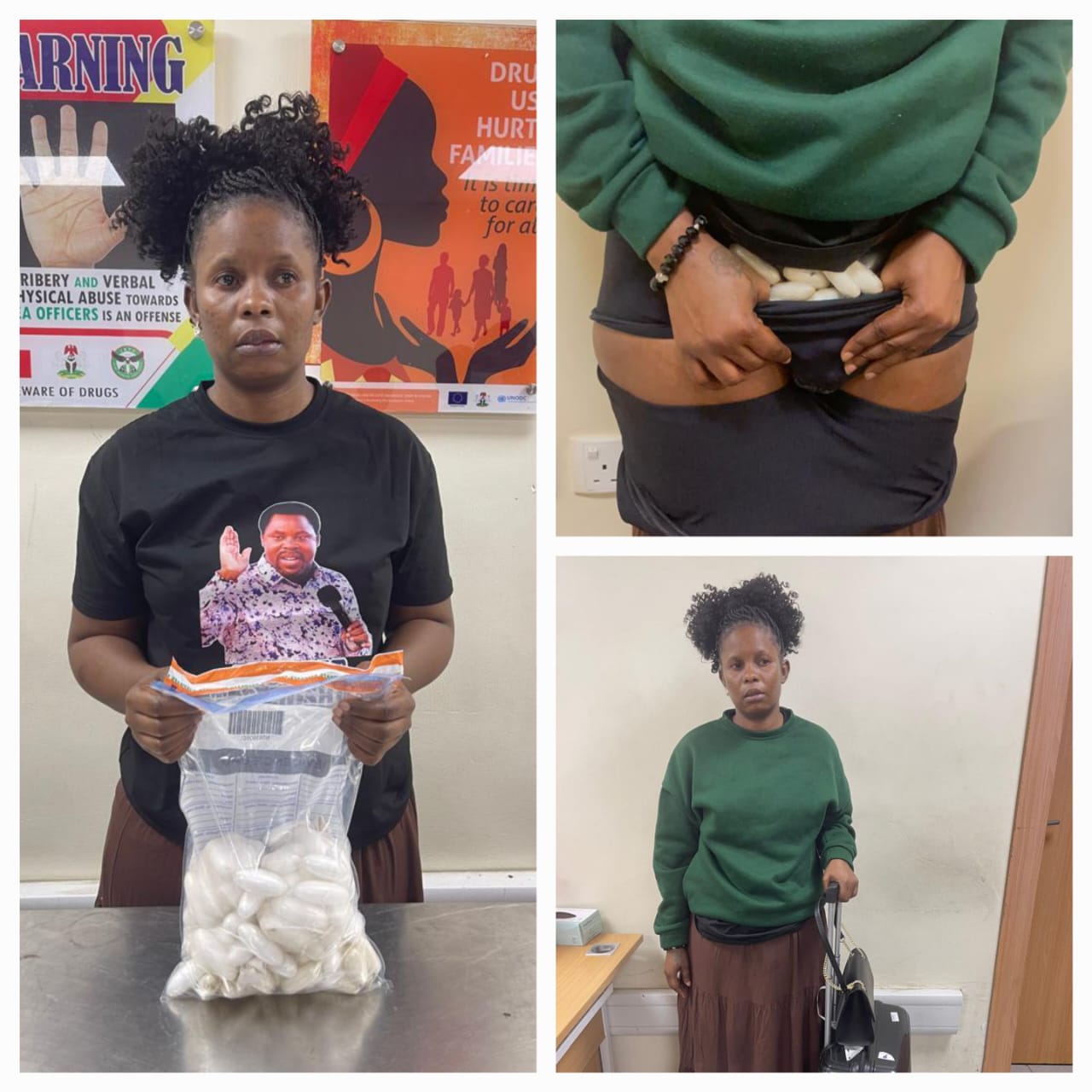
Operatives of the National Drug Law Enforcement Agency ((NDLEA) have arrested a 34-year-old Ugandan woman, Farida Nansubuga,  for allegedly attempting to smuggle 1.15 kilogrammes of cocaine from Nigeria to Uganda.

Nansubuga was arrested at the Murtala Muhammed International Airport, Ikeja, Lagos, on Tuesday, November 3, while preparing to board a flight to Uganda.

According to a statement by the agency’s Director of Media and Advocacy, Femi Babafemi, on Sunday, 87 wraps of cocaine were recovered from her pelvic region, where they had been strapped beneath two layers of underwear.

The suspect reportedly arrived in Nigeria on October 29 with members of her church for a prayer session at the Synagogue Church of All Nations in the Ikotun-Egbe area of Lagos State.

According to Babafemi, the other members of her delegation had returned to Uganda after the prayer session, but Nansubuga remained in Nigeria to allegedly collect the cocaine on behalf of a friend identified as Joy, who lives in Uganda.

He said the suspect was intercepted during a joint passenger screening exercise involving NDLEA operatives and aviation security personnel at Terminal 2 of the airport.

See also  Police to arraign Portable today

“She came to Nigeria with members of her church for spiritual renewal at a prayer session in Lagos. But when it was time to go home, 34-year-old Ugandan, Ms Farida Nansubuga, chose a different path. While the rest of her delegation flew back to Uganda, she stayed behind, not to pray some more, but to pick up a consignment of cocaine, which she hid in her private part in a bid to smuggle it into her country.

“Her plan, however, came crashing down at the MMIA, Ikeja, Lagos, on Tuesday, 3rd November 2026, when operatives of the NDLEA intercepted her at the screening point of Terminal 2 during a joint passenger screening exercise with aviation security personnel. She was due to board a Ugandan airline flight to her home country,” the statement partly read.

Babafemi said a preliminary investigation reportedly revealed that a contact in Nigeria arranged a vehicle to convey her to a hotel on the morning of her scheduled departure, where an unidentified man handed her the drugs.

See also  Ghana dumped out of AFCON by debutant Comoros

The suspect allegedly told investigators that she was instructed to conceal the cocaine beneath her clothing to evade airport security screening.

He said, “During preliminary interview, the suspect said she arrived in Nigeria on 29th October 2026 with members of her church for a prayer session at The Synagogue Church of All Nations, Ikotun Egbe area of Lagos. She claimed that after the prayer session, the other members of her delegation returned to Uganda while she stayed back to collect the illicit consignment on behalf of a friend, simply identified as Joy, who resides in Uganda.”

She reportedly said that although no definite payment was agreed upon, she expected to receive at least $1,000 after successfully delivering the consignment in Uganda.

The NDLEA Chairman, Brig-Gen. Mohamed Buba Marwa (retd.), described the incident as a reminder of how drug cartels exploit religious activities and travel to recruit couriers.

Marwa, while commending officers involved in the arrest, urged personnel across the agency’s commands to sustain efforts to tackle drug trafficking and abuse.

See also  Nigerians now at the mercy of bandits, terrorists- Fayose

“The case of the Ugandan woman is a sad reminder that drug cartels will stop at nothing, including exploiting faith and religious travel, to recruit couriers for their deadly trade. I urge officers across all commands to sustain the tempo of their supply and demand reduction efforts, ” he said.

In another operation at the Lagos airport, operatives intercepted 750,000 tablets of Tapentadol 250mg, weighing 526 kilogrammes and valued at N900m.

The consignment, which arrived from India aboard an Ethiopian Airlines flight, was allegedly declared as Paracetamol tablets.

“In another interception at the Lagos airport, NDLEA operatives on Friday, 6th November uncovered 750,000 tablets of Tapentadol 250mg, weighing 526 kilograms with a street value of N900 million, in a consignment from India declared as Paracetamol Tablets 500mg. The consignment, made up of eleven cartons packed in two wooden structures, arrived at the import shed of the airport on Tuesday 3rd November aboard an Ethiopian Airlines flight from Ahmedabad, India,” he said.

Continue Reading

Metro News

NDLEA arrests two France-bound Nigerians with 200 cocaine wraps

Published

on

By

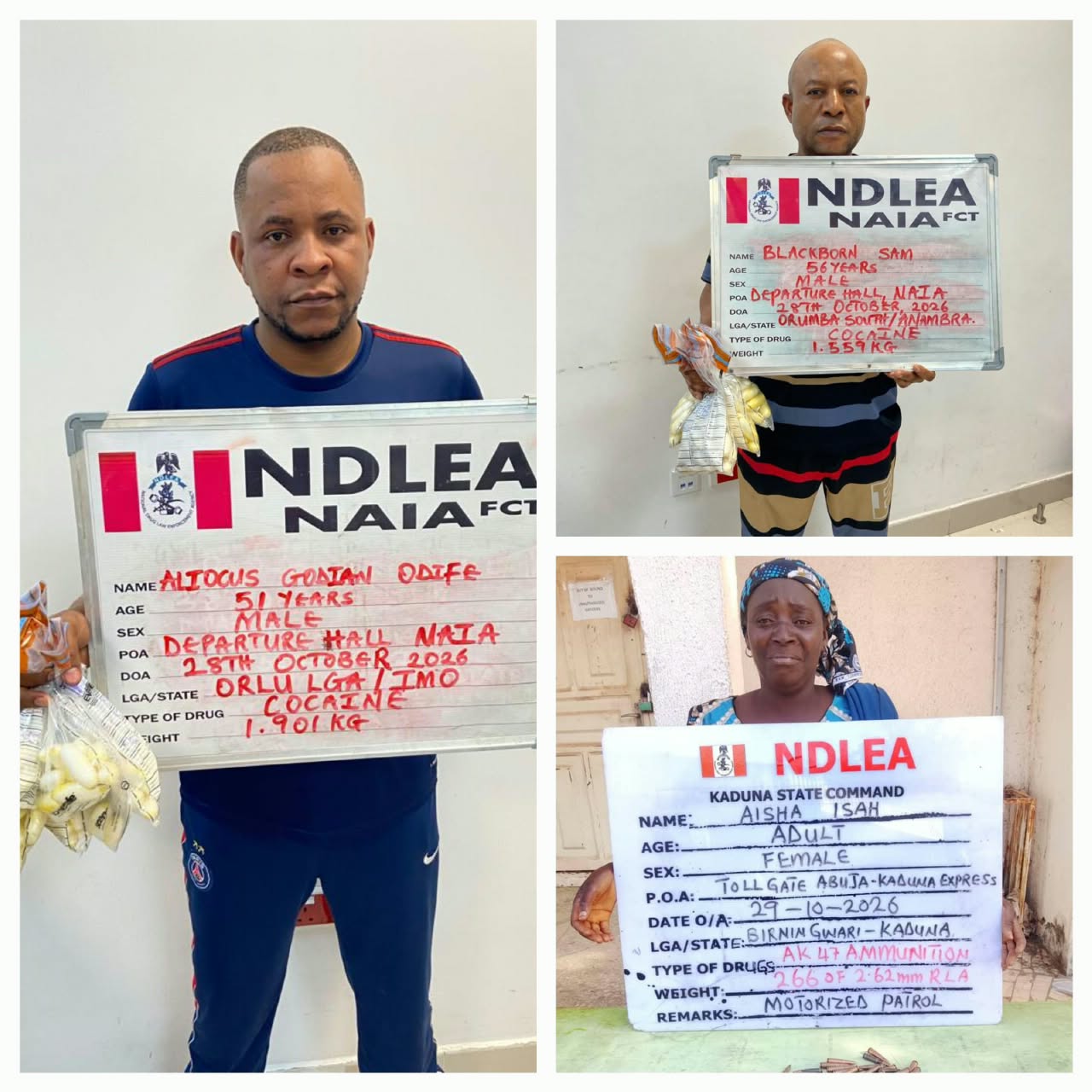
The National Drug Law Enforcement Agency (NDLEA) says its operatives have arrested two Nigerians based in Europe with ingested 200 wraps of cocaine weighing 3.46Kg while attempting to travel from Abuja to Paris, France.

According to a statement issued on Sunday by NDLEA’s spokesperson, Femi Babafemi, the suspects, identified as Aliocus Odife and Sam Blackborn, were arrested on Wednesday, October 28, during the outward clearance of an Air France flight, AF 832, at the Nnamdi Azikiwe International Airport, Abuja.

Babafemi said the suspects, who had returned to Nigeria for holidays, were arrested after body scans confirmed that they had ingested illicit substances.

He said Odife, who lives in France and works in a factory, arrived in Nigeria on October 21 for a short holiday but was arrested while attempting to return to Europe.

Odife was said to have confessed to ingesting 110 wraps of cocaine, which he subsequently excreted under observation. The drugs weighed 1.901kg.

See also  Troops stops international smuggling syndicate, intercept ammunition bound for Anambra

The statement partly read,  “Two Europe-based Nigerian ‘businessmen’ who flew home on holiday and attempted to return to Paris, France with their bellies loaded with cocaine have been arrested by operatives of the  NDLEA at the Nnamdi Azikiwe International Airport, Abuja.

“The duo, Aliocus Godian Odife and Sam Blackborn, were intercepted on Wednesday, 28th October 2026, during the outward clearance of Air France flight AF 832 from Abuja to Paris. Both men have excreted a total of 200 wraps of the Class A drug weighing 3.460 kilogrammes.

“Odife, who claims to live in France where he works in a factory, had arrived in Nigeria for a short holiday on 21st October.

“He was, however, arrested by NDLEA operatives on his return flight a few days later, when he was subjected to a body scan, which confirmed the presence of foreign objects in his stomach.

“Under interview, he admitted to having ingested 110 pellets of cocaine. He was placed under observation during which he excreted all 110 wraps, which tested positive for cocaine with a total weight of 1.901 kilogrammes.”

See also  Nigerians now at the mercy of bandits, terrorists- Fayose

Babafemi added that his co-traveller, Blackborn, also tested positive during a body scan and confessed to swallowing 90 wraps of cocaine.

According to the agency, he excreted all the wraps under observation, with the substances weighing 1.559kg.

Meanwhile, NDLEA operatives on patrol along the Abuja-Kaduna Expressway arrested a woman, Aisha Isah, with 266 rounds of live AK-47 ammunition

Continue Reading

Metro News

Yahoo boy jailed seven years for defrauding American $205,238

Published

on

By

A Federal Capital Territory High Court in Abuja has sentenced one Nwachi Chidozie Kingsley to seven years’ imprisonment for defrauding an American woman, Nicole Kierulff Sayers, of $205,238 under false pretence.

According to a statement issued on Thursday by Dele Oyewale, head,  media & publicity of the Economic and Financial Crimes Commission (EFCC),
Justice U.P. Kekemeke of the FCT High Court, Maitama, in his judgement, also also ordered Kingsley to refund the victim the full amount.

The EFCC said Kingsley was sentenced to seven years on each of the two counts against him, with the sentences to run concurrently at the Kuje Correctional Centre, Abuja, without an option of fine.

The charges bordered on possession of a document containing false pretence and obtaining money by false pretence in connection with a purported contract with the Federal Ministry of Works and Housing.

According to the Commission, one of the charges accused Kingsley of possessing a fake notice of intent to award a contract allegedly issued in his name by the ministry. The second count accused him of obtaining $205,238 from Sayers by falsely claiming that the money was needed to finance a government contract.

See also  Police to arraign Portable today

Testifying before the court, Sayers, an American lawyer based in Oregon, United States, said Kingsley first contacted her through Facebook on her birthday.

“I know the defendant. The defendant messaged me on Facebook on my birthday and he said he was a member of the same spiritual organization as me,” she told the court.

Sayers said their conversations later developed into a romantic relationship, which made her trust Kingsley and believe his claims.

According to her testimony, Kingsley subsequently requested money to facilitate the award of a contract by the Federal Ministry of Works and Housing. She said he claimed that some men were threatening his life because he had not provided the money required to secure the contract.

The witness told the court that Kingsley supplied her with details of the purported contract, including a logo and other information, which she believed because of the emotional attachment she had developed towards him.

She said his initial request was for $15,000, which he promised to repay within 45 days. She transferred the money through a money transfer application.

See also  POS operators in Lagos announce uniform fee of N500 per N10k for transactions

Sayers further testified that Kingsley later introduced her to members of his family during a video call, during which they allegedly thanked her for helping him secure the purported contract.

She said she had transferred approximately $40,000 to him before travelling to Nigeria to meet him in person.

According to the witness, she arrived in Abuja in March 2022 and spent two weeks with Kingsley at his rented house in Sun City, Abuja. She said she continued the relationship because she wanted to recover her money.

Sayers alleged that Kingsley subsequently requested additional funds for various purposes, including medical emergencies, surgeries, malaria treatment and supplies for the purported government contract.

She told the court that the requests involved more than 125 transactions and that, by her estimate, she transferred well over $200,000 to him within 12 months.

The witness also said Kingsley presented a document he claimed showed that he had attempted to transfer $10,000 to her.

See also  BREAKING: Court stops AGF, DSS from arresting Igboho, blocking accounts

According to her, he claimed that the bank had intercepted the transaction because the money was allegedly linked to the misappropriation of government funds, which he said had led to his arrest and detention.

Sayers further alleged that Kingsley asked her to provide money for his bail and for bribes connected to the purported criminal case.

She told the court that she repeatedly demanded a refund, adding that Kingsley eventually requested her bank details and promised to transfer the money the following day but failed to do so.

She said she later realised that he would not repay the money.

At the conclusion of the prosecution’s case, EFCC counsel, Fatsuma Muhammad, urged the court to convict and sentence Kingsley in accordance with the law.

In his judgment, Justice Kekemeke found Kingsley guilty on the two counts and imposed the prison terms without an option of fine. The court also ordered him to restitute the $205,238 to Sayers.

Continue Reading

Trending News