Connect with us

Business

Sallah: Prices of rams soar

Published

on


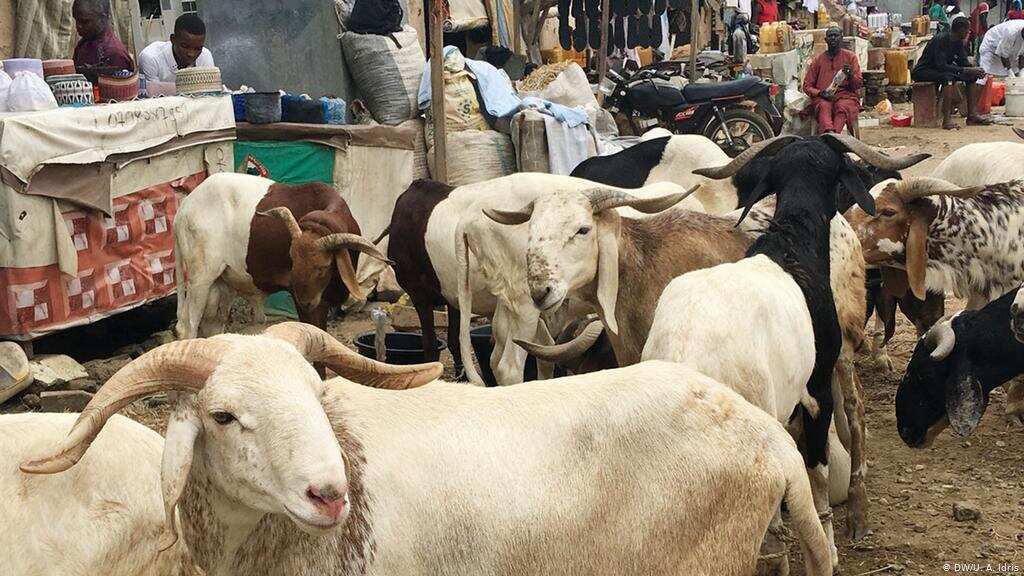
Ahead of the forthcoming Eid-el Kabir celebration, prices of animals used for sacrifice during the annual festival have skyrocketed beyond the reach of many celebrants, according to reports.


Every year during the Islamic month of Dhul Hijjah, Muslims around the world who have the means, slaughter animals like sheep, goat, cow or camel – to reflect the Prophet Ibrahim’s willingness to sacrifice his son Ismail, for the sake of God.


While it is not the only livestock acceptable, a narration in Sahih Muslim records that the Prophet Muhammad (pbuh) sought out horned, white rams to sacrifice during the Eid el-Kabir, as the ram of Prophet Ibrahim had been.


At least, one third of the meat from the animal should go to the poor or vulnerable people.


Like that of ram, prices of cow and camel have also hit the roof top, as findings by our correspondents revealed.


The hike in the cost of basic commodities in Nigeria has reflected itself boldly in the livestock sector, a situation that is likely to deny average Muslims the means to partake in the annual sacrifice amidst economic crunch.


Findings in Abuja, Kano, Yobe, Jigawa, Katsina, Lagos, and Port Harcourt, among others, showed that the cost of rams currently hover between N150,000 and N1 million, depending on the size and the location one is buying from.


Stakeholders interviewed blamed the situation on the insecurity around some major rearing states in the North West and North East, devaluation of the naira as well as withdrawal of fuel subsidy, which have in addition affected the price of animal feeds and the cost of transportation.


The Sultan of Sokoto, Alhaji Muhammadu Sa’ad Abubakar III, had declared Friday, June 7, 2024, as the First Day of Dhul Hijjah 1445AH and Sunday, June 16th, which will be equivalent to the 10th of Dhul Hijjah will be marked as this year’s Eid-El-Kabir.


Low patronage in Abuja

Few days to the Sallah celebration, sales have yet to pick up as noticed during a visit to the Abuja main livestock market located in the Dei-Dei area in the Federal Capital Territory, FCT.


This is a sharp contrast with the past when the market served as a rallying point for suppliers and off-takers well ahead of the Sallah festivity.


A livestock merchant in the market, Uzairu Dan-Kudalo, said that the insecurity problem bedevilling some major rearing states, like Zamfara, Sokoto, and Katsina, is affecting the sector, sending many stakeholders out of the business.


“I know a lot of our members from Zamfara State that lost their capital to this problem just in one fell swoop, after their communities were attacked by bandits or run into their trap along the way. You can see how our animals’ stalls look empty, and it is less than 10 days to the Sallah festivity.


“From Zamfara State alone, we used to receive a supply of no less than 30 trailers during this period, with each trailer loading between 200 and 250 rams,” he said.


“This does not include other mini trucks like canter, which used to supply without getting any attention. But as I am talking to you today, we are yet to receive any kind of supply from there. If you are talking about other states, by this time, a single merchant alone from other states like Kano, Jigawa, or Yobe, would supply about 200 rams into the market. However, many of them can no longer afford a capital of 50 rams now, due to the cost of transportation and the naira devaluation”, he said.

See also  Tinubu to hold bilateral meetings with Biden, EU president at UNGA


He said bulk buyers and individuals were also not forthcoming.


“By now, I would have finished with the supply of rams to all my regular customers who may decide to keep the animals here, or transport them to their agency, for onward distribution among the beneficiaries. But I am yet to witness this gesture so far,” he said.


Another trader, Yahuza Abdullahi, said that some of them that usually travel to the neighbouring countries like Niger, Chad, or Cameroun to supply the animals are now constrained as a result of the naira devaluation, which according to him has given an edge to the traders that come from the Francophone currency nations.


“Their currency (CFA) has greater value compared to the naira, and as such, nothing you can buy from those countries and expect to make any gain out of it there.


“Rather, the traders of those countries stand to gain a lot when they convert their currency to naira and export our commodities,” he said.


The price of ram has either tripled or doubled when compared with how it went last year.


The same thing goes to the animal feed and cost of transportation.


Given the breakdown of ram price, based on their categories, a trader, Abdullahi Adamu, said the smallest animal that attained the level of sacrifice currently sold between N120,000 and N150,000.


He said such categories of rams were sold between N70,000 and N100,000 last year.


According to him, a middle-sized ram, which sold between N150,000 and N180,000 last year now costs between N250,000 and N300,000.


There are also jumbo-sized rams, which cost from N800,000 and N1.4 million.


Same rams were said to be sold last year, at the rate of N500,000, while the biggest of all, sold at N1.1 million last year.


The same scenario is playing out at the animals’ feed commodity.


A breakdown of the commodity in the market indicates that a bag of animals’ feed extracted from raw beans is now sold between N13,000 and N14,000 per bag, depending on product quality and location. This is in contrast to the N7,000 to N8,000 sold last year.


Same goes to the dried groundnut leaves, which are currently sold at between N5,000 and N6,000, compared to previous year, when it was sold at between N3,500 and N4,000.


For the harvested corn by-product, its bag costs between N6,000 and N7,000, compared to the previous price of N4,000 and N4,500.
 

A bag of grounded maize by-product, or dusa in Hausa, is sold at between N18,000 and N20,000, compared to its previous price of N9,000 to N10,000 last year.


In the transportation sector, the traders said a canter truck supplying rams from Katsina or Kano that they paid between N200,000 and N250,000 last year, now goes for between N400,000 to N500,000.


Same truck transporting the animals from either Adamawa or Yobe states in the North East costs around N700,000, in contrast to between N400,000 and N500,000 paid in the past.


It was further learnt that transporting rams in trailer trucks from Mubi, in Adamawa State, a town neighbouring Cameroon Republic, now costs up to N1.5 million, as against last year’s N800,000.


They’re beyond our reach

An Abuja resident, Alhaji Shuaib Hassan who went to buy ram at the livestock market on Wednesday, left there disappointed, as according to him, the N200,000 he budgeted for the kind of ram he bought at N150,000 last year could not get him a ram as it now costs N300,000.

See also  Sallah: Tension in Kano as Ado Bayero invites district heads to Durbar amid Emirship crisis


He said he was contemplating returning to the market on Saturday when more traders, especially those from the rural areas, are expected to arrive.


Sani Yusuf said he found succour when he bought two rams at his home town of Bichi, in Kano State, two months ago.


“I bought them at the rate of N150,000, and so far, I have sent about N10,000 for their feeding. I am expecting to pay an additional N10,000 for their transportation from the area to Abuja in the company of other animals tomorrow,” he said.


There was the same lamentation from some roadside ram markets visited in the neighbouring Niger State.


A ram trader in Suleja town in the state, Abubakar Kwamba, predicted the likely drop in ram supply, as well as patronage of buyers this year, owing to the present economic reality.


“We are about 20 traders that supplied ram to this makeshift market last year. But as I am speaking to you now, there are only three of us that arrived, and still with lower supply, compared to what we brought last year. I could only afford to buy 12 rams this year, against 20 that I bought last year”, he said.


Sale outlets springing up in Kano

Roadside livestock markets are springing up in Kano, our correspondent reports.


At Kofar Naisa, where the sacrificial animals are available for would-be buyers, a trader, Yusuf Sani said they were bringing the animals from outside the state, in the hope of making little profit.


He said that the economic situation in the country makes everything look bleak at the moment, but he was hopeful that in the next few days, the market will record improved patronage.


He said the price of a big ram starts from N400,000, while medium-sized ones go for N300,000. A small-sized ram costs N100,000.


Another ram seller, Aminu Gwagwarmaya from Hauran Makaranta, said with N150,000, one can get a modest ram in the market.


Hajiya Ummah Kulthum Muhammad Lawan was seen at one of the markets.


She said the money she used and bought many rams last year, which she shared with relatives, will not give her half the number this time around.


“The price for each ram has almost tripled and only God can see us through,” she said.


At the Kofar Naisa Market, the price of camels range from N780,000, depending on the size.


It is permissible for three to seven people to contribute money to buy a camel or a cow for sacrifice and share the meat, clerics said.


The situation in Jigawa State is the same as merchants at Dutse temporary animals’ market lament low patronage.


One of them, Shafiu Hamisu, said scarcity of rams in the state has forced them to resort to buying from neighbouring states.


He said the prices of rams have increased significantly, with a big ram now selling for between N200,000 and N250,000, compared to less than N120,000 in 2023.


Sani Muhammad Bashir, a buyer at Dutse temporary ram market, said he will manage to buy the ram, though the price is very costly.


He called on the government to look into the matter and make things easy for the masses by finding ways to tackle inflation and provision of affordable means of transportation.

See also  ‘$200k was paid for my release’ — Fast-rising singer, Gnewzy recounts ordeal in kidnappers’ den


Yobe traders in a fix

In Yobe State, livestock sellers have decried low patronage of the sacrificial animal ahead of the Eid-el-Kabir.


The sellers said buyers are reluctant to come forward, saying this may not be unconnected with the high cost of the animals at a time people were struggling to buy food for their families.


The few buyers seen were lamenting over the price of ram and cow, which has increased significantly compared with last year.


A buyer at the livestock market in Potiskum, Adamu Umar, told Daily Trust Saturday that “A cow that you can buy at the cost of N400,000 last year, has now been increased to N650,000, while a bull, which we used to buy at N1,000,000 has now skyrocketed to N1,600,000.


“The situation of the market is not encouraging and by the body language of the buyers, you will understand that many people will not slaughter cows this year,” he said.


MD Adechu, a buyer from Lagos said that cattle are very expensive even though the Potiskum market is one of the largest livestock markets in the North.


“I don’t know what is happening; please, our government should make things easy for the masses and its citizens”, he said.


Abubakar Usman, a dealer said the price of a medium-sized ram starts from N100,000.


Another ram seller, Alhaji Zakari Yau, told Daily Trust Saturday that most of the buyers are from the southern part of the country.


In Lagos, Abduwasiu Ibrahim, a middleman, said rams and cattle are cheaper in the North.


“The ram that you can buy for N120,000 will cost you around N220,000 here; and a cow of N1,000,000 in the North will be sold at around N1,500,000 here,” he said.


He said the situation is the same in Port Harcourt, Enugu and Uyo.


“The reason is the cost of transportation and other challenges on the highway. You have to pay a lot of money to many tax collectors,” he said.


The same thing goes to the animal feed and cost of transportation.


Giving the breakdown of ram price, based on their categories, a trader, Abdullahi Adamu, said the smallest animal that attained the level of sacrifice currently sold between N120,000 and N150,000.


He said such categories of rams were sold between N70,000 and N100,000 last year.


According to him, a middle-sized ram, which sold between N150,000 and N180,000 last year now costs between N250,000 and N300,000.


There are also jumbo-sized rams, which cost from N800,000 and N1.4 million.


Same rams were said to be sold last year, at the rate of N500,000, while the biggest of all, sold at N1.1 million last year.


The same scenario is playing out at the animals’ feed commodity.


A breakdown of the commodity in the market indicates that a bag of animals’ feed extracted from raw beans is now sold between N13,000 and N14,000 per bag, depending on product quality and location. This is in contrast to the N7,000 to N8,000 sold last year.


Same goes to the dried groundnut leaves, which are currently sold at between N5,000 and N6,000, compared to previous year, when it was sold at between N3,500 and N4,000.


For the harvested corn by-product, its bag costs between N6,000 and N7,000, compared to the previous price of N4,000 and N4,500.


Continue Reading
Click to comment

Leave a Reply

Your email address will not be published. Required fields are marked *

Business

Wema Bank meets CBN’s recapitalisation, retains national banking license

Published

on

By

Wema Bank, Nigeria’s oldest indigenous national bank and pioneer of Africa’s first fully digital bank, ALAT, has successfully met and surpassed the Central Bank of Nigeria’s (CBN) recapitalisation requirements, reaffirming its status as a National bank.

This achievement represents a critical milestone in the Bank’s growth journey, reflecting its ability to meet regulatory expectations and its deliberate strategy to scale sustainably, strengthen its balance sheet, and reinforce its position within Nigeria’s banking sector.

The milestone follows the Bank’s successful completion of a ₦150 billion Rights Issue and an additional ₦50 billion special placement in 2025, bringing its Total Qualifying Capital to ₦264.7 billion, well above the regulatory minimum.

This achievement was concluded six months ahead of the CBN’s stipulated deadline, further reinforcing the Bank’s strong financial position, shareholder confidence, and long-term growth trajectory.

Earlier in April 2026, the Central Bank of Nigeria also formally confirmed that Wema Bank, alongside 32 other financial institutions across international, national, and regional categories, had successfully concluded the recapitalisation process.

Notably, Wema stands among only ten national banks that met and surpassed the minimum required capital threshold, thereby sustaining its national banking license.

See also  Tinubu to hold bilateral meetings with Biden, EU president at UNGA

This milestone not only affirms regulatory compliance but also signals a new phase of accelerated growth for the Bank; one defined by stronger capital base, increased capacity to support customers, and a reinforced position within Nigeria’s competitive banking landscape.

Commenting on the milestone, the Managing Director/Chief Executive Officer of Wema Bank, Moruf Oseni, stated, “The successful completion of our recapitalisation exercise is a defining moment for Wema Bank. It is a strong validation of our strategy, our performance, and the enduring confidence our shareholders and stakeholders have in our vision. We have not only met the CBN’s requirements; we have exceeded them, reinforcing our position as a National Bank with the scale, strength, and stability to compete and lead.”

In March 2024, the Central Bank of Nigeria announced the recapitalisation programme requiring all national banks to maintain a minimum capital base of ₦200 billion.

The initiative was designed to strengthen the resilience of financial institutions, enhance their capacity to absorb economic shocks, and position them to drive sustainable economic growth.

In response, Wema Bank embarked on a strategic capital raise through the stock market, successfully strengthening its shareholder base and securing the required capital through strong participation from existing investors.

See also  Wonder: Fish with human teeth

The ₦150 billion Rights Issue, which opened on April 14, 2025, and closed on May 21, 2025, marked a significant step in this journey. This was subsequently complemented by a ₦50 billion special placement later in the year, ensuring the Bank not only met but exceeded the regulatory threshold well ahead of schedule.

For Wema Bank, this journey is a testament to its transformation. After regaining its national license in 2015, the Bank has consistently demonstrated financial discipline and strategic foresight. By raising the necessary capital primarily from existing shareholders, the Bank has underscored a deep-seated mutual trust between the institution and its investors.

Speaking further on what this achievement means for the Bank’s future and its customers, Oseni added: “This milestone strengthens our ability to compete at scale, deepen our market presence, and deliver more value to our customers across Nigeria through improved access to credit, enhanced digital banking experiences, and innovative financial solutions. It positions us to play an even bigger role in powering Nigeria’s economy while continuing to deliver sustainable value to all our stakeholders.

See also  You muddled up facts again, claims on FX management false, Presidency tells Atiku

Looking ahead, we remain focused on deepening our market presence, driving customer-centric innovation, and strengthening our role as a catalyst for growth across retail, SME, and corporate segments. This is not just about retaining our license; it is about building a bigger, stronger, and more impactful Wema Bank.”

The successful conclusion of the recapitalisation process underscores Wema Bank’s financial strength, disciplined execution, and unwavering commitment to regulatory compliance as it continues to expand its footprint across Nigeria.

With a significantly strengthened capital base, the Bank is now positioned to do more – support more customers, enable more businesses, and unlock more opportunities across every segment it serves.

As it enters this new phase, Wema Bank is not only reaffirming its status as a National Bank; it is stepping forward with greater scale, sharper ambition, and a clear intent to lead.

The Bank remains firmly committed to powering progress, driving innovation through ALAT, and delivering sustained value; powering a future of possibilities for all its stakeholders.

Continue Reading

Business

Oando plans $750 million drilling campaign, expects funding boost from Iran turmoil

Published

on

By

Nigeria’s leading energy firm, Oando, plans to raise up to $750 million this year for a drilling campaign that could boost output by 300%, tapping improved investor appetite for West African producers amid turmoil linked to the Iran war, Group Chief Executive of the firm Jubril Adewale ‌Tinubu, CON, told Reuters in an interview recently.

The oil and gas company is among a handful of local companies that have snapped up assets from oil majors in the past decade as they exit Nigerian onshore. This year, surging energy prices should open more funding sources for producers in the region, Tinubu said.

We are pushing very, very hard towards getting the financing that we need to do an extensive drilling campaign,” Tinubu told Reuters.

Nigeria is Africa’s biggest oil producer with crude and condensate output of around 1.6 million barrels a day.

Oando, whose production averaged just over 32,000 barrels of oil equivalent per day in ⁠fiscal 2025, aims to drill as many as 100 wells to boost output, particularly from assets purchased from Western majors ConocoPhillips and Eni.

See also  Kenya election result: Deputy president William Ruto wins presidential poll

While in the past the company had struggled with securing cash for drilling due to investor worries that Africa was an “unsafe environment”, the Iran war and Russia’s invasion of Ukraine in 2022 have shifted that view, Tinubu said.

“Africa is very, very peaceful compared to these regions,” he said.

Already, Tinubu said there was a shift in demand for Nigeria’s crude, with more cargoes sailing to Asia to replace Gulf oil trapped due to the closure of the Strait of Hormuz.

FUNDING SQUEEZE FROM EUROPE
Oando has raised $3 billion-$4 billion in the past decade, much of it from European banks, the GCE said, the bulk of which went toward acquisitions.

European banks had now almost completely withdrawn from African hydrocarbons due to climate concerns, he said, pushing Oando to funders including the African Export-Import Bank and the African Finance Corporation, and to oil trading houses ‌including Vitol, ⁠Trafigura, Glencore and Mercuria.

See also  You muddled up facts again, claims on FX management false, Presidency tells Atiku

However, Africa needed more “substantial long-term funding”, he added.
More Gulf banks were interested in hydrocarbon projects in Africa and more parties were joining their syndications, while private equity funds and hedge funds were also more active in funding African energy, he said.

Oando recently expanded into Angola, and Tinubu said they are exploring opportunities in Ghana and Ivory Coast.

Africa should pool capital available at home, via pension funds and other sources, to fund large-scale capital projects, he added.

Geopolitical turmoil will have “long-reaching strategic implications for global ⁠energy security”, he said, and keep focus on West Africa’s reserves.

“Even if the ceasefire lasts, which, hopefully it will, it wouldn’t change the fact that consistently, you’re going to find disruptions,” he said.

GASOLINE EXPORTS, BUSINESS OPPORTUNITIES

Nigeria, Tinubu said, is well placed to draw funding after a landmark 2021 overhaul of its hydrocarbon law and reforms by current President ⁠Bola Tinubu, his uncle, to currency and costly petrol subsidies.

See also  'I’ll join APC if my political movement is recognised' - Kwankwaso gives condition to dump NNPP

The new 650,000 barrel-per-day Dangote Oil Refinery on the outskirts of Lagos, Tinubu said, highlighted the value of Nigeria’s resources.

Tinubu, whose company was once among the nation’s largest fuel importers, said imports were now only needed to test for pricing or during refinery maintenance.

Longer term, ⁠Tinubu hopes to exploit some of Oando’s own gas production for petrochemicals and fertilizers to further boost the value added to Nigerian resources.

The company was working to “streamline” financials to avoid further delays in filing audited statements with the Nigerian Exchange after deadline extension in recent years.

In August, Oando’s board signed off on a proposal to launch a multi-instrument issuance programme of up to $1.5 billion.
-Culled from Reuters.

Continue Reading

Business

Oando plans $750 million drilling campaign, expects funding boost from Iran turmoil

Published

on

By

Nigeria’s leading energy firm Oando plans to raise up to $750 million this year for a drilling campaign that could boost output by 300%, tapping improved investor appetite for West African producers amid turmoil linked to the Iran war, Group Chief Executive of the firm Jubril Adewale ‌Tinubu, CON, told Reuters in an interview recently.

The oil and gas company is among a handful of local companies that have snapped up assets from oil majors in the past decade as they exit Nigerian onshore. This year, surging energy prices should open more funding sources for producers in the region, Tinubu said.

We are pushing very, very hard towards getting the financing that we need to do an extensive drilling campaign,” Tinubu told Reuters.

Nigeria is Africa’s biggest oil producer with crude and condensate output of around 1.6 million barrels a day.

Oando, whose production averaged just over 32,000 barrels of oil equivalent per day in ⁠fiscal 2025, aims to drill as many as 100 wells to boost output, particularly from assets purchased from Western majors ConocoPhillips and Eni.

See also  Insecurity: Defence chief Musa, COAS Lagbaja hail troops' sacrifice, doggedness at Sallah

While in the past the company had struggled with securing cash for drilling due to investor worries that Africa was an “unsafe environment”, the Iran war and Russia’s invasion of Ukraine in 2022 have shifted that view, Tinubu said.

“Africa is very, very peaceful compared to these regions,” he said.

Already, Tinubu said there was a shift in demand for Nigeria’s crude, with more cargoes sailing to Asia to replace Gulf oil trapped due to the closure of the Strait of Hormuz.

FUNDING SQUEEZE FROM EUROPE
Oando has raised $3 billion-$4 billion in the past decade, much of it from European banks, the GCE said, the bulk of which went toward acquisitions.

European banks had now almost completely withdrawn from African hydrocarbons due to climate concerns, he said, pushing Oando to funders including the African Export-Import Bank and the African Finance Corporation, and to oil trading houses ‌including Vitol, ⁠Trafigura, Glencore and Mercuria.

See also  'I’ll join APC if my political movement is recognised' - Kwankwaso gives condition to dump NNPP

However, Africa needed more “substantial long-term funding”, he added.

More Gulf banks were interested in hydrocarbon projects in Africa and more parties were joining their syndications, while private equity funds and hedge funds were also more active in funding African energy, he said.

Oando recently expanded into Angola, and Tinubu said they are exploring opportunities in Ghana and Ivory Coast. Africa should pool capital available at home, via pension funds and other sources, to fund large-scale capital projects, he added.

Geopolitical turmoil will have “long-reaching strategic implications for global ⁠energy security”, he said, and keep focus on West Africa’s reserves.
“Even if the ceasefire lasts, which, hopefully it will, it wouldn’t change the fact that consistently, you’re going to find disruptions,” he said.

GASOLINE EXPORTS, BUSINESS OPPORTUNITIES
Nigeria, Tinubu said, is well placed to draw funding after a landmark 2021 overhaul of its hydrocarbon law and reforms by current President ⁠Bola Tinubu, his uncle, to currency and costly petrol subsidies.

See also  Tinubu to hold bilateral meetings with Biden, EU president at UNGA

The new 650,000 barrel-per-day Dangote Oil Refinery on the outskirts of Lagos, Tinubu said, highlighted the value of Nigeria’s resources.

Tinubu, whose company was once among the nation’s largest fuel importers, said imports were now only needed to test for pricing or during refinery maintenance.
Longer term, ⁠Tinubu hopes to exploit some of Oando’s own gas production for petrochemicals and fertilizers to further boost the value added to Nigerian resources.

The company was working to “streamline” financials to avoid further delays in filing audited statements with the Nigerian Exchange after deadline extension in recent years.

In August, Oando’s board signed off on a proposal to launch a multi-instrument issuance programme of up to $1.5 billion.
-Culled from Reuters.

Continue Reading

Trending News