Connect with us

Business

Otedola rejoins billionaires club, now Nigeria’s fourth richest person

Published

on


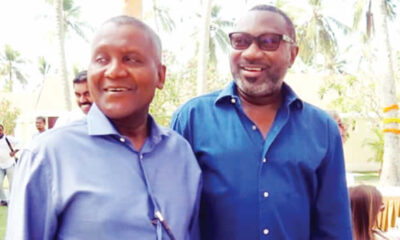
The number of Nigerian billionaires on the Forbes list has increased to four after the wealth-tracker included Femi Otedola, the chairman of Geregu Power.


According to the Forbes Billionaire Index sighted on Thursday, Otedola, who fell below the billion-dollar mark in 2017, occupied the fourth position behind AbdulSamad Rabiu, Mike Adenuga and Aliko Dangote.


As a result, the total wealth held by the four Nigerian billionaires now stands at $29.10 billion —  28 percent of the $103.70 billion the listed 20 African billionaires are valued.


At six, South Africa has the highest number of billionaires, followed by Egpyt (five), Nigeria (four), Morocco (two), and one each in Algeria, Tanzania, and Zimbabwe.


NIGERIAN BILLIONAIRES’ NET WORTH AND SOURCE OF WEALTH


ALIKO DANGOTE

Dangote, valued at $14.3 billion, is the richest person in Nigeria and Africa. The billionaire who has held the position since 2012 is ranked 132 in the world.


Dangote, who was once valued at $25 billion in 2014, has seen his net worth fluctuate over the years, resulting in Johann Rupert, a South African businessman briefly taking his number one spot on June 15, 2023, and January 4, 2024.


The 66-year-old investor made his fortune largely from cement production, through Dangote Cement, as well as his sugar and fertilizer businesses, amongst other investments.


He has expanded his investment portfolio to include an oil refinery, which gulped $19 billion and is described as Africa’s largest oil refinery and the world’s largest single-train facility.

See also  FG enlists Dangote, Otedola, Elumelu as members of council to eliminate malaria


MIKE ADENUGA

With a $7.4 billion net worth, Adenuga is the second richest person in Nigeria, sitting behind Dangote, after his wealth rose by $2.8 billion within 10 years.


He built his wealth through investments in telecommunications and oil production, as well as acquiring shares in a prominent financial institution, Sterling Financial Holdings Company.


Adenuga’s telecom company, Globacom, is the second largest network provider in Nigeria, with 61.3 million call subscribers and 43.9 million data users.


According to Forbes, his oil exploration outfit, Conoil Producing, operates six oil blocks in the Niger Delta.


ABDULSAMAD RABIU

Rabiu is the third richest Nigerian, with a net worth of $6.2 billion, placing him on the 440 spot on the global billionaire list and sixth in Africa.

The number of Nigerian billionaires on the Forbes list has increased to four after the wealth-tracker included Femi Otedola, the chairman of Geregu Power.

According to the Forbes Billionaire Index sighted on Thursday, Otedola, who fell below the billion-dollar mark in 2017, occupied the fourth position behind AbdulSamad Rabiu, Mike Adenuga and Aliko Dangote.

As a result, the total wealth held by the four Nigerian billionaires now stands at $29.10 billion —  28 percent of the $103.70 billion the listed 20 African billionaires are valued.

At six, South Africa has the highest number of billionaires, followed by Egpyt (five), Nigeria (four), Morocco (two), and one each in Algeria, Tanzania, and Zimbabwe.

Advertisement

NIGERIAN BILLIONAIRES’ NET WORTH AND SOURCE OF WEALTH

See also  Adeleke freezes govt accounts in first assignment as Governor

ALIKO DANGOTE

Dangote, valued at $14.3 billion, is the richest person in Nigeria and Africa. The billionaire who has held the position since 2012 is ranked 132 in the world.

Advertisement

Dangote, who was once valued at $25 billion in 2014, has seen his net worth fluctuate over the years, resulting in Johann Rupert, a South African businessman briefly taking his number one spot on June 15, 2023, and January 4, 2024.

The 66-year-old investor made his fortune largely from cement production, through Dangote Cement, as well as his sugar and fertilizer businesses, amongst other investments.

He has expanded his investment portfolio to include an oil refinery, which gulped $19 billion and is described as Africa’s largest oil refinery and the world’s largest single-train facility.

MIKE ADENUGA

Advertisement

With a $7.4 billion net worth, Adenuga is the second richest person in Nigeria, sitting behind Dangote, after his wealth rose by $2.8 billion within 10 years.

He built his wealth through investments in telecommunications and oil production, as well as acquiring shares in a prominent financial institution, Sterling Financial Holdings Company.

Adenuga’s telecom company, Globacom, is the second largest network provider in Nigeria, with 61.3 million call subscribers and 43.9 million data users.

According to Forbes, his oil exploration outfit, Conoil Producing, operates six oil blocks in the Niger Delta.

ABDULSAMAD RABIU

Rabiu is the third richest Nigerian, with a net worth of $6.2 billion, placing him on the 440 spot on the global billionaire list and sixth in Africa.

He has a similar business footprint as Dangote, as the source of his wealth is traced mostly to cement and sugar production.

See also  PDP holds National Convention October 29-30


The billionaire is also eyeing the oil refinery market in Nigeria, which will expand his business from industrial and consumer goods, thereby stoking his rivalry with Dangote.


Unlike Dangote, his wealth has been on the rise since 2014 when he was worth $1.2 billion — recording $5 billion in about 10 years.


FEMI OTEDOLA

Otedola’s name appeared on the Forbes Billionaire List with a $1.1 billion net worth, taking over the fourth spot previously occupied by Folorunsho Alakija, Nigeria’s richest businesswoman.


He occupies the 17th position in Africa with Michiel Le Roux, a South African billionaire, and is ranked 2,353 globally.


In 2016, a year before Otedola fell off the billionaire’s list, he was worth $1.8 billion.


Otedola is a major investor in Geregu and FBN Holdings, with both investments fueling his valuation as their shares appreciated significantly in 2023.


His investment in Geregu rose by 227.2 percent after the demand for the company’s shares drove the price from N110 to N399 within 12 months.


Also, FBN Holdings’ share value rose from N11.25 to N23.55 last year, raising Otedola’s investment in the financial institution by 109.33 percent.

Continue Reading
Click to comment

Leave a Reply

Your email address will not be published. Required fields are marked *

Business

Wema Bank launches Hackaholics Accelerator 2026 Cohort with ten startups

Published

on

By

Wema Bank, Nigeria’s most innovative bank and the pioneer of Africa’s first fully digital bank, ALAT, has launched the 2026 Hackaholics Accelerator Program, welcoming ten startups into the cohort.

The Hackaholics Accelerator, a selective growth program under Wema Bank’s Hackaholics platform, is designed to help promising Nigerian startups strengthen their business foundations and prepare for sustainable scale and investment.

After six years of driving innovation through Hackaholics, Wema Bank is extending its support beyond ideation and competition into hands-on startup building through Hackaholics Accelerator. The initiative provides founders with the structure, mentorship, and ecosystem access they need to turn strong ideas into viable, scalable businesses.

The 2026 cohort comprises ten startups in total, drawn from the top 10 performing finalists from Hackaholics 6.0. The startups include Farmslate, Ploy, Stocmed, Feest (Chao), Varsityscape, MamaAlert, Sane, Cyclex, Kieva, and Loocomo.

Commenting on the evolution of Hackaholics and the second edition of its Accelerator program, MD/CEO of Wema Bank, Moruf Oseni, said it reflects the Bank’s commitment to supporting founders beyond ideation and helping promising innovations grow into sustainable businesses.

See also  FG enlists Dangote, Otedola, Elumelu as members of council to eliminate malaria

“Over the past six years, Hackaholics has grown into more than a competition; it has become a platform that reveals the depth of innovation and entrepreneurial potential that exists across Nigeria,” Oseni said. “With this second edition of Hackaholics Accelerator, we are taking the next step by supporting founders beyond the ideation stage and into the process of building sustainable businesses.

The startups selected for this cohort represent some of the most promising solutions emerging from the Hackaholics ecosystem, and we are committed to helping them refine their models, strengthen their foundations, and scale their impact.”

Speaking on the ten startups selected for the cohort, Babatunde Mumuni, Chief Transformation Officer, Wema Bank, added that the Accelerator will guide founders through a structured process to strengthen their businesses and prepare them for sustainable growth.

“The startups selected for this cohort already have strong foundations, with products already in market, early traction, and clear potential for growth,” Mumuni said. “Each of the selected startups brings a unique solution to real challenges across different sectors. What Hackaholics Accelerator provides is the environment to strengthen those foundations through hands-on mentorship, strategic guidance, and access to the right networks. Over the course of the program, we will work closely with these founders to refine their models, deepen market traction, and prepare them for sustainable scale.”

See also  Dangote refinery petrol supply to NNPC will eliminate queues - Otedola

All 10 startup founders will undergo a series of training sessions led by industry experts across key areas critical to startup growth. Facilitators for the programme include the Chief Transformation Officer, Corporate Transformation & Innovation, Wema Bank, Babatunde Mumuni; Head, Strategy & Investor Relations, Wema Bank, Femi Akinfolarin; Head, Data Transformation, Wema Bank, Olamide Jolaoso; and Team Lead, Corporate Social Investment, Wema Bank, Oluwatoyin Adetunji.

Other facilitators include the Managing Director, Impact Hub Lagos, Idowu Akinde; Managing Director, B4B Partners, Napa Onwusa; Startup Advisor and Scout, Onaopemipo Dara; Mentor at Google for Startups, Rosemond Phil-Othihiwa; Head of Growth, Africhange, Tega Ogigirigi; and Startup Advisor and Mentor, Ademola Adewuyi.

Hackaholics Accelerator is supported by Wema Bank’s broader innovation infrastructure, including IDEAx Labs, the Bank’s innovation and venture platform, and its corporate venture programme, which focuses on enabling startup growth through partnerships, infrastructure, and capital access.

Since its launch in 2019, Hackaholics has grown into one of Nigeria’s most influential youth innovation platforms, attracting over 15,000 applicants and supporting hundreds of digital solutions across multiple industries.

See also  Bring home the trophy, get $250,000, Femi Otedola promises Super Eagles

Through the Hackaholics initiative, Wema Bank has disbursed over $400,000 in funding to young innovators and startup founders across Nigeria.

Startups, such as Feegor, Myitura, and Bunce are among those that have participated in previous editions of the program, reflecting the Accelerator’s focus on supporting growth-ready companies across diverse sectors. This second edition builds on that progress by helping startups move decisively from innovation to growth.

Continue Reading

Business

Banks to charge 7.5 VAT for mobile transfer, PoS transaction fees

Published

on

By

Banks are set to commence the deduction of 7.5 percent value-added tax (VAT) on banking services, including point of sale (POS) transaction fees, mobile banking transfer fees, from January 19. 

In an email to customers, Moniepoint Microfinance Bank said the charge stems from a government-endorsed regulatory change.

According to reports, the VAT is charged on the N50 stamp duty and does not affect the actual amount being transferred or withdrawn.

The proceeds of the charge will be remitted to the Nigerian Revenue Service (NRS).

“We would like to inform you of an upcoming government-endorsed regulatory change regarding Value Added Tax (VAT),” Moniepoint said.

“From Monday, 19 January 2026, we are required to collect a 7.5% VAT, to be remitted to the Nigerian Revenue Service (NRS) (formerly known as the Federal Inland Revenue Service).

“VAT will apply to certain banking services that include: electronic banking charges such as POS transaction fees, mobile banking fees (transfers), USSD transaction fees, POS activation fee, card issuance fee and Moniebook subscription.”

See also  FG enlists Dangote, Otedola, Elumelu as members of council to eliminate malaria

According to the bank, the charge also applies to other fees, such as loan processing and documentation fees.

“Services that DO NOT attract VAT include: interest on loans and advances, and interest on deposits and savings,” Moniepoint said.

“Please note: This is not a price increase by Moniepoint. Moniepoint is required to collect and remit VAT to the Nigerian Revenue Service (NRS).

“The NRS has communicated a deadline of 19th January for all financial institutions (commercial banks, microfinance banks and electronic money transfer operators) to start collecting and remitting VAT.”

The bank clarified that VAT applies only to banking or service fees and not to interest, adding that the charge will be listed separately on transaction reports and statements.

The new tax laws retain the VAT rate at 7.5 percent.

Continue Reading

Business

Wema Bank Launches Upgraded Version of ALAT Banking App

Published

on

By


…introduces Voice Banking, Tap and Pay and Uptime Prediction

Wema Bank, Nigeria’s most innovative bank and pioneer of Africa’s first fully digital bank, ALAT, has launched the upgraded version of its flagship digital banking platform, ALAT by Wema. Designed as the next phase in digital banking, the upgraded version of ALAT delivers a smarter, faster, and more intuitive experience, reinforcing Wema Bank’s leadership in technology-driven financial services.


Tagged ALAT: The Evolution, the upgraded version represents a significant advancement in how customers interact with their bank.


It enables seamless banking through intelligent features such as voice banking (called SAW), which allows customers to carry out banking activities using natural voice commands, reducing friction and improving accessibility. It also introduces Tap and Pay for quick, secure, and convenient contactless transactions, alongside uptime prediction that enhances transparency, reliability, and confidence around service availability.


Together, these innovations are designed to simplify everyday banking while anticipating customer needs in real time, reinforcing Wema Bank’s commitment to trust, efficiency, and customer-centric digital experiences.

See also  Thriller in Qatar: Argentina narrowly beat Netherlands on penalties


Announcing the upgraded version, the Managing Director and Chief Executive Officer of Wema Bank, Mr. Moruf Oseni, said, “ALAT: The Evolution is more than an upgrade. It is a clear demonstration of our commitment to redefining digital banking in Africa.

” By understanding the future of banking and listening closely to our customers, we have upgraded ALAT by Wema to a digital banking platform that is smart, intelligent and dependable.

“This evolution reinforces our promise to deliver innovation that genuinely enhances how people live, work, and transact everyday.”


He added that migrating to the upgraded app is seamless. “Existing customers can simply visit the Google Play Store or Apple App Store to update their existing ALAT app and sign-in with their existing login details (All their account information and transaction history remain intact on their profile and they will also gain access to new features that make banking faster, more intuitive, and more reliable).

See also  Adeleke freezes govt accounts in first assignment as Governor


For new customers, all they have to do is visit the Google Play Store or Apple App Store to download ALAT by Wema app and click the Get Started icon to onboard seamlessly.


Speaking on the technology in the upgraded ALAT by Wema, Mr. Olusegun Adeniyi, Chief Digital Officer at Wema Bank, explained, “With ALAT: The Evolution, we set out to enhance not just functionality but the overall banking experience. By integrating voice banking, contactless payments, and predictive reliability, we are delivering a platform that is built on powerful technology and responds intelligently to customer needs. This upgrade reflects our long-term digital vision to create a digital bank that is adaptive, intuitive, and consistently available.”


Built on speed, intelligence, and user-centric design, ALAT: The Evolution redefines everyday banking through intuitive features such as voice-enabled transactions, contactless payments, and predictive service reliability. Designed to anticipate customer needs in real time, the platform delivers a smarter, more seamless, and dependable digital banking experience that reflects Wema Bank’s vision for the future of finance.

See also  Beloved daughter: Otedola gives Cuppy £5m home on 30th birthday


With the upgraded version of ALAT, Wema Bank continues to strengthen its position as a digital-first institution, delivering innovative solutions that empower individuals and businesses to bank with confidence in an increasingly digital economy.

Continue Reading

Trending News