
Metro News
Obituary: Life and Times of Queen Elizabeth II

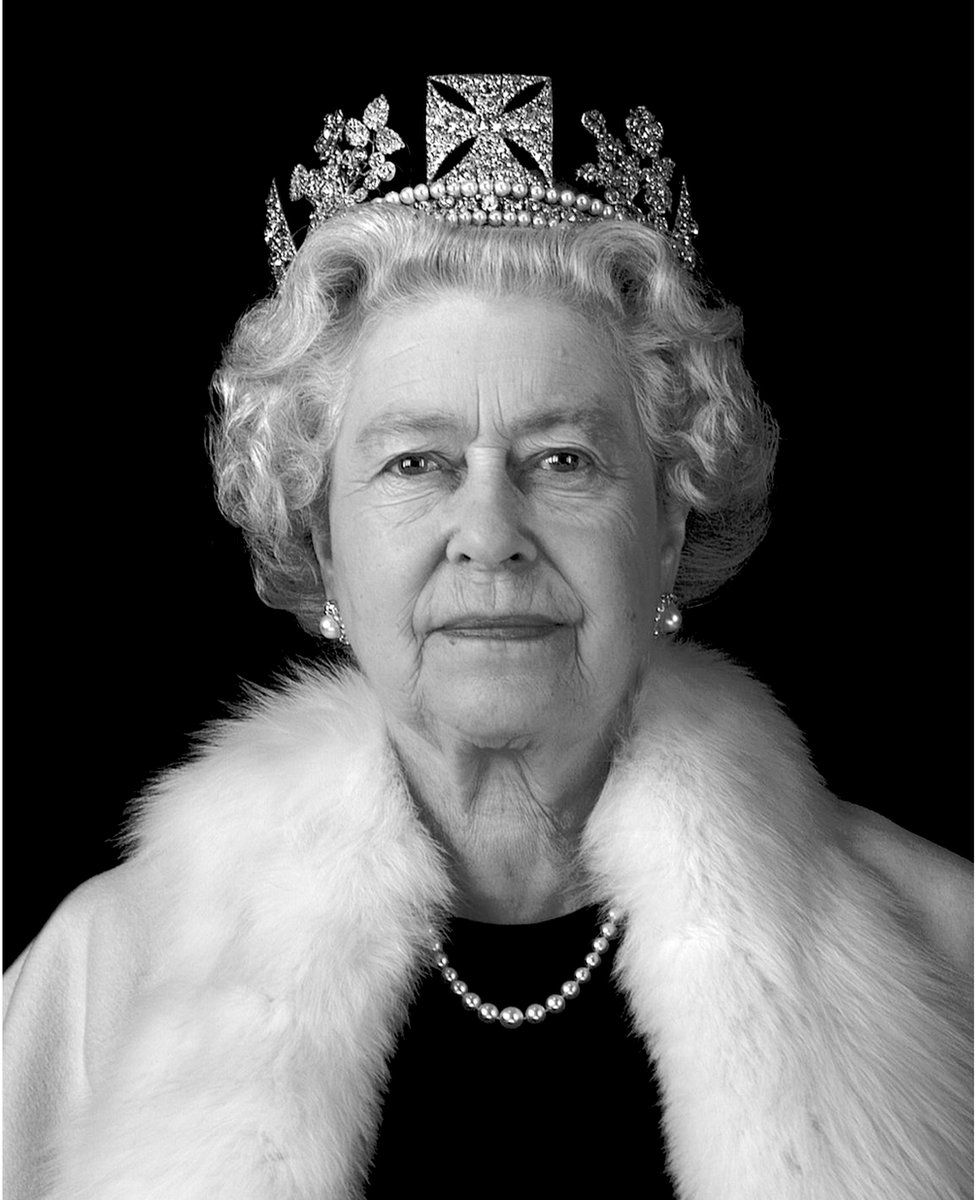
The long reign of Queen Elizabeth II was marked by her strong sense of duty and her determination to dedicate her life to her throne and to her people.
She became for many the one constant point in a rapidly changing world as British influence declined, society changed beyond recognition and the role of the monarchy itself came into question.
Her success in maintaining the monarchy through such turbulent times was even more remarkable given that, at the time of her birth, no-one could have foreseen that the throne would be her destiny.
Elizabeth Alexandra Mary Windsor was born on 21 April 1926, in a house just off Berkeley Square in London, the first child of Albert, Duke of York, second son of George V, and his duchess, the former Lady Elizabeth Bowes-Lyon.
Both Elizabeth and her sister, Margaret Rose, who was born in 1930, were educated at home and brought up in a loving family atmosphere. Elizabeth was extremely close to both her father and her grandfather, George V.
At the age of six, Elizabeth told her riding instructor that she wanted to become a “country lady with lots of horses and dogs”.
She was said to have shown a remarkable sense of responsibility from a very early age. Winston Churchill, the future prime minister, was quoted as saying that she possessed “an air of authority that was astonishing in an infant”.
Despite not attending school, Elizabeth proved adept at languages and made a detailed study of constitutional history.
A special Girl Guides company, the 1st Buckingham Palace, was formed so that she could socialise with girls of her own age.
Increasing tension
On the death of George V in 1936, his eldest son, known as David, became Edward VIII.
However, his choice of wife, the twice-divorced American Wallis Simpson, was deemed to be unacceptable on political and religious grounds. At the end of the year he abdicated.
A reluctant Duke of York became King George VI. His Coronation gave Elizabeth a foretaste of what lay in store for her and she later wrote that she had found the service “very, very wonderful”.
Against a background of increasing tension in Europe, the new King, together with his wife, Queen Elizabeth, set out to restore public faith in the monarchy. Their example was not lost on their elder daughter.
In 1939, the 13-year-old princess accompanied the King and Queen to the Royal Naval College at Dartmouth.
Together with her sister Margaret, she was escorted by one of the cadets, her third cousin, Prince Philip of Greece.
Obstacles
It was not the first time they had met, but it was the first time she took an interest in him.
Prince Philip called on his royal relatives when on leave from the navy, and by 1944, when she was 18, Elizabeth was clearly in love with him. She kept his picture in her room and they exchanged letters.
The young princess briefly joined the Auxiliary Territorial Service (ATS) towards the end of the war, learning to drive and service a lorry. On VE Day, she joined the Royal Family at Buckingham Palace as thousands gathered in The Mall to celebrate the end of the war in Europe.
“We asked my parents if we could go out and see for ourselves,” she later recalled. “I remember we were terrified of being recognised. I remember lines of unknown people linking arms and walking down Whitehall, all of us just swept along on a tide of happiness and relief.”
After the war, her desire to marry Prince Philip faced a number of obstacles.
The King was reluctant to lose a daughter on whom he doted, and Philip had to overcome the prejudice of an establishment that could not accept his foreign ancestry.
But the wishes of the couple prevailed and on 20 November 1947 the couple married in Westminster Abbey.
The Duke of Edinburgh, as Philip had become, remained a serving naval officer. For a short time, a posting to Malta meant the young couple could enjoy a relatively normal life.
Their first child, Charles, was born in 1948, followed by a sister, Anne, who arrived in 1950.
But the King, having suffered considerable stress during the war years, was terminally ill with lung cancer, brought about by a lifetime of heavy smoking.
In January 1952, Elizabeth, then 25, set off with Philip for an overseas tour. The King, against medical advice, went to the airport to see the couple off. It was to be the last time Elizabeth would see her father.
Elizabeth heard of the death of the King while staying at a game lodge in Kenya and the new Queen immediately returned to London.
“In a way, I didn’t have an apprenticeship,” she later recalled. “My father died much too young, so it was all a very sudden kind of taking on and making the best job you can.”
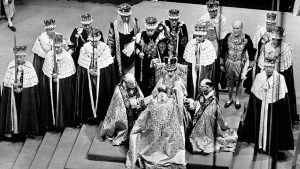
Her Coronation was the first to be broadcast live on British TV
Personal attack
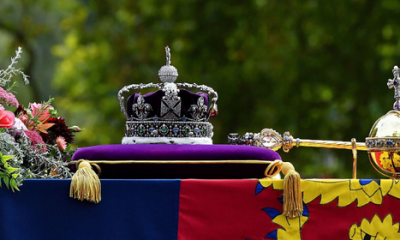
Her Coronation in June 1953 was televised, despite the opposition of Prime Minister Winston Churchill, and millions gathered around TV sets, many of them for the first time, to watch as Queen Elizabeth II made her oath.
With Britain still enduring post-war austerity, commentators saw the Coronation as the dawn of a new Elizabethan age.
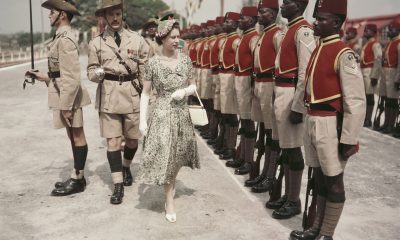
World War Two had served to hasten the end of the British Empire, and by the time the new Queen set off on a lengthy tour of the Commonwealth in November 1953, many former British possessions, including India, had gained independence.
Elizabeth became the first reigning monarch to visit Australia and New Zealand. It was estimated that three-quarters of Australians turned out to see her in person.
Throughout the 1950s, more countries hauled down the union flag and the former colonies and dominions now came together as a voluntary family of nations.
Many politicians felt that the new Commonwealth could become a counter to the newly emerging European Economic Community and, to some extent, British policy turned away from the Continent.
But the decline of British influence was hastened by the Suez debacle in 1956, when it became clear that the Commonwealth lacked the collective will to act together in times of crisis. The decision to send British troops to try to prevent Egypt’s threatened nationalisation of the Suez Canal ended in an ignominious withdrawal and brought about the resignation of Prime Minister Anthony Eden.
This embroiled the Queen in a political crisis. The Conservative Party had no mechanism for electing a new leader and, after a series of consultations, the Queen invited Harold Macmillan to form a new government.
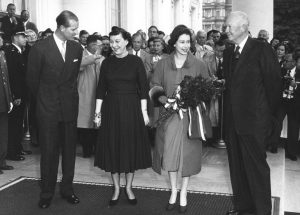
The Queen also found herself the subject of a personal attack by the writer Lord Altrincham. In a magazine article, he claimed her court was “too British” and “upper-class” and accused her of being unable to make a simple speech without a written text.
His remarks caused a furore in the press and Lord Altrincham was physically attacked in the street by a member of the League of Empire Loyalists.
Nevertheless, the incident demonstrated that British society and attitudes to the monarchy were changing fast and old certainties were being questioned.
From ‘the Monarchy’ to ‘the Royal Family’
Encouraged by her husband, notoriously impatient with the court’s stuffiness, the Queen began to adapt to the new order.
The practice of receiving debutantes at court was abolished and the term “the Monarchy” was gradually replaced by “the Royal Family”.
The Queen was once more at the centre of a political row when in 1963, Harold Macmillan stood down as prime minister. With the Conservative Party still to set up a system for choosing a new leader, she followed his advice to appoint the Earl of Home in his place.
It was a difficult time for the Queen. The hallmark of her reign was constitutional correctness, and a further separation of the monarchy from the government of the day. She took seriously her rights to be informed, to advise and to warn – but did not seek to step beyond them.
It was to be the last time she would be put in such a position. The Conservatives finally did away with the tradition that new party leaders just “emerged”, and a proper system was put in place.
By the late 1960s, Buckingham Palace had decided that it needed to take a positive step to show the Royal Family in a far less formal and more approachable way.
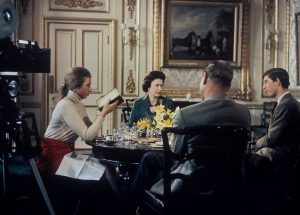
The result was a ground-breaking documentary, Royal Family. The BBC was allowed to film the Windsors at home. There were pictures of the family at a barbecue, decorating the Christmas tree, taking their children for a drive – all ordinary activities, but never seen before.
Critics claimed that Richard Cawston’s film destroyed the mystique of the royals by showing them to be ordinary people, including scenes of the Duke of Edinburgh barbecuing sausages in the grounds at Balmoral.
But the film echoed the more relaxed mood of the times and did much to restore public support for the monarchy.
By 1977, the Silver Jubilee was celebrated with genuine enthusiasm in street parties and in ceremonies across the kingdom. The monarchy seemed secure in the public’s affection and much of that was down to the Queen herself.
Two years later, Britain had, in Margaret Thatcher, its first woman prime minister. Relations between the female head of state and female head of government were sometimes said to have been awkward.
Scandals and disasters
One difficult area was the Queen’s devotion to the Commonwealth, of which she was head. The Queen knew the leaders of Africa well and was sympathetic to their cause.
She was reported to have found Thatcher’s attitude and confrontational style “puzzling”, not least over the prime minister’s opposition to sanctions against apartheid South Africa.
Year by year, the Queen’s public duties continued. After the Gulf War in 1991, she went to the United States to become the first British monarch to address a joint session of Congress. President George HW Bush said she had been “freedom’s friend for as long as we can remember”.
However, a year later, a series of scandals and disasters began to affect the Royal Family.
The Queen’s second son, the Duke of York, and his wife Sarah separated, while Princess Anne’s marriage to Mark Phillips ended in divorce. Then the Prince and Princess of Wales were revealed to be deeply unhappy and eventually split up.
The year culminated in a huge fire at the Queen’s favourite residence, Windsor Castle. It seemed a grimly appropriate symbol of a royal house in trouble. It was not helped by a public row over whether the taxpayer, or the Queen, should foot the bill for the repairs.
The Queen described 1992 as her “annus horribilis” and, in a speech in the City of London, appeared to concede the need for a more open monarchy in return for a less hostile media.
“No institution, city, monarchy, whatever, should expect to be free from the scrutiny of those who give it their loyalty and support, not to mention those who don’t. But we are all part of the same fabric of our national society and that scrutiny can be just as effective if it is made with a measure of gentleness, good humour and understanding.”
The institution of monarchy was very much on the defensive. Buckingham Palace was opened to visitors to raise money to pay for the repairs at Windsor and it was announced that the Queen and the Prince of Wales would pay tax on investment income.
Abroad, the hopes for the Commonwealth, so high early in her reign, had not been fulfilled. Britain had turned its back on its old partners with new arrangements in Europe.
The Queen still saw value in the Commonwealth and was deeply gratified when South Africa, where she had come of age, at last threw apartheid aside. She celebrated with a visit in March 1995.
At home, the Queen sought to maintain the dignity of the monarchy while public debate continued on whether the institution had any future.
Death of Diana, Princess of Wales
As Britain struggled to find a new destiny, she tried to remain a reassuring figure, and with a sudden smile could lighten a solemn moment. The role she valued above all was that of symbol of the nation.
However, the monarchy was shaken and the Queen herself attracted unusual criticism after the death of Diana, Princess of Wales, in a car accident in Paris in August 1997.
As the public crowded around the palaces in London with tributes of flowers, the Queen seemed reluctant to provide the focus that she had always tried to do during great national moments.
Many of her critics failed to understand that she was from a generation that recoiled from the almost hysterical displays of public mourning that typified the aftermath of the princess’s death.
She also felt as a caring grandmother that she needed to comfort Diana’s sons in the privacy of the family circle.
Eventually, she made a live broadcast, paying tribute to her daughter-in-law and making a commitment that the monarchy would adapt.
Losses and celebrations
The deaths of the Queen Mother and Princess Margaret, in the Queen’s Golden Jubilee year, 2002, cast a shadow over nationwide celebrations of her reign.
But despite this, and the recurring debate over the future of the monarchy, a million people crowded into The Mall, in front of Buckingham Palace, on the evening of the jubilee.
In April 2006, thousands of well-wishers lined the streets of Windsor as the Queen performed an informal walkabout on her 80th birthday.
And in November 2007, she and Prince Philip celebrated 60 years of marriage with a service attended by 2,000 people at Westminster Abbey.
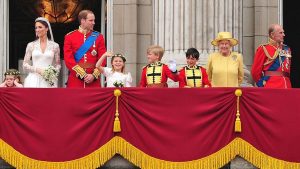
There was yet another happy occasion in April 2011 when the Queen attended the wedding of her grandson, William, Duke of Cambridge, to Catherine Middleton.
In May that year she became the first British monarch to make an official visit to the Irish Republic, an event of great historical significance.
In a speech, which she began in Irish, she called for forbearance and conciliation and referred to “things we wish had been done differently or not at all”.
Referendum
A year later, on a visit to Northern Ireland as part of the Diamond Jubilee celebrations, she shook hands with the former IRA commander Martin McGuinness.
It was a poignant moment for a monarch whose much-loved cousin, Lord Louis Mountbatten, had been killed by an IRA bomb in 1979.
The Diamond Jubilee brought hundreds of thousands of people on to the streets and culminated in a weekend of celebrations in London.
The referendum on Scottish independence, in September 2014, was a testing time for the Queen. Few had forgotten her speech to Parliament in 1977 in which she made clear her commitment to a United Kingdom.
“I number kings and queens of England and of Scotland, and princes of Wales among my ancestors and so I can readily understand these aspirations. But I cannot forget that I was crowned Queen of the United Kingdom of Great Britain and Northern Ireland.”
In a remark to well-wishers at Balmoral on the eve of the Scottish referendum, which was overheard, she said she hoped people would think very carefully about the future.
Once the result of the vote was known, her public statement underlined the relief she felt that the Union was still intact, although recognising that the political landscape had changed.
“Now, as we move forward, we should remember that despite the range of views that have been expressed, we have in common an enduring love of Scotland, which is one of the things that helps to unite us all.”
On 9 September 2015 she became the longest reigning monarch in British history, surpassing the reign of her great-great-grandmother Queen Victoria. In typical style she refused to make any fuss saying the title was “not one to which I have ever aspired”.
Less than a year later, in April 2016, she celebrated her 90th birthday.
She continued with her public duties, often alone after the retirement of the Duke of Edinburgh in 2017.
There were continued strains on the family – including her husband’s car accident, the Duke of York’s ill-judged friendship with convicted American businessman Jeffrey Epstein and Prince Harry’s growing disillusionment with life in the royal family.
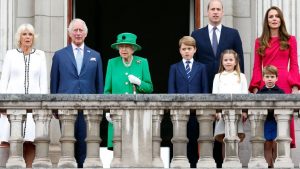
These were unsettling moments, presided over by a monarch who demonstrated that she was still firmly in control. There was also the death of Prince Philip in April 2021, in the midst of the coronavirus pandemic, and her Platinum Jubilee a year later.
Although the monarchy might not have been as strong at the end of the Queen’s reign as it was at the start, she was determined that it should continue to command a place of affection and respect in the hearts of the British people.
On the occasion of her Silver Jubilee, she recalled the pledge she had made on a visit to South Africa 30 years before.
“When I was 21, I pledged my life to the service of our people and I asked for God’s help to make good that vow. Although that vow was made in my salad days, when I was green in judgement, I do not regret, or retract, one word of it.”
CULLED FROM BBC NEWS








-
 News4 years ago
Insecurity: Buhari presides over National Security Council meeting (Photos)
-
 Privacy5 years ago
Self-imposed Oba vacates ‘palace’ after warnings by community
-
 News5 years ago
Nollywood Actress Nkechi Blessing speaks on plastic surgery, big butts
-
 Entertainment4 years ago
DJ Dimple Nipple dropped by longtime boyfriend after claiming D’Prince allegedly demanded sex for roles
-
 News5 years ago
Plus size rocks: Ghanaian plus size dancer who can’t travel by air because of her size
-
 Opinion5 years ago
Leave our community, Imobi orders self-imposed Oba
-
 News5 years ago
How CCTV ’caught’ Baba Ijesha molesting minor
-

 Sports5 years ago
Meet Ashleigh Plumptre, the ‘Oyinbo’ member of Nigeria Super Falcons [Video]