Connect with us

Business

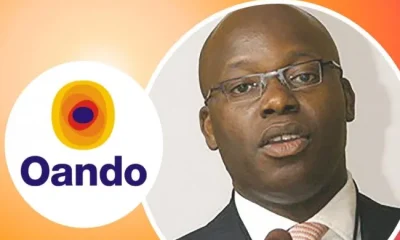
Wale Tinubu’s Quest To Expand Oando’s Footprint Beyond Africa Gains Momentum

Published

on


Adebayo Adeoye

A journey of a thousand miles, in the words of Chinese philosopher Laozi, famously romanticized as Lao Tzu, begins with a single step.

Laozi, also an author, had penned those words to encourage people to start and take action towards their goals in life.

Several decades after Laozi literally gifted the world this inspiring quote, evidence abounds that a Nigerian businessman, Jubril Adewale Tinubu, CON has been most inspired by it.

It all began when he took a leap of faith to dump Law, a profession he had practised
with impressive record, while he worked in a family law firm, K.O. Tinubu and Co., from 1990 to 1994.

Tinubu, who obtained a degree in Law from the University of Liverpool and a Master of Law from the London School of Economic, wasn’t under any illusion about his next move. His vision was as clear as daylight: to rule the world of oil and gas business.

It was a steely resolve, one that he was convinced would fetch him global recognition in the end.

To achieve this, he carefully profiled two individuals whom he believed would prop him up in this life-defining journey: Omamofe Boyo and Onajite Okoloko.

Following preliminary feasibility studies, the trio floated Ocean and Oil Services Limited in 1994 to supply diesel and Low Pour Fuel Oil (LPFO) to various shipping firms and offshore exploration companies in Nigeria.

From the outset, they were not driven by any inordinate ambition; rather, what was uppermost in their minds was to first register their presence in the nation’s thriving oil and gas sector.

It was a humble beginning, as the budding oil company started out only with a vessel, MT Carolina, anchored in
Bonny Island, Rivers State to supply diesel and Low Pour Fuel Oil (LPFO) to off-shore companies from the Port-Harcourt, Rivers State refinery.

See also  Oando: Three decades of outstanding excellence

Before the eyes of the morbid critics, Ocean and Oil Services Limited successfully acquired six ships within its six years of operations.


Some four years after, Tinubu and his partners caused a stir when they sought to acquire a 30 % controlling interest in the defunct Unipetrol, following government’s decision to sell its controlling 60% stake in Unipetrol Plc,an integrated downstream oil marketing company.


Though many industry watchers had tagged it a huge joke, it was obvious they were belittling the capabilities of the brains behind the company, which was already showing evidence of a potentially big player.


The planned acquisition, contrary to the naysayers, turned out a dream come through. And by 2001, Ocean and Oil Services had increased its shares in Unipetrol to 42%, owing to the support from its foreign technical partners, Compagnia Espanola De Petroleos (CEPSA), the second largest oil group in Spain.
Since then Tinubu has shown the oil and gas sector that he is not one your run-of-the-mill oil player.


Interestingly, in 2003, almost a decade after it surfaced on the nation’s oil and gas sector, the newly acquired companies were merged, resulting in the historic birth of Oando Limited.


Still consolidating on its gains, Oando Plc, in 2005, secured a cross-border listing on the Johannesburg Stock of Exchange (JSE) in South Africa in 2005!


In its first 30 years of operations, Oando Plc now prides itself on a number of subsidiaries with staggering value-added services: Oando Marketing Limited, OML, one of the largest downstream petroleum marketing companies in Nigeria with over 500 retail outlets across Nigeria, Ghana, and Togo; Oando Supply and Trading Limited, OST, one of the largest independent traders of crude and refined petroleum products in sub-Saharan Africa incorporated in 2004, among several others.

See also  Oando to participate as lead sponsor of Africa Oil Week 2023


Unlike its competitors, Oando’s exploits in the upstream journey have continued to attract interesting discourses among industry watchers.

The first shocker was when it secured a 42.75% interest in the marginal field, OML 56.

.
It later steadied its feet in 2007, with the acquisition of a 15% stake in OML 125 & OML 134.


In 2014, Oando Energy Resources, OER, acquired ConocoPhillips Nigerian assets for $1.8bn (inclusive of working capital), secured a 20% interest in the NAOC-Joint Venture (“the JV”) and augmented its total net 2P reserves to 503 million barrels of oil equivalent (mmboe), with peak net production levels of 45,000 barrels of oil equivalent per day (kboep/d).


A careful study of its rising profile points to the fact that Oando has steadily been eyeing the global stage. And Tinubu is not making any pretense about it. In 2016, it announced that it was divesting from its Naira-earning businesses to focus on its US$-earning portfolio.


It was a well thought out business plan, considering the spate of the sale of its interest in the downstream between 2016 and 2019 as well as its stake in the midstream in 2017.

.
Ten years after the widely reported purchase of ConocoPhillips Nigerian asset, Oando, in August 2024, completed the acquisition of 100% of Eni’s interest in NAOC, the operating company of the JV, thereby increasing its stake in the JV from 20% to 40%, and securing operatorship of the JV as well as doubling its 2P reserves to 996.2 mmboe.

Tinubu-led Oando has, nevertheless, been hit by the vagaries of business. This flip side to its otherwise enviable feats in the sector was inputted in the annals of the company about 20 years after its quiet but impactful entry into the sector.

See also  AFCON Semi-Final: Oando boss, Wale Tinubu congratulates Super Eagles


To its shareholders, the news of the loss of a humongous N184bn in the 2014 financial year was a sour taste in their mouths.


But the company, by the middle of that same year, successfully reversed the doleful story by getting new investors, including Vitol, a Dutch oil trading giant, and Helios Holdings, to put their money in its downstream arm, Oando Marketing.


Obviously, the Oando trajectory is a story waiting to be told. This became more tellingly interesting on February 27, 2025 when news of its selection as the preferred bidder for the Guaracara refinery, Trinidad and Tobago broke.


The awards, no doubt, underscores Oando’s track record of reliability, innovation, infrastructure development, which aligns with its corporate strategic vision of expanding across the Caribbean region.


Speaking on the development, Tinubu, the Group Chief Executive Officer, GCEO, described the partnership as “a strategic bridge between Africa and the Caribbean.”


According to him, “Oando’s involvement in the refinery will serve as a catalyst for deeper Afro-Caribbean collaboration in the energy sector, paving the way for increased trade, investment, and knowledge exchange. This initiative underscores Africa’s growing influence in the global energy landscape and highlights the role of indigenous African companies in fostering economic transformation across borders.”


This development, which has been described as compelling chapter in the history of Oando, is a testament of its resolve to strengthen its presence in the international market.

Continue Reading
Click to comment

Leave a Reply

Your email address will not be published. Required fields are marked *

Business

Wema Bank launches Hackaholics Accelerator 2026 Cohort with ten startups

Published

on

By

Wema Bank, Nigeria’s most innovative bank and the pioneer of Africa’s first fully digital bank, ALAT, has launched the 2026 Hackaholics Accelerator Program, welcoming ten startups into the cohort.

The Hackaholics Accelerator, a selective growth program under Wema Bank’s Hackaholics platform, is designed to help promising Nigerian startups strengthen their business foundations and prepare for sustainable scale and investment.

After six years of driving innovation through Hackaholics, Wema Bank is extending its support beyond ideation and competition into hands-on startup building through Hackaholics Accelerator. The initiative provides founders with the structure, mentorship, and ecosystem access they need to turn strong ideas into viable, scalable businesses.

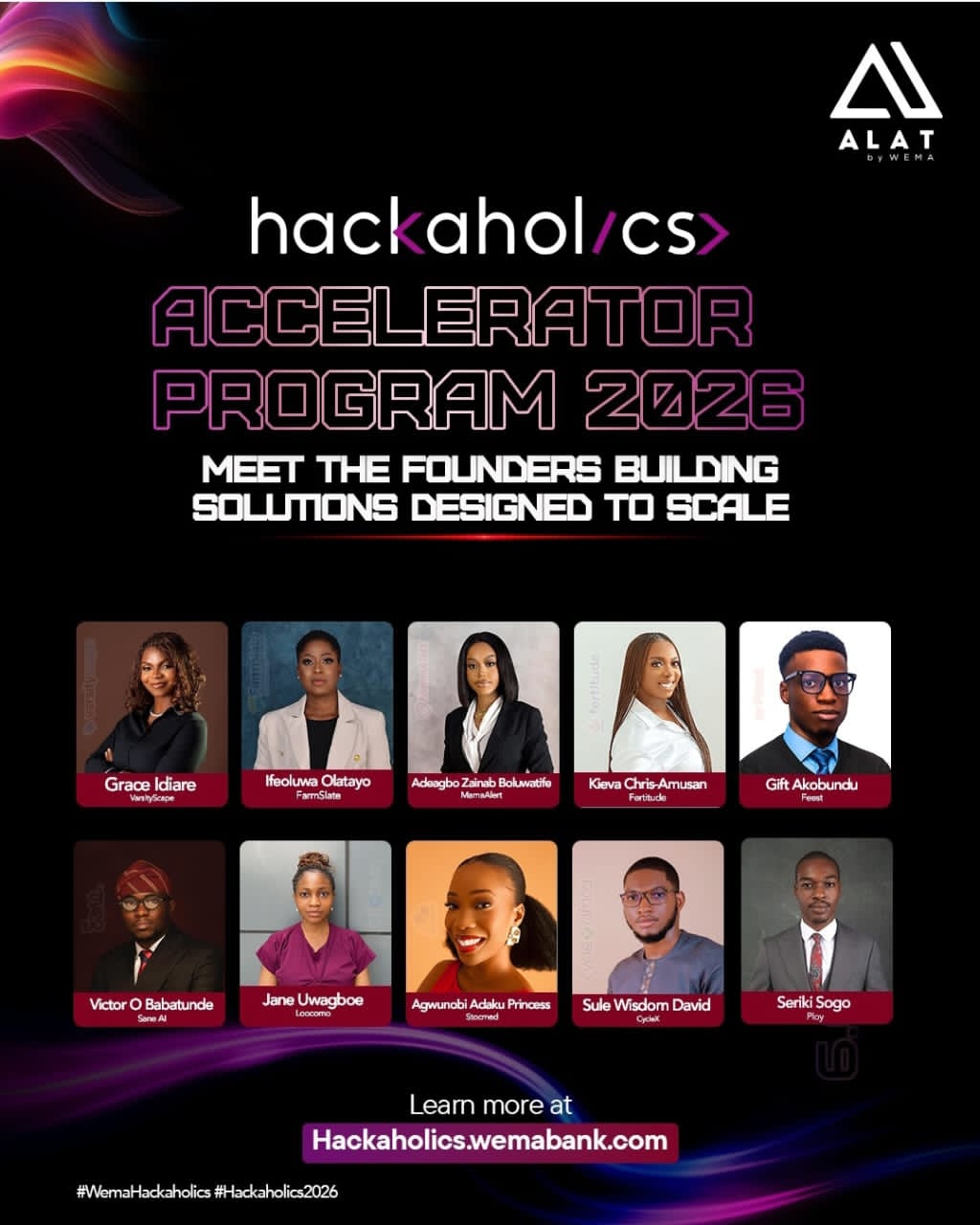
The 2026 cohort comprises ten startups in total, drawn from the top 10 performing finalists from Hackaholics 6.0. The startups include Farmslate, Ploy, Stocmed, Feest (Chao), Varsityscape, MamaAlert, Sane, Cyclex, Kieva, and Loocomo.

Commenting on the evolution of Hackaholics and the second edition of its Accelerator program, MD/CEO of Wema Bank, Moruf Oseni, said it reflects the Bank’s commitment to supporting founders beyond ideation and helping promising innovations grow into sustainable businesses.

See also  Wema Bank doles out N11m to 131 women

“Over the past six years, Hackaholics has grown into more than a competition; it has become a platform that reveals the depth of innovation and entrepreneurial potential that exists across Nigeria,” Oseni said. “With this second edition of Hackaholics Accelerator, we are taking the next step by supporting founders beyond the ideation stage and into the process of building sustainable businesses.

The startups selected for this cohort represent some of the most promising solutions emerging from the Hackaholics ecosystem, and we are committed to helping them refine their models, strengthen their foundations, and scale their impact.”

Speaking on the ten startups selected for the cohort, Babatunde Mumuni, Chief Transformation Officer, Wema Bank, added that the Accelerator will guide founders through a structured process to strengthen their businesses and prepare them for sustainable growth.

“The startups selected for this cohort already have strong foundations, with products already in market, early traction, and clear potential for growth,” Mumuni said. “Each of the selected startups brings a unique solution to real challenges across different sectors. What Hackaholics Accelerator provides is the environment to strengthen those foundations through hands-on mentorship, strategic guidance, and access to the right networks. Over the course of the program, we will work closely with these founders to refine their models, deepen market traction, and prepare them for sustainable scale.”

See also  Naira appreciates in parallel, official markets

All 10 startup founders will undergo a series of training sessions led by industry experts across key areas critical to startup growth. Facilitators for the programme include the Chief Transformation Officer, Corporate Transformation & Innovation, Wema Bank, Babatunde Mumuni; Head, Strategy & Investor Relations, Wema Bank, Femi Akinfolarin; Head, Data Transformation, Wema Bank, Olamide Jolaoso; and Team Lead, Corporate Social Investment, Wema Bank, Oluwatoyin Adetunji.

Other facilitators include the Managing Director, Impact Hub Lagos, Idowu Akinde; Managing Director, B4B Partners, Napa Onwusa; Startup Advisor and Scout, Onaopemipo Dara; Mentor at Google for Startups, Rosemond Phil-Othihiwa; Head of Growth, Africhange, Tega Ogigirigi; and Startup Advisor and Mentor, Ademola Adewuyi.

Hackaholics Accelerator is supported by Wema Bank’s broader innovation infrastructure, including IDEAx Labs, the Bank’s innovation and venture platform, and its corporate venture programme, which focuses on enabling startup growth through partnerships, infrastructure, and capital access.

Since its launch in 2019, Hackaholics has grown into one of Nigeria’s most influential youth innovation platforms, attracting over 15,000 applicants and supporting hundreds of digital solutions across multiple industries.

See also  POS operators in Lagos announce uniform fee of N500 per N10k for transactions

Through the Hackaholics initiative, Wema Bank has disbursed over $400,000 in funding to young innovators and startup founders across Nigeria.

Startups, such as Feegor, Myitura, and Bunce are among those that have participated in previous editions of the program, reflecting the Accelerator’s focus on supporting growth-ready companies across diverse sectors. This second edition builds on that progress by helping startups move decisively from innovation to growth.

Continue Reading

Business

Banks to charge 7.5 VAT for mobile transfer, PoS transaction fees

Published

on

By

Banks are set to commence the deduction of 7.5 percent value-added tax (VAT) on banking services, including point of sale (POS) transaction fees, mobile banking transfer fees, from January 19. 

In an email to customers, Moniepoint Microfinance Bank said the charge stems from a government-endorsed regulatory change.

According to reports, the VAT is charged on the N50 stamp duty and does not affect the actual amount being transferred or withdrawn.

The proceeds of the charge will be remitted to the Nigerian Revenue Service (NRS).

“We would like to inform you of an upcoming government-endorsed regulatory change regarding Value Added Tax (VAT),” Moniepoint said.

“From Monday, 19 January 2026, we are required to collect a 7.5% VAT, to be remitted to the Nigerian Revenue Service (NRS) (formerly known as the Federal Inland Revenue Service).

“VAT will apply to certain banking services that include: electronic banking charges such as POS transaction fees, mobile banking fees (transfers), USSD transaction fees, POS activation fee, card issuance fee and Moniebook subscription.”

See also  Oando makes resounding comeback with N74.7 billion

According to the bank, the charge also applies to other fees, such as loan processing and documentation fees.

“Services that DO NOT attract VAT include: interest on loans and advances, and interest on deposits and savings,” Moniepoint said.

“Please note: This is not a price increase by Moniepoint. Moniepoint is required to collect and remit VAT to the Nigerian Revenue Service (NRS).

“The NRS has communicated a deadline of 19th January for all financial institutions (commercial banks, microfinance banks and electronic money transfer operators) to start collecting and remitting VAT.”

The bank clarified that VAT applies only to banking or service fees and not to interest, adding that the charge will be listed separately on transaction reports and statements.

The new tax laws retain the VAT rate at 7.5 percent.

Continue Reading

Business

Wema Bank Launches Upgraded Version of ALAT Banking App

Published

on

By


…introduces Voice Banking, Tap and Pay and Uptime Prediction

Wema Bank, Nigeria’s most innovative bank and pioneer of Africa’s first fully digital bank, ALAT, has launched the upgraded version of its flagship digital banking platform, ALAT by Wema. Designed as the next phase in digital banking, the upgraded version of ALAT delivers a smarter, faster, and more intuitive experience, reinforcing Wema Bank’s leadership in technology-driven financial services.


Tagged ALAT: The Evolution, the upgraded version represents a significant advancement in how customers interact with their bank.


It enables seamless banking through intelligent features such as voice banking (called SAW), which allows customers to carry out banking activities using natural voice commands, reducing friction and improving accessibility. It also introduces Tap and Pay for quick, secure, and convenient contactless transactions, alongside uptime prediction that enhances transparency, reliability, and confidence around service availability.


Together, these innovations are designed to simplify everyday banking while anticipating customer needs in real time, reinforcing Wema Bank’s commitment to trust, efficiency, and customer-centric digital experiences.

See also  FG unveils new NNPC


Announcing the upgraded version, the Managing Director and Chief Executive Officer of Wema Bank, Mr. Moruf Oseni, said, “ALAT: The Evolution is more than an upgrade. It is a clear demonstration of our commitment to redefining digital banking in Africa.

” By understanding the future of banking and listening closely to our customers, we have upgraded ALAT by Wema to a digital banking platform that is smart, intelligent and dependable.

“This evolution reinforces our promise to deliver innovation that genuinely enhances how people live, work, and transact everyday.”


He added that migrating to the upgraded app is seamless. “Existing customers can simply visit the Google Play Store or Apple App Store to update their existing ALAT app and sign-in with their existing login details (All their account information and transaction history remain intact on their profile and they will also gain access to new features that make banking faster, more intuitive, and more reliable).

See also  Oando boss Wale Tinubu celebrates Dangote @67


For new customers, all they have to do is visit the Google Play Store or Apple App Store to download ALAT by Wema app and click the Get Started icon to onboard seamlessly.


Speaking on the technology in the upgraded ALAT by Wema, Mr. Olusegun Adeniyi, Chief Digital Officer at Wema Bank, explained, “With ALAT: The Evolution, we set out to enhance not just functionality but the overall banking experience. By integrating voice banking, contactless payments, and predictive reliability, we are delivering a platform that is built on powerful technology and responds intelligently to customer needs. This upgrade reflects our long-term digital vision to create a digital bank that is adaptive, intuitive, and consistently available.”


Built on speed, intelligence, and user-centric design, ALAT: The Evolution redefines everyday banking through intuitive features such as voice-enabled transactions, contactless payments, and predictive service reliability. Designed to anticipate customer needs in real time, the platform delivers a smarter, more seamless, and dependable digital banking experience that reflects Wema Bank’s vision for the future of finance.

See also  Wema Bank Set to Turn Up December with the Fashion Souk 2025 Experience


With the upgraded version of ALAT, Wema Bank continues to strengthen its position as a digital-first institution, delivering innovative solutions that empower individuals and businesses to bank with confidence in an increasingly digital economy.

Continue Reading

Trending News