Connect with us

Business

Customers in Togo, Benin, Niger owe $51.2m for electricity – NERC

Published

on


The Nigerian Electricity Regulatory Commission (NERC) says international electricity consumers owe $51.26 million for electricity exported in 2023.


NERC made this known in its quarterly report released recently.


Under international treaty, Nigeria sells electricity to neighbouring countries like Benin Republic, Togo, and Niger.


According to NERC, special and cross-border customers include Mainstream-NIGELEC and Odukpani-CEET (from Togo), while Paras-SBEE and Transcorp-SBEE from (the Republic of Benin).


Another category under the international market is the bilateral customers.


NERC said bilateral power consumers did not remit N7.61 billion to Nigeria in 2023.


Bilateral customers are customers that purchase electricity directly from generating companies (GenCos) without a middleman (e.g., bulk trader).


There are currently 16 bilateral customers.


BREAKDOWN OF ELECTRICITY DEBT

In the first quarter of (Q1) 2023, international customers failed to remit $16.11 million while bilateral consumers failed to remit N827 million.

See also  Police arrest 7 suspects, recover firearms, vehicle in Delta


“None of the under-listed international customers made any payment against the cumulative $16.11 million invoice issued to them in 2023/Q1: Paras-SBEE ($3.46 million), Transcorp-SBEE ($3.85 million), Mainstream-NIGELEC ($5.48 million) and Odukpani-CEET ($3.32 million),” the commission said.


“Out of N842.38 million invoice issued by MO to all the eight bilateral  customers in the NESI (Nigeria Electricity Supply Industry), only North South/Star Pipe made a remittance of N15.38 million against its invoice of N24.69 million.”


In the second quarter of the review period, the unsettled remittances dropped to $11.97 million and bilateral customers’ debt stood at N2 billion.


“In 2023/Q2, out of the four international customers serviced by market operators (MO), only Transcorp-SBEE made a payment of $1.43 million against an invoice of $2.13 million issued for services rendered in 2023/Q2,” NERC said.


“The three other international customers did not make any payment against the $11.97 million invoice issued to them by the MO for services rendered in 2023/Q2.

See also  FG will continue electricity subsidy to ease burden on Nigerians, says NERC


“Cumulatively, bilateral customers made a total payment of N816.66m against the cumulative invoice of N2.845 billion issued to them by the MO for services rendered in 2023/Q2.”


Also, in Q3, international customers failed to remit $11.16 million. 

For bilateral customers, the commission said they failed to remit N2.8 billion.


The report, however, showed that while only Transcorp-SBEE made payment in Q2 2023, it could not sustain this in Q3, as all four international customers remitted nothing to the federal government.


“In 2023/Q3, none of the four international customers being supplied by Gencos (power generation companies) in the NESI (Nigeria Electricity Supply Industry) made any payment against the cumulative invoice of $11.16 million issued to them by the MO for services rendered in 2023/Q3,” NERC said.


“Similarly, none of the 16 bilateral customers operating in the NESI made any payment against the cumulative invoice of N2.814 billion issued to them by the MO for services rendered in 2023/Q3.”

See also  Again, bandits attack Niger community, kill one, abduct 68


In the fourth quarter, NERC said special and cross-border customers failed to remit $12.02 million, while debts owed by bilateral consumers were N1.95 billion.


“In 2023/Q4, none of the four international customers serviced by the MO made any payment against the $12.02 million invoice issued to them by the MO for services rendered in 2023/Q4,” NERC said.


“Cumulatively, no bilateral customer made any payment against the cumulative invoice of N1.952 billion issued to them by the MO for services rendered in 2023/Q4.”


NERC said the recurrent delay of remittances by international and bilateral customers should prompt the market operator (MO) to invoke the provision of the market rules to curtail the payment indiscipline being exhibited by the various market participants.


Continue Reading
Click to comment

Leave a Reply

Your email address will not be published. Required fields are marked *

Business

Wema Bank launches Hackaholics Accelerator 2026 Cohort with ten startups

Published

on

By

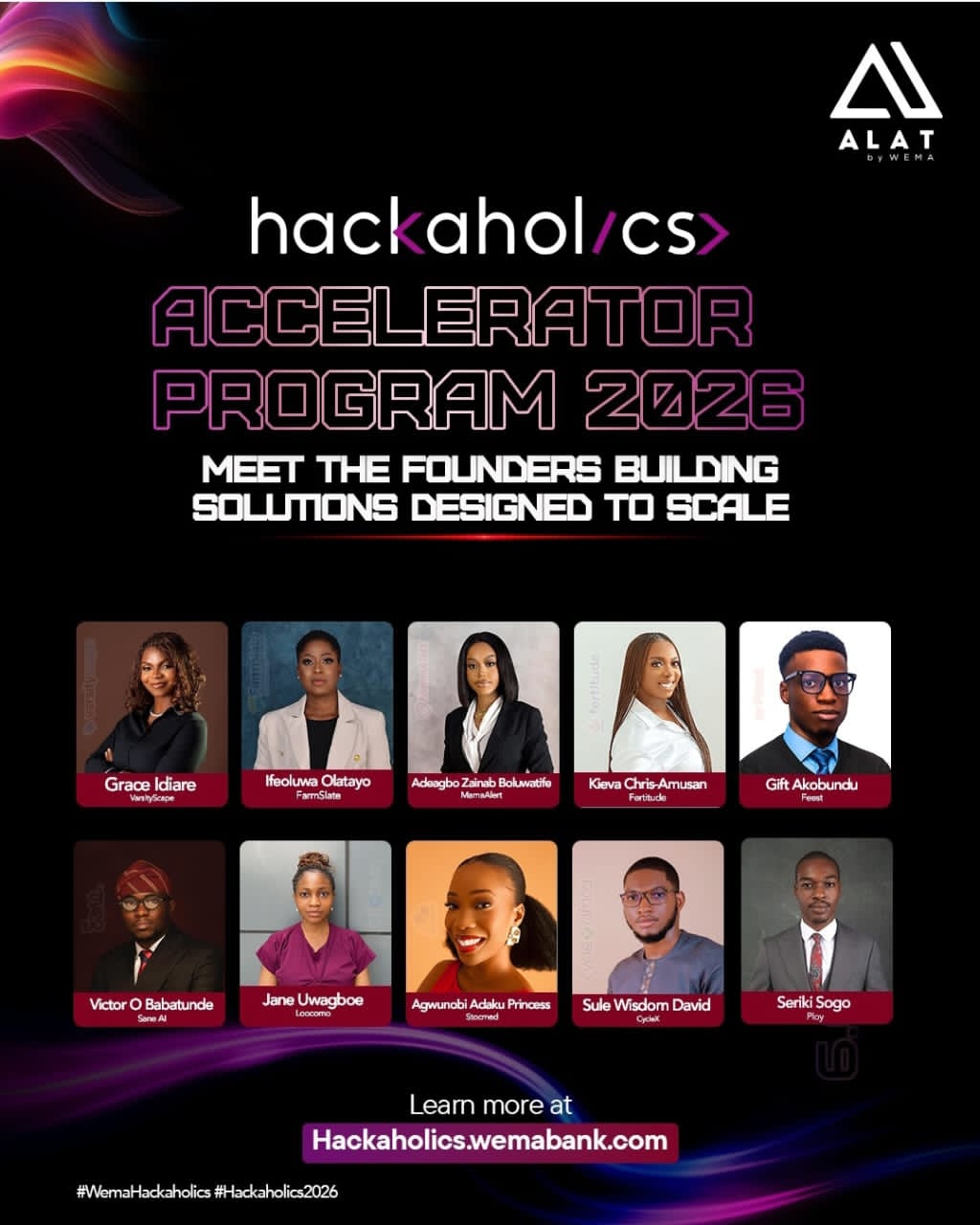
Wema Bank, Nigeria’s most innovative bank and the pioneer of Africa’s first fully digital bank, ALAT, has launched the 2026 Hackaholics Accelerator Program, welcoming ten startups into the cohort.

The Hackaholics Accelerator, a selective growth program under Wema Bank’s Hackaholics platform, is designed to help promising Nigerian startups strengthen their business foundations and prepare for sustainable scale and investment.

After six years of driving innovation through Hackaholics, Wema Bank is extending its support beyond ideation and competition into hands-on startup building through Hackaholics Accelerator. The initiative provides founders with the structure, mentorship, and ecosystem access they need to turn strong ideas into viable, scalable businesses.

The 2026 cohort comprises ten startups in total, drawn from the top 10 performing finalists from Hackaholics 6.0. The startups include Farmslate, Ploy, Stocmed, Feest (Chao), Varsityscape, MamaAlert, Sane, Cyclex, Kieva, and Loocomo.

Commenting on the evolution of Hackaholics and the second edition of its Accelerator program, MD/CEO of Wema Bank, Moruf Oseni, said it reflects the Bank’s commitment to supporting founders beyond ideation and helping promising innovations grow into sustainable businesses.

See also  Nigerians to pay more for electricity as Discos apply for rate review

“Over the past six years, Hackaholics has grown into more than a competition; it has become a platform that reveals the depth of innovation and entrepreneurial potential that exists across Nigeria,” Oseni said. “With this second edition of Hackaholics Accelerator, we are taking the next step by supporting founders beyond the ideation stage and into the process of building sustainable businesses.

The startups selected for this cohort represent some of the most promising solutions emerging from the Hackaholics ecosystem, and we are committed to helping them refine their models, strengthen their foundations, and scale their impact.”

Speaking on the ten startups selected for the cohort, Babatunde Mumuni, Chief Transformation Officer, Wema Bank, added that the Accelerator will guide founders through a structured process to strengthen their businesses and prepare them for sustainable growth.

“The startups selected for this cohort already have strong foundations, with products already in market, early traction, and clear potential for growth,” Mumuni said. “Each of the selected startups brings a unique solution to real challenges across different sectors. What Hackaholics Accelerator provides is the environment to strengthen those foundations through hands-on mentorship, strategic guidance, and access to the right networks. Over the course of the program, we will work closely with these founders to refine their models, deepen market traction, and prepare them for sustainable scale.”

See also  Excessive fast can damage kidney — NAFDAC

All 10 startup founders will undergo a series of training sessions led by industry experts across key areas critical to startup growth. Facilitators for the programme include the Chief Transformation Officer, Corporate Transformation & Innovation, Wema Bank, Babatunde Mumuni; Head, Strategy & Investor Relations, Wema Bank, Femi Akinfolarin; Head, Data Transformation, Wema Bank, Olamide Jolaoso; and Team Lead, Corporate Social Investment, Wema Bank, Oluwatoyin Adetunji.

Other facilitators include the Managing Director, Impact Hub Lagos, Idowu Akinde; Managing Director, B4B Partners, Napa Onwusa; Startup Advisor and Scout, Onaopemipo Dara; Mentor at Google for Startups, Rosemond Phil-Othihiwa; Head of Growth, Africhange, Tega Ogigirigi; and Startup Advisor and Mentor, Ademola Adewuyi.

Hackaholics Accelerator is supported by Wema Bank’s broader innovation infrastructure, including IDEAx Labs, the Bank’s innovation and venture platform, and its corporate venture programme, which focuses on enabling startup growth through partnerships, infrastructure, and capital access.

Since its launch in 2019, Hackaholics has grown into one of Nigeria’s most influential youth innovation platforms, attracting over 15,000 applicants and supporting hundreds of digital solutions across multiple industries.

See also  Good morning! Here Are Some Major News Headlines In The Newspapers Today: Nigerians in Niger beg FG for evacuation over impending attack

Through the Hackaholics initiative, Wema Bank has disbursed over $400,000 in funding to young innovators and startup founders across Nigeria.

Startups, such as Feegor, Myitura, and Bunce are among those that have participated in previous editions of the program, reflecting the Accelerator’s focus on supporting growth-ready companies across diverse sectors. This second edition builds on that progress by helping startups move decisively from innovation to growth.

Continue Reading

Business

Banks to charge 7.5 VAT for mobile transfer, PoS transaction fees

Published

on

By

Banks are set to commence the deduction of 7.5 percent value-added tax (VAT) on banking services, including point of sale (POS) transaction fees, mobile banking transfer fees, from January 19. 

In an email to customers, Moniepoint Microfinance Bank said the charge stems from a government-endorsed regulatory change.

According to reports, the VAT is charged on the N50 stamp duty and does not affect the actual amount being transferred or withdrawn.

The proceeds of the charge will be remitted to the Nigerian Revenue Service (NRS).

“We would like to inform you of an upcoming government-endorsed regulatory change regarding Value Added Tax (VAT),” Moniepoint said.

“From Monday, 19 January 2026, we are required to collect a 7.5% VAT, to be remitted to the Nigerian Revenue Service (NRS) (formerly known as the Federal Inland Revenue Service).

“VAT will apply to certain banking services that include: electronic banking charges such as POS transaction fees, mobile banking fees (transfers), USSD transaction fees, POS activation fee, card issuance fee and Moniebook subscription.”

See also  We won’t stay beyond three years, says Niger coup leader

According to the bank, the charge also applies to other fees, such as loan processing and documentation fees.

“Services that DO NOT attract VAT include: interest on loans and advances, and interest on deposits and savings,” Moniepoint said.

“Please note: This is not a price increase by Moniepoint. Moniepoint is required to collect and remit VAT to the Nigerian Revenue Service (NRS).

“The NRS has communicated a deadline of 19th January for all financial institutions (commercial banks, microfinance banks and electronic money transfer operators) to start collecting and remitting VAT.”

The bank clarified that VAT applies only to banking or service fees and not to interest, adding that the charge will be listed separately on transaction reports and statements.

The new tax laws retain the VAT rate at 7.5 percent.

Continue Reading

Business

Wema Bank Launches Upgraded Version of ALAT Banking App

Published

on

By


…introduces Voice Banking, Tap and Pay and Uptime Prediction

Wema Bank, Nigeria’s most innovative bank and pioneer of Africa’s first fully digital bank, ALAT, has launched the upgraded version of its flagship digital banking platform, ALAT by Wema. Designed as the next phase in digital banking, the upgraded version of ALAT delivers a smarter, faster, and more intuitive experience, reinforcing Wema Bank’s leadership in technology-driven financial services.


Tagged ALAT: The Evolution, the upgraded version represents a significant advancement in how customers interact with their bank.


It enables seamless banking through intelligent features such as voice banking (called SAW), which allows customers to carry out banking activities using natural voice commands, reducing friction and improving accessibility. It also introduces Tap and Pay for quick, secure, and convenient contactless transactions, alongside uptime prediction that enhances transparency, reliability, and confidence around service availability.


Together, these innovations are designed to simplify everyday banking while anticipating customer needs in real time, reinforcing Wema Bank’s commitment to trust, efficiency, and customer-centric digital experiences.

See also  Sanwo-Olu to Nigerians: There’s light at the end of tunnel, support Tinubu’s administration


Announcing the upgraded version, the Managing Director and Chief Executive Officer of Wema Bank, Mr. Moruf Oseni, said, “ALAT: The Evolution is more than an upgrade. It is a clear demonstration of our commitment to redefining digital banking in Africa.

” By understanding the future of banking and listening closely to our customers, we have upgraded ALAT by Wema to a digital banking platform that is smart, intelligent and dependable.

“This evolution reinforces our promise to deliver innovation that genuinely enhances how people live, work, and transact everyday.”


He added that migrating to the upgraded app is seamless. “Existing customers can simply visit the Google Play Store or Apple App Store to update their existing ALAT app and sign-in with their existing login details (All their account information and transaction history remain intact on their profile and they will also gain access to new features that make banking faster, more intuitive, and more reliable).

See also  I’ve managed diabetes for 35 years, says Obasanjo


For new customers, all they have to do is visit the Google Play Store or Apple App Store to download ALAT by Wema app and click the Get Started icon to onboard seamlessly.


Speaking on the technology in the upgraded ALAT by Wema, Mr. Olusegun Adeniyi, Chief Digital Officer at Wema Bank, explained, “With ALAT: The Evolution, we set out to enhance not just functionality but the overall banking experience. By integrating voice banking, contactless payments, and predictive reliability, we are delivering a platform that is built on powerful technology and responds intelligently to customer needs. This upgrade reflects our long-term digital vision to create a digital bank that is adaptive, intuitive, and consistently available.”


Built on speed, intelligence, and user-centric design, ALAT: The Evolution redefines everyday banking through intuitive features such as voice-enabled transactions, contactless payments, and predictive service reliability. Designed to anticipate customer needs in real time, the platform delivers a smarter, more seamless, and dependable digital banking experience that reflects Wema Bank’s vision for the future of finance.

See also  Again, bandits attack Niger community, kill one, abduct 68


With the upgraded version of ALAT, Wema Bank continues to strengthen its position as a digital-first institution, delivering innovative solutions that empower individuals and businesses to bank with confidence in an increasingly digital economy.

Continue Reading

Trending News