Connect with us

Metro News

N4.6bn ONSA fund was shared to organise prayers for Nigeria against insecurity – EFCC witness

Published

on


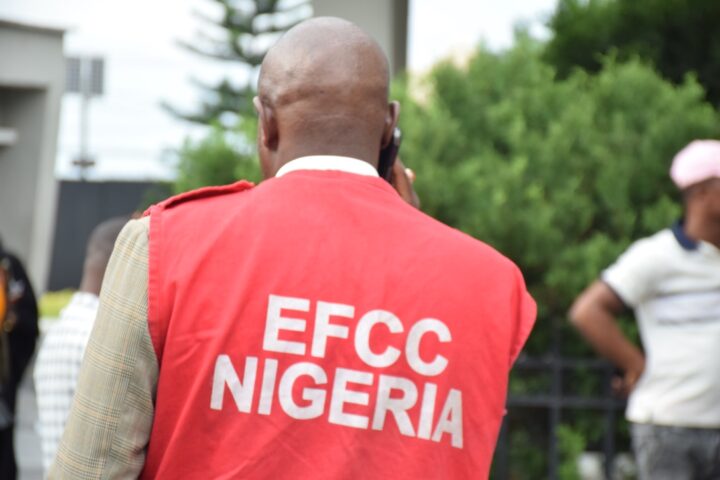
 An officer of the Economic and Financial Crimes Commission (EFCC), Kazeem Yusuf,has told a federal capital territory (FCT) high court that N4.6 billion was allegedly diverted to organise prayer for Nigeria.

Yusuf spoke on Tuesday while testifying as the second prosecution witness (PW2) in the trial of Bashir Yuguda, a former minister of state for finance.


Yuguda is standing trial alongside Sambo Dasuki, former national security adviser (NSA); Attahiru Bafarawa, ex-governor of Sokoto; his son Sagir, and Dalhatu Investment Limited, a company owned by Bafarawa.


The defendants are facing 25 counts of misappropriation, criminal breach of trust and receiving stolen property.


While being led in evidence by  Rotimi Jacobs, EFCC counsel, the witness said an investigation was carried out after the commission received a petition from the office of the national security adviser (ONSA).


He said the investigation revealed that “Dalhatu Investment Limited was one of the 78 companies alleged to have received money from ONSA without any documents to show that they bided for contracts”.

See also  JUST IN: Betta Edu arrives EFCC office


Yusuf said an analysis of the statement of account of Dalhatu Investment Limited by EFCC from UBA revealed that the company got N4.6 billion from ONSA.


He added that the amount was paid in instalments between 2014 and 2015, noting that N783 million, being part of the money, came from the SAS account.


Yusuf said in a written statement, that Sagir, who represented the company, told the EFCC that “the money was meant for prayers for the country because of the insecurity prevalent at that time”. 


He said Sagir later gave a breakdown of how the N4.6 billion was spent, including a list of beneficiaries.


The witness said Abdallah Wali, a former senator, who received N580 million from the company, told EFCC that the money was meant for his gubernatorial election campaign in Sokoto in 2015.


He also told the EFCC team that Muazu Madawaki,  former secretary of the Pilgrims and Welfare Agency (PWA) in Sokoto, received N322 million, which he claimed was for payment of Hajj seats for some Sokoto indigenes.

See also  CSP Abonde, killed by Lagos mob for burial Friday


The witness said other beneficiaries listed include Ibrahim Maigoma, former Sokoto chairman of the Peoples Democratic Party (PDP), who received N111million; Yahaya Dada (N327,549,000); Sani Kabir (N159million); INEC (N293,500,000), among others.


The witness added that the money received by Wali was sent through a company, Development Strategies International Limited, owned by Islam Wali and Mohammed Wali, who are cousins to the former senator.


The witness told the court that parts of the money meant for supplies of security equipment, including hand-held devices, were used to procure a Lexus car, a Hilux van and 16 Peugeot 206 cars which were distributed to PDP local government chairmen in Sokoto.


However, he stated that 14 of the Peugeot 206 vehicles were recovered in the course of the investigation.


The witness said one Amanze Obi received N15.3 million for political publicity for Bafawara’s 2015 presidential campaign.


He further told the court that about £123,000 was transferred to a bank in the United Kingdom to offset a mortgage for Bafarawa while N1billion went to Bureaux de Change (BDCs) to convert to dollars.

See also  NDLEA seizes 22 UK, France, Portugal passports at Lagos Airport


Yusuf added that the defendants were invited by EFCC for interviews and statements, noting that they all showed up at the commission’s headquarters and volunteered their statements.


When the prosecuting counsel sought to tender Sagir’s statements through the witness, his lawyer, J.O Olatoke, objected to their admissibility on the ground that they were not voluntarily obtained.


Olatoke told the court that the statements were made based on inducement, intimidation, receipt and invitation to settlement.


He prayed the court to grant them trial-within-trial to determine the voluntariness of the statements.


Based on the request, Yusuf Halilu, the presiding judge, ordered a trial-within-trial to determine the voluntariness of the statements made by Sagir.


He subsequently adjourned the trial until February 14.


Continue Reading
Click to comment

Leave a Reply

Your email address will not be published. Required fields are marked *

Metro News

Okada rider stabbed to death over N100 ticket in Ogun

Published

on

By


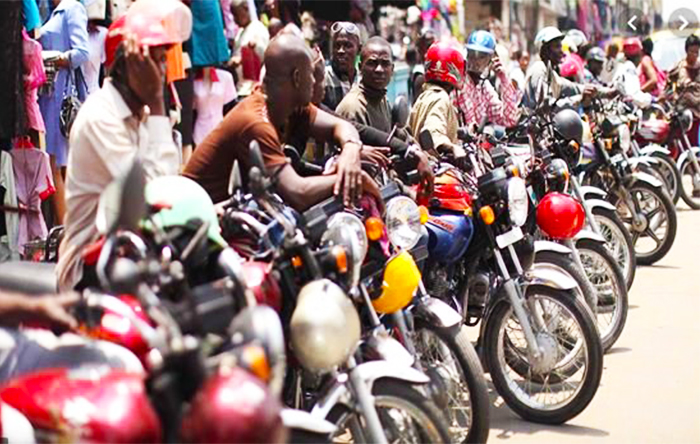
A commercial motorcyclist has reportedly been stabbed to death by a transport union tax collection group, popularly known as agberos, following an argument over a N100 ticket in the Ijoko area of Ogun State.

According to reports, the incident occurred on Tuesday night after a disagreement between the deceased and some levy collectors escalated into a violent confrontation.

While it was unclear if the suspect had been arrested, the killing reportedly sparked protests by commercial motorcyclists across Lambe, Agbado and Akute communities.

Some riders were seen confronting levy collectors in parts of the affected areas, disrupting transport activities and forcing many commuters to trek to their destinations.

A motorcyclist said that two persons were stabbed during the altercation, but only one survived.

“They were fighting over a N100 ticket. It started as a small argument before it escalated on Tuesday night. The person who was killed is one of the motorcyclists from Nasarawa,” he said.

See also  IMMORTAL: Sanwo-Olu names Printing Corporation Press Hall after Jakande

“His colleagues are the ones now confronting agberos in Lambe, Ijoko and parts of Akute.”

Another rider in Akute confirmed the incident, saying tensions had remained high since the killing.

“The man was stabbed to death by one of the agberos during an argument over the ticket. The agbero suddenly brought out a knife and stabbed him,” he said.

“Some riders have refused to work since then, which is why there are fewer commercial motorcyclists around today. The police are aware and arrested some people during another confrontation.”

Violent clashes between commercial motorcyclists and levy collectors are not new in the state. In recent years, riders have repeatedly protested what they describe as extortion and harassment.

Continue Reading

Metro News

VIDEO: Police bust illegal baby factory in Ekiti

Published

on

By

The Ekiti State Police Command says its operatives have uncovered an illegal baby factory located in Ikere Local Government Area of the state.

The state commissioner of police, Joe Eribo, who disclosed this to journalists, said the command received a tip-off and arrested one Onyechi Oluwadare, alongside four other suspects behind a popular hotel along Ise-Ekiti Road, Ikere-Ekiti.

Other people arrested were, Onuoha Gloria, Victoria Linus, Ihegbogu Mercy, and a pregnant woman, Emmanuel Esther.


The statement read in part, “On the 24/01/2026 at about 08:30hrs, the Command received a credible tip-off that the prime suspect, Oluwadare Onyechi, a 43-year old woman, runs an illegal baby gactory alongside four other suspects somewhere behind Inisa Hotel and Suit, along Ise-Ekiti Road, Ikere-Ekiti.

“Upon the receipt of the information, the Command Operatives swung into action, cordon off the premises used for the illegal business, and arrested Oluwadare Onyechi and four other accomplices namely, Onuoha Gloria ‘28 yrs’, Victoria Linus ‘25 yrs’, Ihegbogu Mercy ‘21 yrs’ and a heavily pregnant Emmanuel Esther ’23yrs’.

See also  I rejected Atiku’s advice to take N1bn loan for PDP – Ayu

“Search was conducted in the premises and six children within the age of 2 and 9 reasonably suspected to be under bondage and exploitation were rescued. Items such as baby delivery materials, some rolls of dexamethasone tablet, and some bottles of Goya oil were recovered from the scene”.

The prime suspect in the alleged baby factory, Onyechi, denied the allegations, saying she only prays in the building for those seeking God’s favour.

The Command’s operatives also arrested one Ibrahim Abubakar, a notorious cattle rustler.

Investigation revealed that Ibrahim Abubakar has over the years, rustled numerous cattle in Ekiti, Kwara and Kogi States and has been on the wanted list of the three States.

During investigation, Ibrahim Abubakar confessed that he is into cattle rustling business and equally mentioned different occasions in the past where he attacked Cattle owners and made away with their cattle.

A large number of rustled cattle numbering two hundred and fifty-five(255) were recovered from him, alongside other 303 cattles recovered from prime suspect, making 558 cattles.

See also  NDLEA seizes 22 UK, France, Portugal passports at Lagos Airport

Continue Reading

Metro News

NAFDAC uncovers fake Goya oil factory, counterfeit alcoholic drinks syndicate in Lagos

Published

on

By

Operatives of the National Agency for Food and Drug Administration and Control (NAFDAC) have uncovered an illegal factory producing fake Goya oil in Lagos.

The agency also dismantled a major syndicate involved in the counterfeiting of alcoholic drinks in Lagos, warning that the activities pose grave dangers to public health.

Martins Iluyomade, Director of Investigation and Enforcement at NAFDAC and Chairman of the Federal Task Force on Fake and Substandard Products, said the discoveries were made during surveillance and enforcement operations carried out over the past few weeks.

“We have carried out a couple of activities in recent weeks, and what we discovered was very surprising to us. We felt it was important to speak with Nigerians so they can know what has been going on,” Iluyomade said.

He disclosed that NAFDAC operatives uncovered an illegal operation inside Oke-Arin market, Lagos, where counterfeit Goya oil was being produced locally.

“The original Goya oil is imported into this country through a reputable company, and there are still original products in circulation. But we discovered that some people were faking this product and manufacturing it inside the market,” he said.

According to Iluyomade, the fake oil was produced by burning palm oil and adding chlorine, using crude equipment like stove.

See also  CSP Abonde, killed by Lagos mob for burial Friday

“They were using a stove. We saw the stove and everything they were using. We also saw a large number of empty bottles they were refilling and repackaging,” he added.

Iluyomade warned Nigerians, particularly, churches and prayer houses, stressing that original Goya oil is never packaged in plastic (PET) bottles.

“Let me say this clearly to everybody—churches, prayer houses, and anywhere this oil is used: there is no original Goya oil packed in plastic bottles. Original Goya oil comes in glass bottles,” he said.

He urged Nigerians to report anyone selling the product in plastic bottles to the nearest NAFDAC office.

“Anywhere you see Goya oil being sold in PET bottles, report it. People should beware, noting that the use of fake anointing oils in religious settings had become widespread and dangerous.

“Some people even drink anointing oil. You are not drinking anointing oil—you are drinking poison,” Iluyomade said.

The enforcement director explained that NAFDAC’s strategy is to halt production at the source rather than punish unsuspecting traders.

“We are stopping the production. Once there is no new supply, whatever is in the market will dry up,” he said.

See also  Keeping government's money in Government House: Nigerian Governor withdraws N60 billion cash from state's account: EFCC boss Bawa

“We do not want to compound the problem of market women and others who may not know. But for the producers, it is the end of the road.”

He appealed to religious bodies to cooperate with the agency.

“We are not issuing threats, but it will not be nice for us to arrest people within your premises. Please partner with us and do not allow the sale or use of this product,” he said.

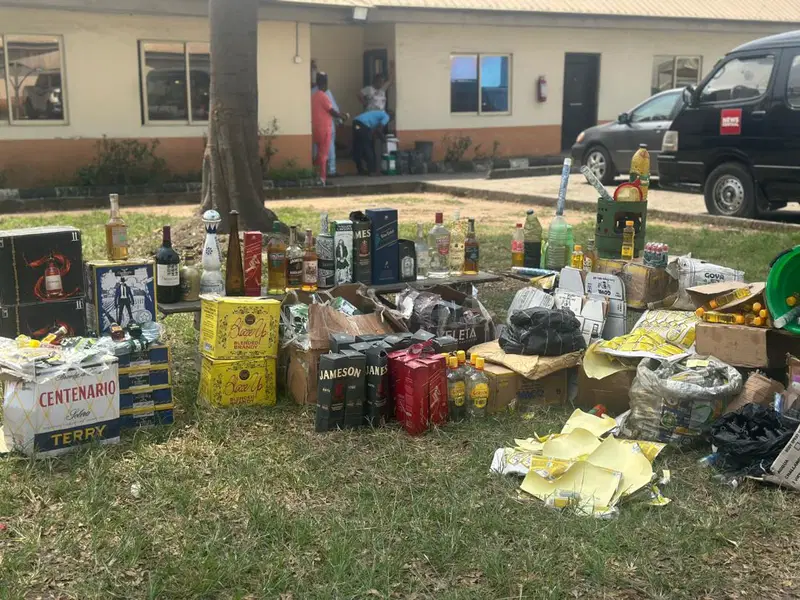
Iluyomade also revealed that NAFDAC had busted a major operation involved in the production of fake alcoholic drinks in Lagos.

“The faking of alcoholic drinks has become seriously endemic in Nigeria because it is one of the easiest products to counterfeit,” he said.

He said a suspect, Mr. Moses Nelson, was arrested in the Badagry area of Lagos and has been charged to court.

“In his house, we found all manner of fake products—virtually every major brand. There was none we did not see,” Iluyomade said.

According to him, the syndicate operated a distribution chain, producing the drinks in Badagry and supplying them to major markets across Lagos.

See also  I rejected Atiku’s advice to take N1bn loan for PDP – Ayu

NAFDAC also warned distributors against patronising unauthorised suppliers.

“You know the original owners of these brands. Why buy from people you know are not the owners just to make more money? In the process, you are killing people,” he cautioned.

He also advised Nigerians to be wary of unusually cheap products.

“If the normal price is five naira and someone offers it at three naira, you should be suspicious. The little money you want to save, I hope you will not spend it in the hospital,” he said.

Stating that no one has the right to endanger the lives of others, Iluyomade appealed to Nigerians engaged in such illegal businesses to desist.

“We are all Nigerians and everyone wants to make ends meet, but no Nigerian has the right to make ends meet at the expense of the health of another Nigerian,” he said.

“No one has the right to make huge profits while increasing the health burden of this country.”

He assured Nigerians that NAFDAC would sustain enforcement actions nationwide and urged the public to stop patronising counterfeit products and report suspicious activities to the agency.

Continue Reading

Trending News